Auction Catalogue




 Create new list
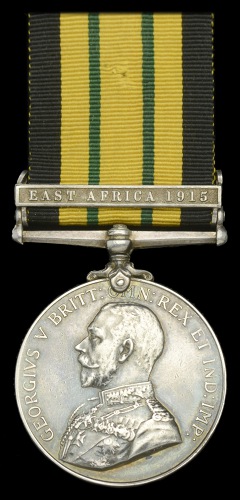
The scarce A.G.S. ‘East Africa 1915’ awarded to Sir E. J. Waddington [G.B.E., K.C.M.G., K.C.V.O.], attached to the East Africa Police and later Governor and Commander in Chief, Northern Rhodesia, 1941-48 - a key player in the political manoeuvrings over the future of Northern and Southern Rhodesia during and after the Second World War
Africa General Service 1902-56, 1 clasp, East Africa 1915 (E. J. Waddington Ration Escort.) attempted erasure to naming details, otherwise very fine £600-£800
This lot is to be sold as part of a special collection, Medals from an Africa Collection.

View
Collection
Eubule John Waddington is listed on the East Africa Police roll as the only “Ration Escort” to receive the A.G.S. with ‘East Africa 1915’ clasp. His obituary which appeared in The Times, 21 January 1957, gives further insight into the man who became a Colonial Governor:
‘Sir John Waddington, G.B.E., K.C.M.G., K.C.V.O., who was Governor of Northern Rhodesia during the last war, died on Friday in hospital in London. He was 66.
Eubule John was the son of Thomas Waddington and was born on April 9, 1890. Having received his education at Dulwich College and Merton College, Oxford, he entered the Colonial Service in 1913. He spent 19 years in East Africa as provincial commissioner in Jubaland, senior assistant secretary in the Kenya secretariat, and later as resident commissioner at Mombasa. In 1932 he was appointed Colonial Secretary of Bermuda, and three years later he transferred to British Guiana. He was appointed Governor and Commander-in-Chief of Barbados in 1938 and a few months later he also assumed the administration of the Government of British Guiana when the Governor of that colony was absent on medical advice. In 1941 he went as Governor to Northern Rhodesia. His turn of office there was extended by a year and he retired in 1947.
In 1950 Waddington was appointed chairman of a commission to review the franchise and other constitutional questions in British Guiana. The commission reported the next year, and in 1953 a constitution for the colony was introduced which followed closely the recommendations of the commission.’
Two weeks after the obituary appeared in The Times, the paper published a letter written in by Sir George Beresford-Stooke, K.C.M.G. (Chief Secretary of Northern Rhodesia, 1942-45, and later Governor of Sierra Leone):
‘May I be permitted to add a few lines to the obituary notice about Sir John Waddington which appeared in your columns? During his term of office as Governor of Northern Rhodesia he showed himself to be an outstanding leader of men. His standards were high and he lived up to them. His dignity was in his personality and needed no pomp or artifice to sustain it. No Governor could have won greater respect and affection from his colleagues and subordinates. In 1948 he accepted an invitation to serve on the Council of the African Institute, and in March 1949 the council unanimously elected him as its chairman, an office he continued to hold until his death. The qualities which had contributed so much to his success as a Governor were quickly recognised and appreciated by the council, and by his tact and sympathy as well as the scrupulous fairness with which he conducted the meetings and affairs of the Institute he endeared himself to all members.’
Waddington is also mentioned in The Welensky Papers and The Rhodesian - The Life of Sir Roy Welensky, as well as featuring in Black Heart, Gore-Browne and the Politics of Multi-Racial Zambia by R. I. Rotberg. He was also elected as a Fellow of the Royal Geographical Society in 1920.
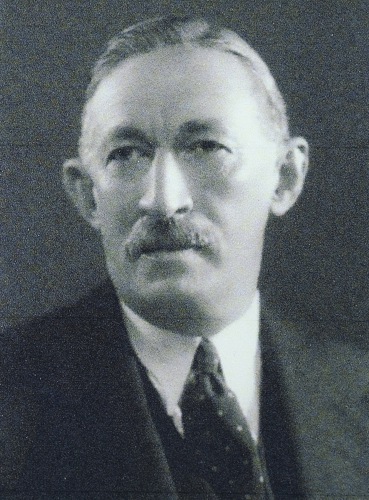
Sold with copied research, including a photographic image of recipient - as held by the National Portrait Gallery.
Share This Page