Auction Catalogue




 Create new list
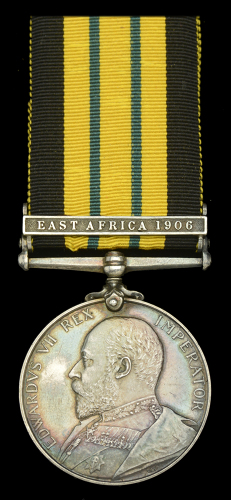
The scarce A.G.S. ‘East Africa 1906’ awarded to C. W. Neligan, Political Officer, attached 3rd Battalion, King’s African Rifles, a veteran of the Boer War who served as a Lieutenant with the Imperial Yeomanry, and was praised by Captain J. W. O. Maycock, D.S.O. in his report of the operations against the Embu Tribe, June - July 1906. A talented and published photographer, he appears to have been destined for high office in the Colonial Service in East Africa, only to die of a heart attack in 1909, aged just 29, whilst on leave in the UK
Africa General Service 1902-56, 1 clasp, East Africa 1906 (Pol. Offcr. C. W. Neligan. 3/K.A.R.) toned, good very fine £700-£900
This lot is to be sold as part of a special collection, Medals from an Africa Collection.

View
Collection
Charles Walter Neligan was born in Tavistock, Devon in 1879, and was the son of J. W. Neligan of Bray Head, Co. Wicklow and Tavistock. Neligan was educated at Ipswich School and Bedford Grammar School. He initially served in the ranks of the 49th (Montgomeryshire) Company, 9th Battalion, Imperial Yeomanry during the Boer War, before being commissioned Lieutenant (entitled to Q.S.A. with ‘Cape Colony’, ‘Orange Free State’, ‘Transvaal’, ‘South Africa 1901’).
Neligan joined the Colonial Service, and served as an Assistant District Commissioner, East Africa Protectorate from 1902. He was posted to Fort Hall in December 1902, and the following is recorded in S. E. Gillett’s Kenya Diary:
‘Oct. 1903 - Fort Hall - About 3 weeks ago Neligan developed fever. Lawson and I were the only Europeans in the station, and as Neligan got worse and worse it became clear that his attack was not ordinary malaria. Lawson and I diagnosed it as rheumatic fever... After the 10th day we decided to send to Nairobi for a doctor... After 6 days an answer came from Nairobi telling us to give him salicylic acid. Was there ever such a stupid message? Of course none of us had salicylic acid; nor if we had had, did we know how much to give him... a doctor, Drake-Brockman arrived... But this only added to our troubles, for Drake-Brockman arrived with a bad attack of blackwater fever on him. We at once bundled him into bed....’
Neligan recovered, and served as an Acting Collector, Mombasa in April 1905, and as Acting Collector, Nyeri in November of the same year. He was attached to the 3rd Battalion, King’s African Rifles as a Political Officer for the operations against the Embu Tribe, led by Captain J. W. O. Maycock, D.S.O., June - July 1906 (1 of 3 Political Officers to receive the clasp ‘East Africa 1906’).
Neligan was mentioned in Maycock’s report for the operation:
‘The Transport and Intelligence duties were carried out by the Political Officers attached to the Columns and were exceptionally performed. In conclusion I was to thank H.M.’s Sub Commissioner, Fort Hall, Mr N. E. F. Corbett and Mr C. W. Neligan the Political Officers of Number I and II Columns for the invaluable help I received from them from start to finish of the expedition. The transport arrangements and information obtained by them was excellent and had a large share in the early termination of the expedition.... Number II Column. This column was the strongest and had by far the hardest task and I could only give Captain Barrett the most general instructions. Enemy’s losses Number II Column: 184’.
Neligan advanced to District Commissioner in April 1907, and was clearly a talented photographer as he had photographs published of Kenya (in particular Mount Kenya from near Ngani Nguki) in The Geographical Journal of 1907. He also contributed some photographs for use by W. S. Routledge in his book With a Prehistoric People. A Kikuyu of British East Africa (published after Neligan’s death). Neligan also had an article titled Description of Kijesu Ceremony among the Akamba, Tiva River, East Africa posthumously published in The Royal Anthropological Institute Journal of 1911:
‘I was sitting in my camp near the Tiva River on January 8th, 1908, under a tree with my [pith] helmet on. The woman seen in the accompanying photographs came in, saw my helmet, and promptly went into a fit. She started trembling very violently, throwing her arms about. She was taken in hand by the people shown in the photographs, more particularly the man with a knife in his hand, who started making passes with his knife around her legs, head, and body. The woman still went on throwing herself about moaning and behaving as if she was in great pain. The man with the knife in his hand then made some patterns on the woman’s legs with sand in this shape...; after which he passed the point of his knife along these patterns and again round and round the woman’s legs, head, and body; he also made the woman - who seemed insane - put her arms out in front of her as if in supplication, the man all the time repeating what seemed to be certain phrases. By this time, thinking the woman was seriously ill, I asked two other native women, who were standing by, what the matter was, and they said, “Oh, its only Kijesu.” Knowing from Mr Traill (who was the original discoverer of this affair) that it was only a sort of fit on account of seeing anyone with a helmet on, I went to my tent: this was after the woman had been about one and a half hours in this fit. About one hour later a message was sent over to me saying that if I would give this woman a letter she would be all right. I tore off a piece of a magazine I was reading and just ran a pencil over it and sent it over. The woman then sent back for some matches, which I sent; she then lit the paper and put the lighted paper in her mouth, and the alleged devil was exorcised. From beginning to end this woman was in this fit for about three and a half hours. Next morning I saw her and she was perfectly all right and did not mind my helmet in the least.’
Neligan was appointed Assistant District Commissioner, Lumbwa, East Africa in 1909. He died of a heart attack, 13 August 1909, aged 29, at his home - 57 Beaumont Street, Marylebone, London, whilst on leave.
Sold with copied research.
Share This Page