Auction Catalogue




 Create new list
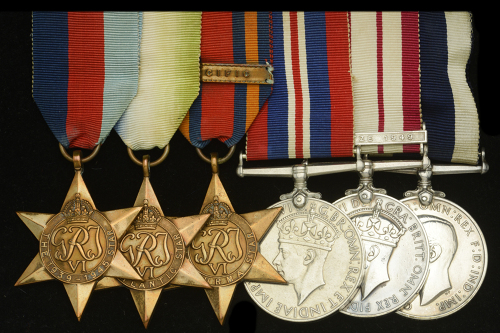
Six: Commissioned Ordnance Officer J. W. F. Harding, Royal Navy, a Japanese Prisoner of War after H.M.S. Exeter was sunk during the Second Battle of the Java Sea on 1 March 1942; he afterwards served aboard H.M.S. London during the Yangtze incident in 1949
1939-45 Star; Atlantic Star; Burma Star, 1 clasp, Pacific; War Medal 1939-45; Naval General Service 1915-62, 1 clasp, Yangtze 1949 (Cd. O.O. J. W. F. Harding. R.N.); Royal Navy L.S. & G.C., G.VI.R., 1st issue (MX.46533 J. W. F. Harding, O.A.1. H.M.S. Drake.) mounted as worn, good very fine (6) £800-£1,000
James William Frank Harding was born at Portsmouth on 3 February 1912. He joined the Royal Navy as an Ordnance Artificer Apprentice at H.M.S. Fisgard on 1 August 1927. Following further service at various training establishments, he joined H.M.S. Rodney as O.A.5, August 1932 to January 1934, H.M.S. Berwick as O.A.4, October 1934 to August 1937, H.M.S. Resolution as O.A.3, February to July 1938, H.M.S. Ramilles, July to October 1938, and H.M.S. Fame, October 1938 to January 1941, as O.A.2 from January 1940. On 11 March 1941 he Joined the heavy cruiser H.M.S. Exeter, engaged on convoy escort duties before she was transferred to the Far East after the start of the Pacific War in December. Exeter was generally assigned to escorting convoys to and from Singapore during the Malayan Campaign, and she continued on those duties in early February 1942 as the Japanese prepared to invade the Dutch East Indies. Later that month, she was assigned to the Striking Force of the joint American-British-Dutch-Australian Command (ABDACOM), and she took on a more active role in the defence of the Dutch East Indies. The culmination of this was her engagement in the Battle of the Java Sea later in the month as the Allies attempted to intercept several Imperial Japanese Navy invasion convoys. Exeter was crippled early in the battle, and she did not play much of a role as she withdrew.
Two days later, she attempted to escape approaching Japanese forces, but she was intercepted and sunk by Japanese ships at the beginning of March in the Second Battle of the Java Sea. On 27 February she was in action against Japanese cruisers Haguro, Naka, Nachi, and Jintsu escorted by 14 destroyers covering invasion ships with ESF ships. She was hit by an 8in shell on the starboard side which exploded in her boiler. Speed was reduced to 11 knots and she was ordered to return to Soerabaya for repair escorted by Dutch destroyer Witte de With.
On 28 February she was ordered to take passage to Australia with H.M.S. Encounter and U.S. Destroyer U.S.S. Pope., but her destination was changed to Colombo because the ship’s draught was too great to allow passage via the Bali Channel and threat of air attacks from newly established airfields. The damage to her boilers restricted speed to 23 knots. She was sighted by Japanese aircraft soon after leaving harbour and, on 1 March 1941, she was ambushed by the Japanese cruisers Haguro and Nachi, escorted by four destroyers which were engaged in a running fight. Soon afterwards she was hit in the boiler room and lost use of director control for her main armament. Despite smoke screens laid by destroyers she received more hits. Fires broke out and all electrical power supplies failed. The ship was abandoned after 3 hours in action and finally sunk by torpedo. 54 of the ship’s company were killed in this action and 651 were rescued by Japanese ships and became POW's. Although most of her crewmen survived the sinking and were rescued by the Japanese about a quarter of them died during Japanese captivity. In September 1945 those who survived captivity, including Ordnance Artificer Harding, were embarked in H.M. Depot Ship Maidstone at Maccassar and arrived at Fremantle on 30 September for repatriation to the U.K.
Harding was commissioned as Ordnance Officer with seniority 23 May 1945, and in this capacity served aboard H.M.S. London during the Yangtze incident in 1949. He was promoted to Senior Commissioned Ordnance Engineer on 1 April 1952.
Share This Page