Auction Catalogue




 Create new list
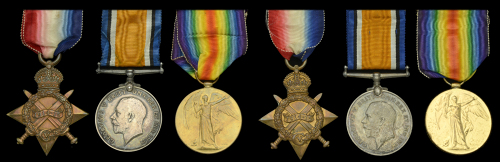
Three: Second Lieutenant H. Glyde, South Wales Borderers, late Army Service Corps, who was wounded on 29 September 1918 whilst attached to the 14th (Swansea Pals) Battalion, Welsh Regiment
1914-15 Star (S/2 SR/01222 Pte. (A/Cpl) H. Glyde. A.S.C.); British War and Victory Medals (2. Lieut. H. Glyde.) good very fine
Three: Lance Corporal W. Haynes, Royal Welsh Fusiliers, who was wounded on 9 February 1916
1914-15 Star (19423 L. Cpl. W. Haynes. R.W. Fus:); British War and Victory Medals (19423 Pte. W. Haynes. R.W. Fus.) good very fine (6) £80-£100
Henry Glyde was born in New Tredegar on 5 April 1885, and was educated at Llanfaes School in Brecon: a master butcher, he had previously served in the Glamorgan Imperial Yeomanry and the Territorials. Described as a horse rider, he attested for the Army Service Corps on 8 October 1914, and having been promoted Acting Corporal on 12 January 1915, served with them during the Great War on the Western Front from 14 January 1915 with 28 Field Bakery. Promoted Acting Sergeant on 6 October 1915, he returned to England on 27 November 1916, and transferred to E Company, 100 T.R.B., Talavera Barracks, Wellington Lines in Aldershot for Officer training. Posted to the 6th Battalion, Middlesex Regiment on 26 September 1917, he was commissioned Second Lieutenant in the 3rd Battalion, South Wales Borderers on 1 May 1918. Returning to the Western Front, he was wounded by mustard shell gas on 29 September 1918 at Fins Ridge, one of four officers and eighteen ranks from the 3rd Battalion, South Wales Borderers wounded whilst attached to the 14 (Swansea Pals) Battalion, Welsh Regiment. Promoted Lieutenant on 1 November 1919, he was demobilised on 6 November 1919, his address given as 11 Picton Terrace, Swansea.
Walter Haynes attested for the Royal Welsh Fusiliers and served with the 16th Battalion during the Great War on the Western Front from 2 December 1915. Wounded on 9 February 1916, he transferred to the 13th (1st North Wales) Battalion, Royal Welsh Fusiliers and was demobilised on 8 March 1919.
Share This Page