Auction Catalogue




 Create new list
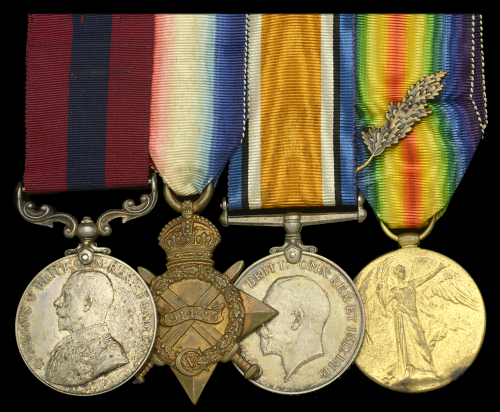
A Great War ‘East Africa’ D.C.M. group of four awarded to Acting Company Sergeant Major C. Goldsmith, South Lancashire Regiment, attached to the King’s African Rifles, who was awarded the Distinguished Conduct Medal for his gallantry in defending his isolated position against an overwhelming enemy force for two days and three nights, and was also Mentioned in Despatches
Distinguished Conduct Medal, G.V.R. (9185 L. Cpl. C. Goldsmith. S. Lanc: R.); 1914-15 Star (9185 L. Cpl. C. Goldsmith, S. Lan. R.); British War and Victory Medals, with M.I.D. oak leaves (9185 Pte. C. Goldsmith. S. Lan. R.) traces of verdigris to VM, otherwise good very fine (4) £800-£1,000
D.C.M. London Gazette 18 February 1918:
‘For conspicuous gallantry and devotion to duty. Though aware that an enemy force was approaching his isolated position he remained at his post until the enemy arrived. He then sent back information of the fact by runner and hid himself for three days until the enemy cleared away. He at once resumed his post and informed headquarters. By his initiative and determination he obtained much valuable information.’
M.I.D. London Gazette 5 June 1919.
Charles Goldsmith attested for the South Lancashire Regiment in 1908, and served with them overseas in India from 1910; upon the outbreak of the Great War he was serving on the North West Frontier. Loaned to the Royal Navy as a signaller, he helped chase gun runners in the Persian Gulf, before being posted to German East Africa in “Z’ Division Signals Company, Royal Engineers, attached to the 3rd Battalion, King’s African Rifles, from 5 July 1915. He was awarded his Distinguished Conduct Medal for his gallantry in his defence of a small fort in East Africa: according to the recipient’s own recollections, he was a sergeant in charge of the small fort, and had under him three Europeans and ten Indians – they were all signallers, not a fighting force – and had about eight rifles between them. The fort was surrounded by 200 Germans, but they held out for two days and three nights until the Germans withdrew. During this time he kept in contact with the British troops, who were 85 miles away, by heliograph. (newspaper cutting with lot refers).
Goldmith was advanced Acting Company Sergeant Major, and was further Mentioned in Despatches. He was discharged Section ‘B’ Reserve on 5 July 1919, and was subsequently employed as station foreman at Ramsgate Railway Station.
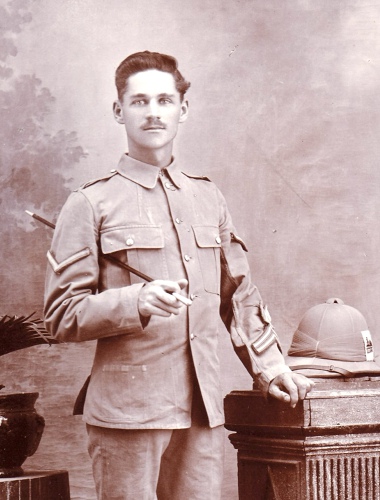
Sold with the recipient’s original Mentioned in Despatches Certificate, inscribed ‘South Lancashire Regiment, 9185 L/C. (A/C.S.M.) C. Goldsmith, D.C.M., attd. 3rd. R., K.A.R.’, and mounted in a glazed frame; various contemporary photographs; and a newspaper cutting containing a photograph of the recipient.
Share This Page