Auction Catalogue




 Create new list
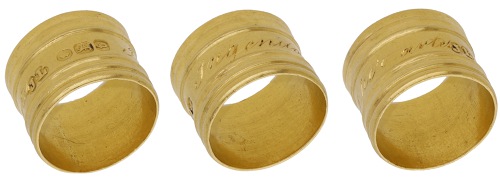
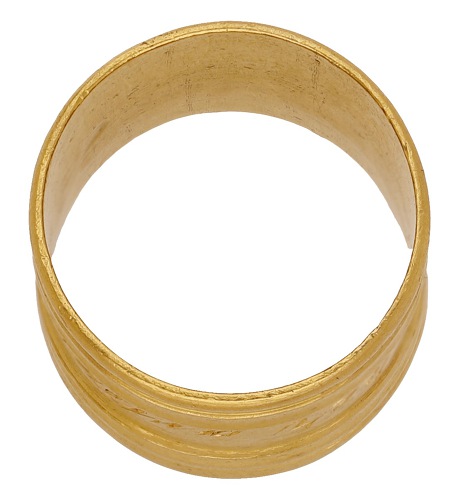
A 19th century Sergeant at Law gold ring for James Scarlett, 1st Baron Abinger, the broad flat band with raised borders, hallmarked to the exterior for London 1834, and bearing maker’s mark ‘J.L’ and inscribed in italics script with the motto ‘Ingenuas per artes’, ring size I. £500-£700
The order of Sergeant at Law dates back to approximately 1300, making it the oldest royally created order. Sergeants were lawyers with exclusive jurisdiction over the Court of Common Pleas, also sitting on the Court of King’s Bench and the Exchequer of Pleas. Only Sergeants could become judges and socially they ranked above Knights Bachelors and Companions of the Bath: they wore a distinguishing black and white skullcap. Sergeants were the only lawyers to argue in court and so precipitated the separate role of the Barrister. New candidates were selected by existing sergeants and appointed by the Lord Chancellor, which was intended to keep selection apolitical and the judiciary neutral. The creation, in 1596, of the first Queen’s Council, QC (or KC under subsequent kings) created a new group which took precedence over and eventually superseded the Sergeants at Law, with the Judicature Act of 1875 ending the practice of appointing new Sergeants.
Upon their promotion Sergeants would, by duty, give a feast and distribute gold rings to close associates, as well as to the monarch and Lord Chancellor. This practice dates back at least to 1390, although the practice of inscribing these rings with a motto in praise of the Law and the King/Queen began in the 15th century, with each intake generally using the same motto. The motto ‘Ingenuas per artes’ translates from Latin as ‘Ingenuity through the arts’. This was the motto recorded for the Sergeant at Law rings for James Scarlett (13 December 1769 – 17 April 1844), later 1st Baron Abinger, when appointed as Sergeant at Law in 1834.
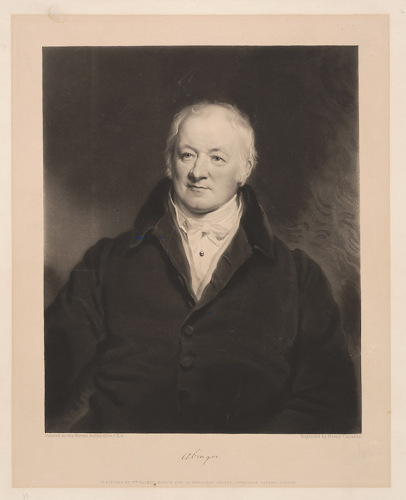
Born in Jamaica, James Scarlett (1769-1844) was educated at Trinity College, Cambridge and the Inner Temple, London. Although without professional connections, he proved his talents on the Northern circuit, before taking the silk in 1816, and ”from this time to the close of 1834 Scarlett had a longer series of success than has ever fallen to the lot of any other man in the law”(DNB). He went on to become an MP (first Whig, later Tory), Attorney General, and a Knight Bachelor. In 1834 he was appointed a Sergeant at Law and Lord Chief Baron of the Exchequer, and in 1835 was raised to 1st Baron Abinger.
This ring is illustrated in Rings 1800-1910, a study of English and related designs, by Verlaine Davies, pub. Write Designs, 2009, p.84.
Band width 12.5mm. Weight 6.1gm.
Caption for image:
Engraving of James Scarlett, 1st Baron Abinger, 1837, by Henry Cousins, after Martin Archer Shee.
Share This Page