Auction Catalogue




 Create new list
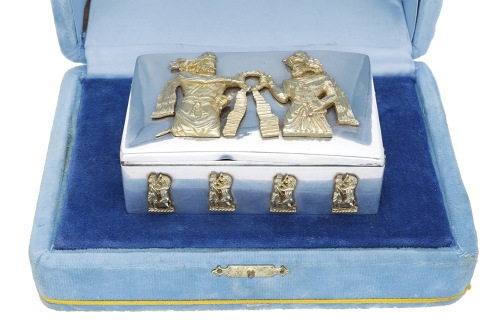
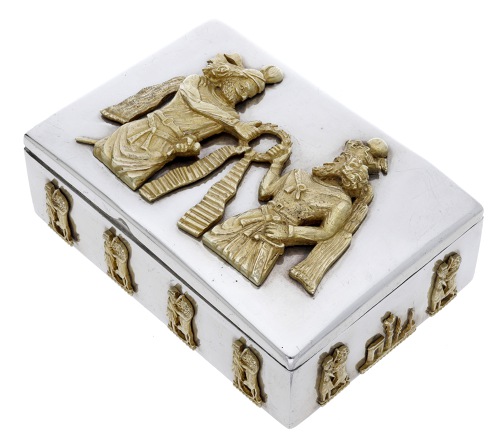
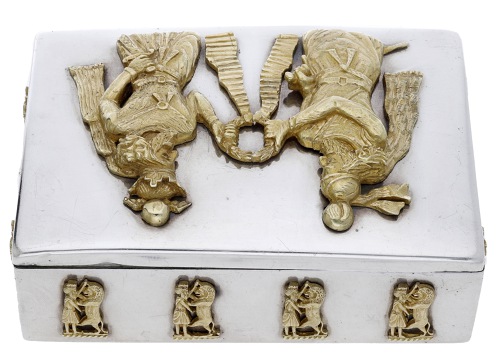
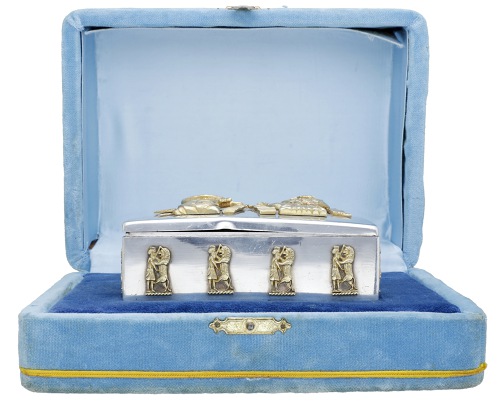
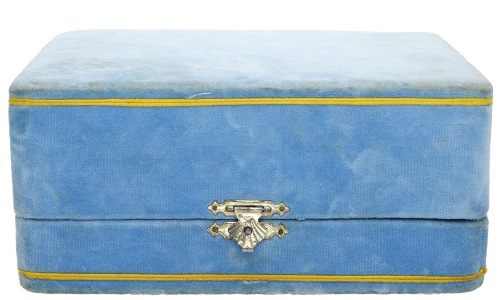
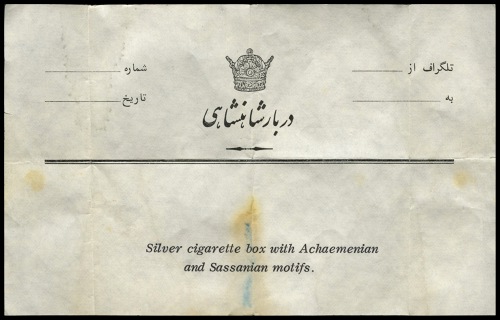
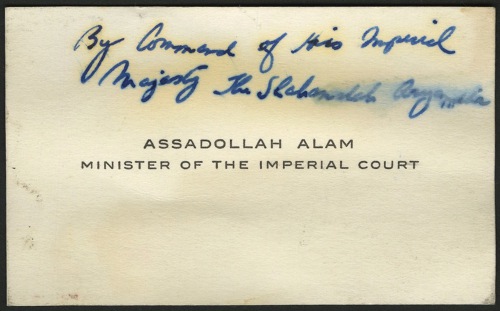
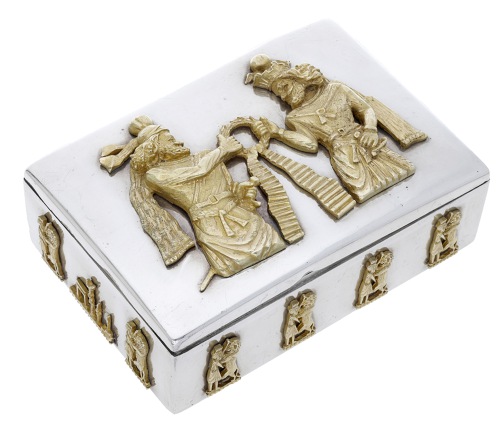
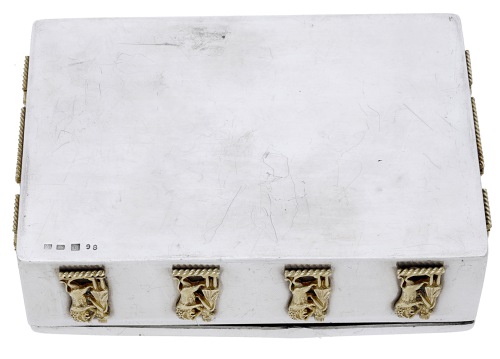
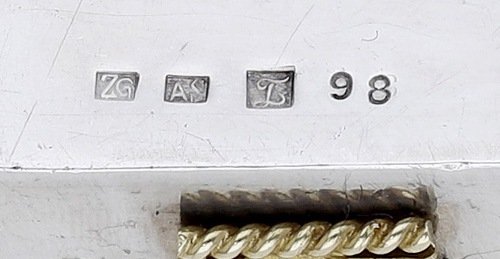
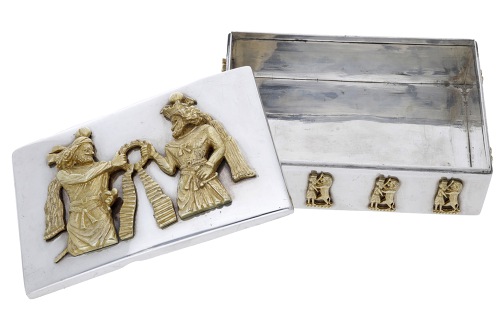
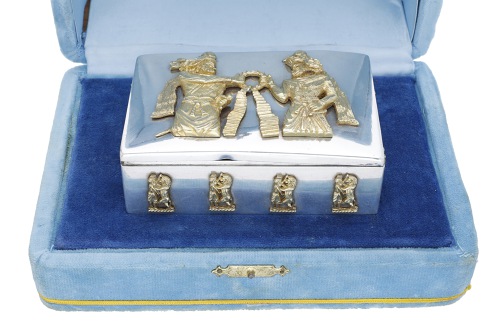
A silver presentation cigarette case and cover, circa 1971, relating to the 2500 year celebration of the founding of the Persian Empire, the case of rectangular form, the detachable cover and sides applied with cast gold Sassanian figures, the case fully lined to the interior and lid, the base stamped with silver fineness mark ‘98, and ‘ZG’, ‘AS’ and initial ‘L’, contained in blue fitted velvet-lined presentation case, with accompanying hand annotated presentation card, dimensions 13 x 4.3cm. £6,000-£8,000
This silver cigarette case was presented to Lord Edmund Ironside, a gift from His Imperial Majesty Mohammad Reza Shah Pahlavi, given at the 2500 year anniversary celebrations held in Persepolis in October 1971, a lavish three day celebration commemorating the founding of the Achaemenid Empire by Cyrus the Great. Lord Ironside was personally invited due to the long-standing friendship between his father - General Lord William Edmund Ironside - and Mohammad Reza's father, Reza Shah Pahlavi, the former Shah.
General Lord William Edmund Ironside GCB, CMG, DSO (1880-1959) played a pivotal role in Iranian history as the architect behind the rise of Reza Khan (later Reza Shah Pahlavi) who founded the Pahlavi dynasty. Between October 1920 and February 1921 Ironside commanded the North Persia Force, a British unit tasked with protecting British interests and blocking Soviet incursions into northern Iran.
Ironside was instrumental in promoting Reza Khan to lead the Persian Cossack Brigade and preventing a Russian Bolshevik takeover. His involvement helped ensure a stable, anti-communist government in Tehran after the British withdrawal at the end of 1921.
By direct family descent.
The applied decoration on the cover and sides of this cigarette case take inspiration from various ancient Persian archaeological details, spanning both the Achaemenid and Sassanian dynasties.
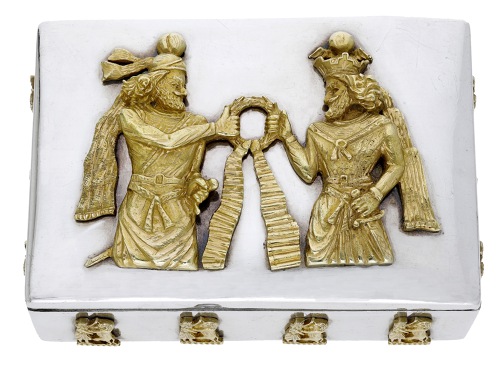
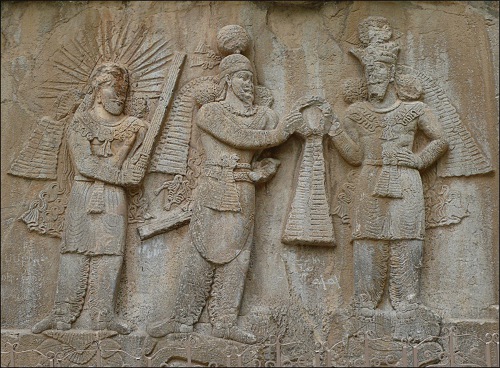
Referencing a relief carving located at Tāq-e Bostān, Iran, the case’s lid depicts a Sassanian royal investiture scene, variously identified as the Investiture of Shapur II, the Triumph of Shapur II over Julian the Apostate, or the Investiture of Ardashir II.
A common scene in Sassanian imperial art, the investiture of kings was crucial in emphasising the legitimacy of monarchs. Here, Shapur II - also known as Shapur the Great (r. 309-379 AD) - stands to the right. To the left, either Ohrmazd, the central deity of Zoroastrianism, or Ardashir II (r. 379-383 AD), Shapur’s successor, stands to the left, presenting or accepting a beribboned ring. Generally agreed to be the ring or diadem of investiture, it was a symbol of power representing divine authority. Its bestowal functioned as the legitimisation of a king’s right to rule.
The sides of the case are decorated with appliqués depicting both a vista of the Gate of All Nations, located in the ruins of Persepolis and the royal hero - or Shahriar - battling a rampant lion, a motif found in many of the carvings from the ancient palace.
One of the contemporary principal entrances into Persepolis, the Gate of All Nations was constructed under Xerxes I (r. 486-465 BC). Originally the scheme of his father, Darius the Great, Xerxes oversaw its completion, with the gate’s inscription dedicated to the latter.
The final appliqué illustrates a well-known theme within Achaemenid art, the so-called royal hero fighting the lion. Its meaning is twofold: firstly, a king’s fierce and heroic aspects as a ‘warrior’ are demonstrated in facing - and overcoming - the savage lion. Secondly, it acted as a metaphor symbolising the supremacy of royal power and civility over the forces of chaos and destruction - the lion threatened humans and livestock, and was therefore seen as an uncontrollable monster that threatened the cultural order. Within the complex of Persepolis, many depictions of this scene exist, their placement on doorways functioning in an apotropaic role.
According to a PMI test on the XRF analyzer, the silver is testing as 98% fineness, the mounts as 18ct gold.
The mounts have been confirmed as 18ct gold by bullion dealers Hatton Garden Metals Ltd, who have also conducted file tests to eliminate the possibility of heavy gold plating to the mounts. Two indentations on the cover are visible to the front and to reverse, resulting in the cover being slightly bent.
Gross weight 584.5gm.
Share This Page