Auction Catalogue




 Create new list
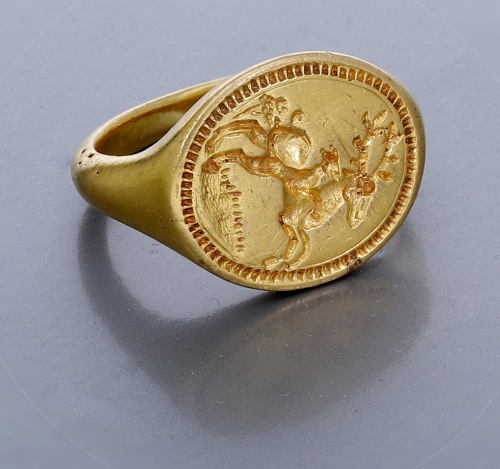
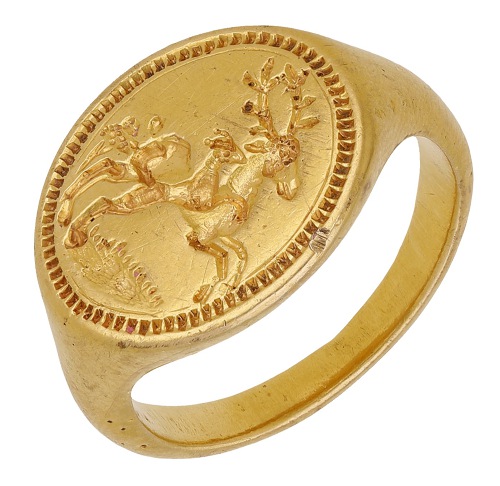
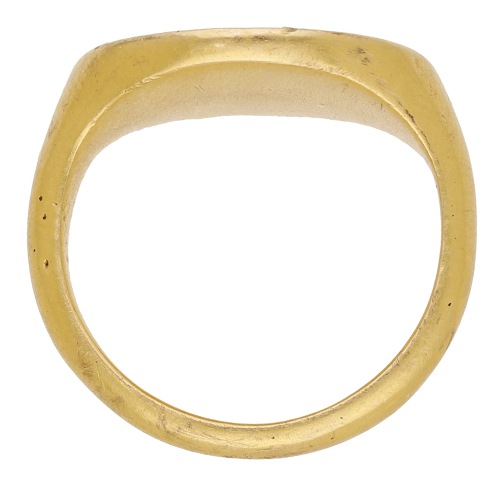
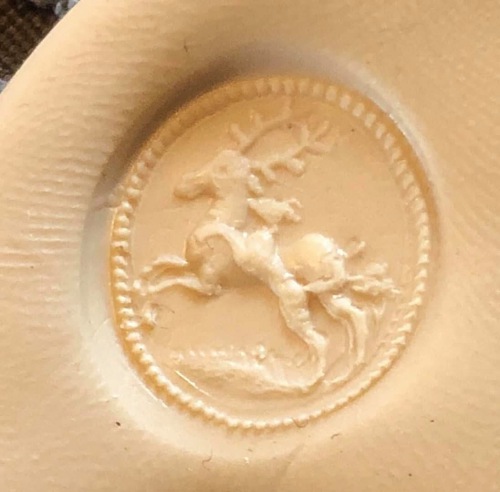
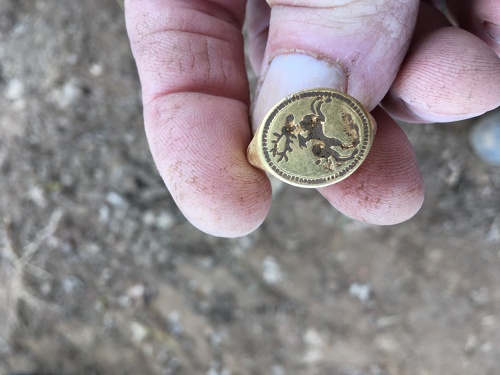
An early 17th century gold signet ring, the oval bezel bearing the intaglio depiction of a salient (springing) red deer stag or hart with five pointed antlers being brought down by a slender hunting hound with vegetation behind, within a beaded border, diameter 23.4mm, band width 2.77mm, ring size N, weight 14.56gm. £12,000-£15,000
This lot is a detectorist find and is registered with the The Portable Antiquities Scheme. The find number is DEV-2992C1.

View Find on
PAS Website
This ring was a detectorist find discovered in Emborough, Somerset in October 2020. It is recorded on the Portable Antiquities Scheme database, ref: DEV-2992C1, and disclaimed as Treasure, ref: 2020 T860.
The stag depicted has five points to its antlers, classifying it as a hart, the second highest hunting prize after a ‘Royal’ stag with six points.
Discussing Tudor and Jacobean signet rings, Anawis Dean notes that in addition to rings bearing armorial imagery, there are those, like this ring, that do not include a crest wreath and only allude to or reflect heraldry. “It is most likely that signet rings were engraved with the visual device most associated with an individual, whether armorial or not. The various types of signet ring underscore that the purpose of a signet remained the clear identification of an individual in a period when an understanding of visual imagery was much stronger than today…Whether or not a ring bore a legitimate heraldic device was not a concern; what mattered more was its legibility to others.”
This ring was discovered near Emborough in Somerset. The Hippisley (Hippesely) family purchased the manor house at Whitnell in 1496, acquiring the manor at Ston Easton in 1544, the manor at Cameley in 1559, and the manor house at Emborough in 1570, combining all as one estate.
Gabriel Hippisley, born 1595, at Ston Easton, was an Equerry of the Stable of Hunting to Charles I. An equerry of the hunt was an appointed officer of the royal household responsible for horses used by the monarch for hunting. Although the Hippisley family were granted coat of arms in 1564, as the 10th son of John Hippisely III, it is possible that Gabriel may have chosen a more individual image for his signet ring to distinguish himself, reflecting instead the important role bestowed upon him by the King.
Literature:
Chadour, A. B., Rings, the Alice and Louis Koch Collection, no. 637, p. 196.
Awais-Dean, N., Bejewelled: Men and Jewellery in Tudor and Jacobean England, pub. British Museum, 2022.
A small nick to the edge of the bezel beyond the beaded border, and some porosity marks visible to one shoulder suggesting repair.
Weight 14.56gm.
According to a PMI test on the XRF Analyzer, the ring is testing as 19.67ct gold, with traces of silver, copper, lead, iron and bismuth, etc.
Share This Page