Auction Catalogue




Lot
№ 132
.To be sold on: 17 September 2026
Estimate: £30,000–£50,000
This lot is in 7 people's cabinets
Current Bid: £12,000
Place Bid Create new list
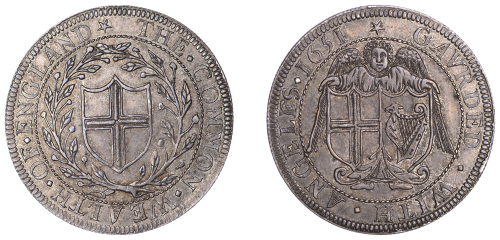
An exceptionally rare 1651 Pattern Shilling by David Ramage, ex Duke of Devonshire
Commonwealth (1649-1660), Pattern Shilling, 1651, in silver, by D. Ramage, from Halfcrown dies, mm. mullet, cross of St George on shield within laurel branches, the common wealth of england, rev. gavrded with angeles and date, conjoined shields of England and Ireland within the protective arms of a winged angel, edge finely grained, 6.30g/6h (ESC 175; Oddie, BNS Blog 30 Sept. 2021, this coin illustrated; N 2734). About extremely fine with old cabinet toning and a distinguished pedigree, exceptionally rare; probably a total of 8 specimens known of both edge types, 3 of which are in institutions £30,000-£50,000
This lot is to be sold as part of a special collection, The Gary Oddie Collection of English Regal Shillings.

View
Collection
Duke of Devonshire Collection, Christie's Auction, 26-30 March 1844, lot 141; E. Wigan Collection; W. Brice Collection; H. Montagu Collection, Part III, Sotheby Auction, 15-17 November 1896, lot 710; J.G. Murdoch Collection, Part II, 8-13 June 1903, lot 426; F.G. Hilton Price Collection, Part I, Sotheby Auction, 17-19 May 1909, lot 246; G.R. Francis Collection, Glendining Auction, 24-6 March 1920, lot 328; E.C. Carter Collection; H.K. Hepburn-Wright Collection; M. Lessen Collection, Part IV, DNW Auction 186, 21 January 2021, lot 1135 [from Spink 1964].
A copy of the blog article accompanies the coin. As provost of the Company of Moneyers working at the Tower, David Ramage (1615-61) was invited to participate in the coinage trials held at Whitehall on 8 May 1651. At the trials of edge-marked pieces, Pierre Blondeau (†1672) exhibited some 300 coins, including halfcrowns, shillings, sixpences and unites, struck on his machinery at Drury House, Strand, but David Ramage, having spent more money than Blondeau in the exercise, was only able to exhibit some two dozen coins produced in the Tower, all in silver and without any indication of their face value. Despite Blondeau’s clear victory, the government did not have the money or political will to fund the large scale minting operation he proposed, which would have required an outlay of £1,400 on buildings and equipment
Share This Page