Auction Catalogue




Lot
№ 245
.To be sold on: 17 September 2026
Estimate: £15,000–£20,000
This lot is in 6 people's cabinets
Starting Price: £6,000
Place Bid Create new list
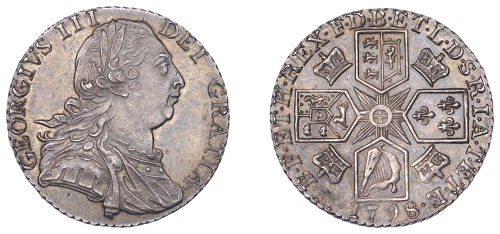
A celebrated ‘Dorrien and Magens’ Shilling, 1798
George III (1760-1820), Pre-1816 issues, Shilling, 1798, the so-called ‘Dorrien and Magens’ type, laureate bust right in armour, stop after gratia, rev. cruciform square-topped shields, crowns in angles, with hearts, 6.03g/12h (ESC 2139; Eimer 101; ‘Selig’ 1223; S 3747). Extremely fine and attractively toned, extremely rare [removed from a certified NGC holder (1846794-003) labelled MS 63] £15,000-£20,000
This lot is to be sold as part of a special collection, The Gary Oddie Collection of English Regal Shillings.

View
Collection
‘Cheshire’ Collection, Goldberg Auction (Beverly Hills), 30 May-1 June 2005, lot 2433; bt I. Goldbart 2006.
Silver had been in short supply during the Napoleonic wars, and as the price of it generally remained higher than the coinage rate of 62 shillings per pound no silver came in to the Mint, but in early 1798 the price of silver dipped to 60 shillings a pound. Accordingly, a group of London city bankers decided to exercise their right to bring in silver to sell, and 9,895 lbs was brought in in tranches over the following months, enough to produce over 600,000 shillings. The vociferous spokesperson of the group was Magens Dorrien Magens (1761-1849), a partner of the banking firm Dorrien Magens, Mello, Martin and Harrison, 22 Finch Lane, Cornhill. Work started at the Mint to convert the bullion into shillings dated 1798, but the Privy Council Committee on Coin, headed by Lord Liverpool, put a stop to more silver bullion coming in and the issue of the coins was embargoed on 9 May, with half of the silver yet to be assayed. Liverpool was worried about the impact of releasing shillings upon the flow of gold, which would no doubt be exchanged for the new silver to then be melted down as gold bullion, and hence leave the country. The bankers protested, and payment was eventually granted as exchequer bills after 20 July, by which time they were out of pocket from the loss of interest on the money tied up in embargoed silver, with eventual payment of the same settled on 24 August. The unassayed silver was then melted, along with perhaps as many as 30,000 coins, and reformed as bars, but these bars were not delivered to the Bank of England vault until July 1799 (Dyer and Gaspar (BNJ 1982, pp.198-214). An accounting discrepancy in the 1799 Mint records suggest that up to 285 coins had gone astray in the months they had lain idle, but perhaps today there are only 25 pieces known, a few of which would appear to have seen some circulation.
In an interesting footnote to Magens, his great-great grandson, Thomas Dorrien, contributed further biographical detail (SNC June 1993, p.152), revealing that the silver was inherited from Magens’ uncle, Nicholas Magens (1697-1764), who had made a fortune from a privateering expedition led by Lord Anson in 1745
Share This Page