Article
30 July 2024
DETECTORIST TURNS UP AN UNUSUAL MIX OF COINS IN A SINGLE HOARD
The initial discovery of a Roman brooch dating to around 43-70AD in a field in Helmingham Suffolk in September 2019 was exciting enough for metal detectorist George Ridgway. But when another soon turned up, and then a Denarius of Julius Caesar, he realised that nearby must be concealed a hoard.
Over the next three hours George unearthed another 160 Roman coins – it was a scatter hoard with the bulk of it still concealed.
Just before sunset he found clusters of pottery with coins inside. Unable to search any longer that day, the site was left under guard all night until work could continue the following day.
With the find reported to the Suffolk Finds Recording Team as part of the local archaeological service, work started again, this time on a two-day excavation on the Helmingham Hall estate, with the permission of its owner, Baron Tollemache.
There George and a former Suffolk Finds Recording Officer found a small Iron Age quarter Stater – from a completely different era to the rest of the treasure. Then an AD41-42 gold aureus of Claudius turned up, along with another extraordinary rarity: a coin from Numidia (in present-day Algeria) of Juba I.
Following the inquest into the three separate finds in 2019, 2020 and 2021, and the declaration of the hoard of 748 gold and silver coins as treasure, the Numidian coin and the aureus of Claudius ended up in the British Museum.
Now Noonans are to offer the released coins of the hoard at auction on 18 September.
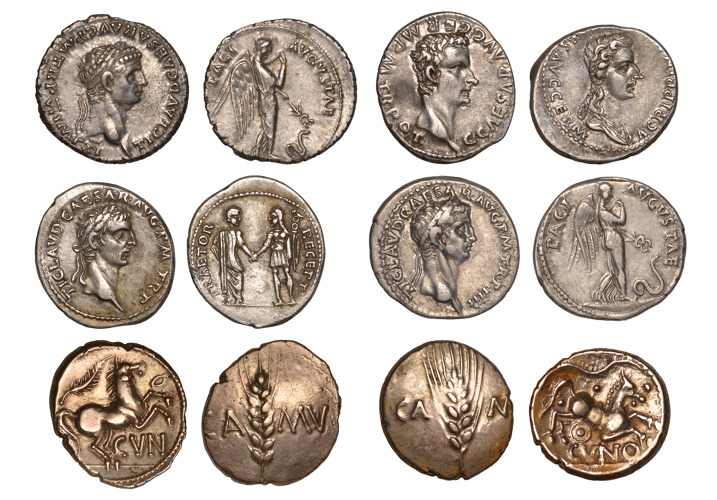
Highlights feature Denarii from Imperial Rome, including that of Claudius (41-54), dating to AD 46-47. With the emperor’s laureate bust, right, the surrounding inscription reads ti clavd caesar avg p m tr p vi imp xi, while the reverse shows Pax-Nemesis winged, draped and advancing right, holding a winged caduceus in the left hand pointed downwards towards a snake gliding right before her. Above is the legend paci avgvstae. This high relief portrait features in a bright lustrous field and the coin is about extremely fine, with an estimate of £2,000-3,000.
A Denarius of Gaius (Caligula) with Agrippina Senior to the reverse (AD 37-38) is expected to fetch £2,000-2,600, while the same estimate applies to another Claudius Denarius (AD 41-42), the reverse showing Claudius, bare-headed and togate standing right, clasping hands with a long-haired praetorian soldier standing left.
A further Claudius Denarius (AD 44-45) is pitched at £1,500-2,000.
Among the Iron Age coins of the same era as the Roman coins is a Wild A type Stater of Cunobelin (AD 8-41) of the Catuvellani. This is unusual because most mixed coin hoards of the period include coins of the Iceni, rather than Cunobelin.
The Stater shows the word ca mv divided by an ear of barley with six pairs of grains, with the reverse struck cvn below a horse bounding right with dashes for its mane, and a branch above. Struck on a broad flan, the horse is particularly well centred, and the condition good very fine. The guide is £1,200-1,500.
A Plastic type of Stater for Cunobelin is also expected to sell for £1,200-1,500.
Share This Page