Article
13 September 2024
TWO EARLY RARITIES THAT PLAYED A SIGNIFICANT PART IN THE HISTORY OF THE UNITED STATES OF AMERICA
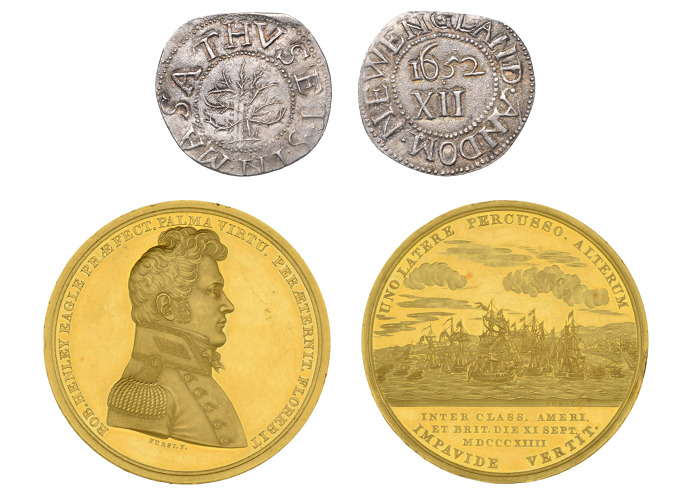
The establishment of the city of Boston can be traced back to 30 September 1630, just ten years after the Mayflower Pilgrims landed at nearby Cape Cod. Just over two decades later, in 1652, Boston’s colonial government authorised a new coinage, an example of which appears as a highlight in this sale with an estimate of £40,000-50,000.
The Massachusetts Oak Tree Shilling, which carries the date of 1652 – the year of the decree rather than that of minting – is extremely rare in the condition found here: in virtually mint state, and well struck with light golden toning over remarkably fresh surfaces.
Coming to Noonans from the family who have owned it for 300 years, it would have been struck by John Hull and Robert Sanderson, the only two skilled silversmiths in the colony at the time of the decree.
At first, the design carried the image of a design willow tree, but difficulties in producing the necessary dies and presses caused a two-year delay and the first Willow tree coin of any denomination wasn’t struck until 1654.
Some years later, probably in 1660 or 1662, the design was altered to an oak tree and the striking technique was changed from the traditional hammered method to a rocker press. It is believed these were struck for only a few years, up to about 1667, being replaced by the commoner Pine Tree type c.1667-1682.
All the coins bear the date 1652 which suggests that this represents the year the coinage was authorised and not that in which the coin was made. In support of this theory, the only coin not originally authorised was the Twopence, which was introduced in 1662 and thus carried that date.
Coin Specialist Bradley Hopper said: “It is no coincidence that the new coinage was introduced within months of Charles II’s flight to France in October 1651 – the colonists being anxious to take advantage of the power vacuum in England. The immobilised date, in the event of a later inquiry, might serve to suggest that all the coins were struck during the period when royal authority was lacking. Despite never receiving royal consent, the mint operated until June 1682, when Hull and Sanderson’s final seven-year contract expired.”
Of the historic medals offered at this auction, the stand-out lot is another product from North America: an early Congressional Gold Medal. George Washington had been the first recipient in 1776, with other Revolutionary awards to military figures of the time.
Those early Revolutionary conflicts had included a Battle of Lake Champlain, but it was another engagement of the same name in 1814 that finally put paid to British efforts to invade the United States during the War of 1812.
Fundamental to the success of the battle were the parts played by Lieutenant (later Captain) Thomas Macdonough, who commanded the American naval forces on the lake, and Robert Henley, who served as second in command on the Eagle during the engagement offshore of the town of Plattsburgh, New York.
The British, under the command of George Downie, attacked the American squadrons shortly after dawn on 11 September 1814, but were defeated, and Downie was killed. The British land attack, under Lieutenant Sir George Prévost, was then abandoned, with the forces retreating to Canada, leaving Brigadier General Alexander Macomb – later the Commanding General of the United States Army – victorious.
The triumph led the President of the United States, James Madison, to request the striking of Congressional Gold Medals for Macdonough, Henley, and Lieutenant Stephen Cassin, as well as for Macomb. Silver medals were struck for each of the commissioned officers of the navy and army serving on board, with swords presented to each of the midshipmen and sailing masters.
Henley’s medal has been consigned here with an estimate of £40,000-50,000. It is inscribed rob. henley eagle præfect. palma virtu. per æternit. Florebit (Rob. henley eagle prefect the palm of virtue for ever will flourish), the inscription surrounding a bust of the Lieutenant right. On the reverse, a scene of the battle, with Plattsburgh burning to the right, is inscribed uno latere percusso. alterum impavide vertit (Hard hit on one side, undaunted he turns the other). Below the scene, a further inscription reads: inter class. ameri. et brit. dei xi sept. mdcccxiiii.
A bronze restrike of the medal may be found in the collection of the Royal Museums Greenwich.
Share This Page