Article
29 October 2024
HOW THE HOLEY DOLLAR WAS COMMISSIONED FROM A CONVICTED FORGER
The Holey dollar, as it is known, is not simply a rare and important coin, it also represents the first steps of the Australian continent towards nationhood.
Created on the orders of New South Wales Governor Lachlan Macquarie, the object was to stabilise the economy, which until then had to rely on trade using a variety of coins from different countries.
Macquarie imported 40,000 Mexican 8 reales coins of Charles IV in 1812 for the purpose, and they were transformed into a new coinage that may rank as the only currency to have been officially created by a convicted forger, William Henshall.
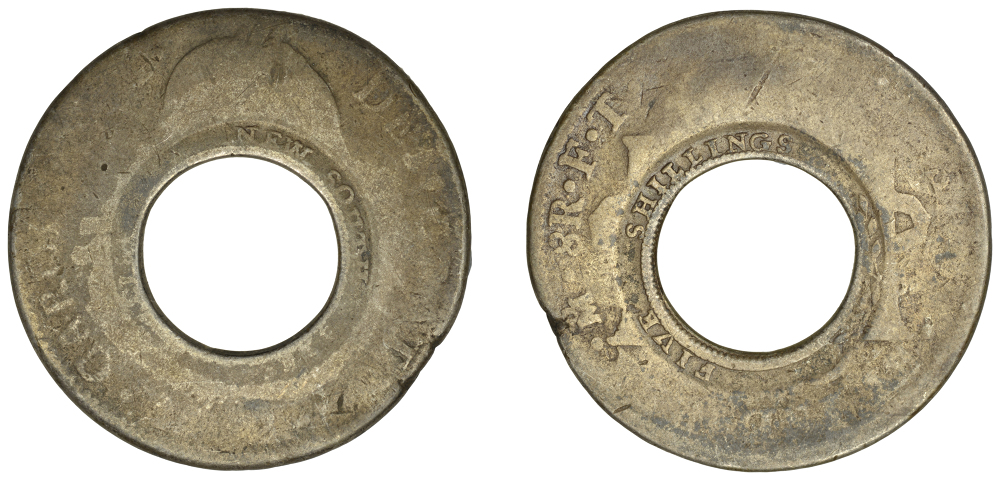
He cut the centre out of each of the reales to create two coins: the holey dollar, made of the outer ring and valued at five shillings, and the dump, worth 15 pence, from the centre. Thus came to be the first coinage minted in Australia.
Henshall stamped the coins with their new value and ‘NEW SOUTH WALES 1813’, adding his ‘H’ initial into the spray of leaves of the counterstamp design. He also inscribed his initial between the words ‘FIFTEEN’ and ‘PENCE’ on the dump reverse dies.
The coins were dated 1813 and issued the following year, remaining in circulation until replaced by sterling in 1822. The holey dollar was eventually demonetised in 1829, almost all of the 40,000 in circulation being exchanged for the new currency before being melted down.
It is thought that around 300 holey dollars and around 1,000 dumps survive today, in various states of wear. This auction presents a holey dollar, shown here, made from an 8 reales of 1801-03 in mediocre condition, but valuable as extremely rare. The estimate is £6,000-8,000.
Share This Page