Article
9 December 2024
CIRCA 425-400 B.C. STATER FROM CRETE LEADS THE WAY AT £300,000
Noonans are delighted and honoured to have handled some truly exceptional pieces across all departments in 2024, many with extraordinary stories behind them.
Among the slew of ancient hoards, historically what was arguably the most significant was the Braintree Hoard of 122 Anglo-Saxon pennies, which went up for sale on 21 February and took almost double its high estimate at £325,560.
The extraordinary hoard displayed a wide profile of moneyers from those in Hastings and Dover to others in Guildford, Rochester, London, Huntingdon and Lincoln. They were struck under the last two Anglo-Saxon kings of England, Edward the Confessor and Harold II Godwinsson, and the hoard was buried during the year 1066 – within five years of all bar two of the coins being minted.
The fact that they were never reclaimed raised the fascinating possibility that their owner may have been killed at the Battle of Hastings.
The highest price of the sale was paid for a very rare single specimen from the Hastings mint which fetched a hammer price of £24,000 – four times its pre-sale high estimate of £5,000-6,000. Only the second Hastings coin to appear at public auction in the last 40 years, it sold to an online bidder. Noonans had sold the other coin in September 2023 for £20,000.
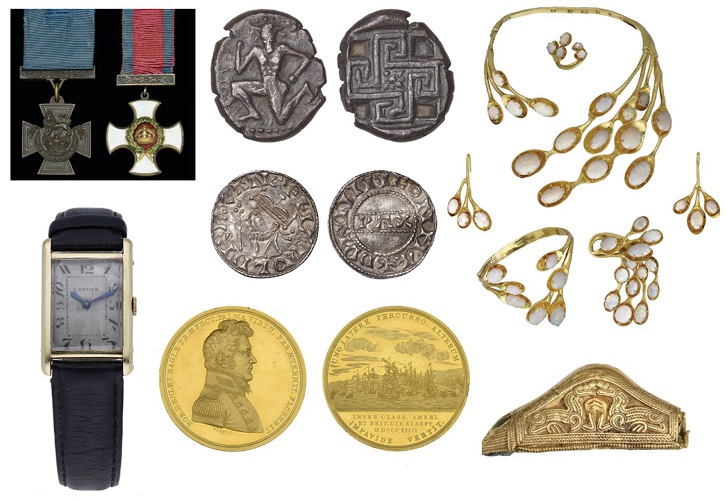
The outstanding Great War posthumous Victoria Cross awarded to Lieutenant-Commander Edgar Christopher Cookson of the Royal Navy made the headlines on 13 March when it sold along with the recipient's D.S.O. for a top-estimate £220,000.
Cookson had been killed while leading a ‘Cavalry Charge’ on water in 1915 during the operations involving the Tigris Flotilla.
The V.C. action arose on 28 September, when the river gunboat Comet had been ordered with other gunboats to examine, and if possible destroy, an obstruction placed across the river by the Turks. When the gunboats were approaching the obstruction, a very heavy rifle and machine-gun fire was opened on them from both banks.
An attempt to sink the centre vessel – a dhow – of the obstruction by gunfire having failed, Lieutenant-Commander Cookson ordered the Comet to be placed alongside, before jumping on to the dhow with an axe to try to cut the wire hawsers connecting it with the two other craft forming the obstruction. He was immediately shot in several places and died within a few minutes. A fellow officer later observed “there were more bullet holes in him than they cared to count.”
The landmark Jason Pilalas collection more than lived up to its reputation, with all 250 lots selling for a combined hammer total of more than £1.8 million on 23 July.
As expected, the stand-out consignment of this white glove auction proved to be the Great War Victoria Cross group awarded to Captain H.P. Ritchie for his gallant command of H.M.S. Goliath’s steam pinnace at Dar-Es-Salaam on 28 November 1914. It was the Royal Navy’s first VC of the Great War and sold here for £240,000.
The unique and poignant Second War bomb and mine disposal G.C., D.S.C. group of ten awarded to Lieutenant-Commander W. E. Hiscock, Royal Navy, sold for £140,000.
Another world-beating collection provided a memorable auction on 25 September. This was the Phillips Family collection of coins from the Ancient Greek World which sold out for £3.14 million.
The result trebled hopes, with the top lot (and of the year at Noonans) being a stater from Crete struck circa 425-400, which sold for a hammer price of £300,000 to a private collector against hopes of £40,000-50,000. Showing the head of a Minatour, the coin was once part of the Sir Arthur J. Evans Collection, the archaeologist who discovered the palace at Knossos. It had formed part of the Burlington Fine Arts Club’s Exhibition of Ancient Greek Art in 1903.
With the same estimate, a decadrachm struck at Syracuse under the tyrant Dionysios I, circa 400-380 sold for £150,000, also to a collector.
The catalogue cover lot was selected because it has a special significance for the family, being a gift from father to son on Christmas Day in 1963. A magnificent Dekadrachm of Carthage, it had an estimate of £20,000-26,000 and sold to a collector for £120,000.
An extremely fine Congressional Gold Medal sold for £180,000 against an estimate of £40,000-50,000 on 19 September. Presented to Lieutenant Robert Henley, as instructed by the President of the United States, James Madison, it was awarded in honour of his triumph at the Battle of Lake Champlain in the War of 1812, which effectively brought an end to British ambitions within the United States.
As Nimrod Dix, Deputy Chairman of Noonans, said: “This medal is a unique and splendid testament to one of the defining moments in Anglo-American history. There are very few Congressional gold and silver naval medals known to exist – possibly only four of each.”
A silver example from the same collection was also in the sale, which had been awarded to Captain Isaac Hull while in the Naval Engagement of U.S.S. Constitution and H.M.S. Guerriere on 19 August 1812. Estimated at £12,000-15,000, it fetched £46,000.
As well as the exceptional collections of Asian banknotes from Frank Goon and the Joe Cook collection reported separately in this newsletter, a notable feature of 2024 was the success Noonans had with rare British banknotes.
One example was the £100 note from the Birmingham branch of the Bank of England, dated May 1894, which took £38,000 on 14 March. Another was the £100 banknote from the Liverpool branch of the Bank of England dating from 1855 signed by Matthew Marshall, who was Chief Cashier from 1835-64. It sold for £32,000 on 26 June.
Noonans have developed a significant reputation for championing the designs of Louis Osman, the jeweller best known for creating the crown for Prince Charles at his investiture as Prince of Wales in 1969. Multiple Osman pieces came up for sale over the year, and Head of Jewellery Frances Noble oversaw a unique exhibition of his jewellery in October, including The Jenkins Family Collection.
One of the stand-out Osman pieces to sell at auction at Noonans in 2024 was a 22ct gold opal parure from 1972 and 1973, that sold for £40,000 on 26 November. Comprising a hinged torque collar, hinged bangle, brooch, pair of ear pendants and ring, each of organic branching form, supporting graduated oval cabochon opals each claw set above a concave dish mount, it came in a customised carved yew wood and silver-fitted case.
Demonstrating the enduring appeal of the Cartier Tank watch, an early London-made example hallmarked for London 1941 left its pre-sale estimate of £5,000-7,000 far behind when it sold to a private collector for £24,000 on 10 September.
With a highly collectable London hallmark, and the dial signed by Jaeger-LeCoultre, the Cartier Tank watch illustrated the continuing strength of the auction market for early Cartier timepieces.
A very striking collection of 11 watches by Pierre Cardin, the Italian-born, French fashion designer (1922-2020) explored his fascination with avant-garde style and Space Age designs. Cardin designed the Nasa spacesuits in 1970 and he launched his Espace collection of 26 wristwatches in 1971.
When the 11-piece collection came up for sale on 12 March, the best performance came from a stainless steel and acrylic curved rectangular wristwatch, PC106, which took £480.
A Russian Imperial jewelled 14 carat gold presentation cigarette case sold for £9,500 on 10 September. From St Petersburg, post 1908, it bore the maker’s mark for Gabriel Nykänen (Niukkanen) and an inscription indicating that it had been a gift from the Dowager Empress Maria Feodorovna, Consort of Czar Alexander III, to the wife of Admiral N. C. Palmer RN, Captain of the Royal Yacht Victoria & Albert from August 1909 - December 1913.
Of rounded rectangular form, it was decorated throughout with bands of reeding, the hinged cover applied with a diamond-set crowned Imperial double-headed eagle, with cabochon sapphire thumbpiece, contained in fitted case by jewellers A. Tillander.
Gabriel Nykänen is known to have worked in St Petersburg from 1889-1917, both independently and as a workmaster for Fabergé.
One of the most stunning antiquities offered this year appeared in the 20 June auction: a circa AD 600 gold Saxon sword pommel cap, which sold for £16,000. Discovered in Billesdon, Leicestershire by an 81-year-old metal detectorist, the ornament had motifs that recalled the rim of a shield from the Sutton Hoo ship.
Other ancient artefact highlights that sold alongside it included a Romano-British, 1st century AD bronze boar figurine, measuring just 5.2 x 3.7cm, found at Beltinge in Kent. The XX Valeria Roman legion took part in the invasion of Britain in 43 AD and were initially based at Colchester. The legionary emblem was a charging running boar. The druids regarded the boar as sacred and the animal was a symbol of strength and fertility appearing on a number of Iron Age coins.
Intact, and in excellent condition with a smooth olive green patina, the boar in this sale had been estimated at £1,000-1,200 but trebled the high estimate at £3,600.
‘Nobby’ is the nickname for a 37 x 10mm fertility figure discovered by Bob Jemmett, a retired HGV driver and avid metal-detectorist, during an organised rally in South Cambridgeshire almost six years ago. It sold for a double-estimate £3,000.
Share This Page