Article
7 January 2025
THE EMPEROR WHO SUCCESSFULLY BID FOR ROME… BUT DIDN'T LAST LONG
A short reign inevitably means limited issue of coinage. Quintillus (AD 270) ruled Rome for just 17 days, while Pertinax (AD 193) lasted a mere 87 before the Praetorian Guard cut him down, it is thought because he underpaid them.
Next came one of the most notorious events in Roman history: the Praetorian Guard's auction of the empire to the highest bidder.
The winner was Marcus Didius Julianus who pledged 25,000 sestertii to each soldier, only to debase the currency once he took power.
Selling the great empire in this way was demeaning, and Julianus, who had succeeded by purchase rather than honourable conquest, failed to win the esteem of the people, with the mob turning on him.
The ensuing civil war set three camps against each other with Septimius Severus, commander of the legions in the Balkan region, eventually successful. Sixty six days after he had come to power, Julianus himself was killed by a soldier.
Significantly, the damage his method of acquiring the imperial throne did to the reputation of Rome, accompanied by his debasing the currency, marked the beginning of the empire's economic and military decline, and its eventual demise.
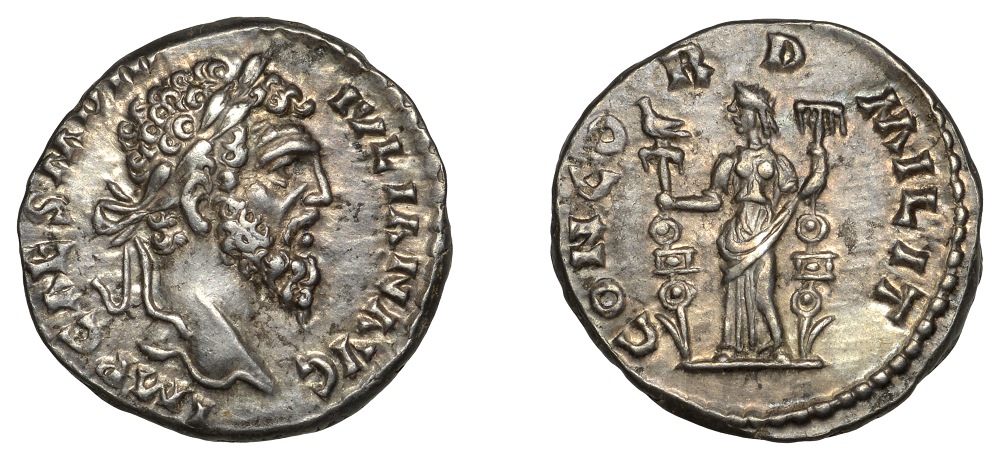
Thus the inclusion of a denarius of Didius Julianus in this sale is a poignant reminder of that fate. The depiction of Concordia – the Roman goddess of harmony, peace and agreement – on the reverse is an irony considering the politics of the day.
The obverse shows Julianus with laureate head right, and IMP CAES M DID IVLIAN AVG around. In good very fine condition, this is a superb example of an already rare issue and is estimated at £2,000-2,600.
Share This Page