Article
7 January 2025
HOW A POLICY FOR TACKLING RISK CAN HELP FEED A COLLECTING MARKET
Attempts to control the movement of currency have resulted in innovations that have proved highly collectable in the long term. The Haj notes of 1959 are a fine example of this phenomenon.
The Reserve Bank of India issued the notes as part of the country's currency controls for pilgrims visiting Mecca. The Haj notes were not legal tender within India itself but could be exchanged easily for riyals in Saudi Arabia.
The special issue helped the Reserve Bank of India prevent the smuggling of large numbers of rupees that might then be returned from banks in Saudi Arabia.
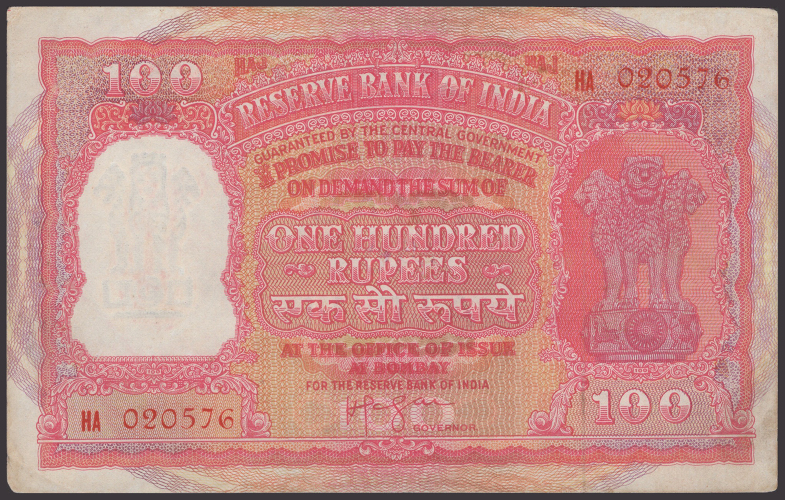
To make them easily distinguishable from the domestic currency, the Reserve Bank issued 10 and 100 Rupee notes in colour variants, the 10 in blue instead of violet, and the 100 in red instead of purple.
A leading highlight of this sale is an extremely rare 100 Rupees, 1959 Haj Issue, serial number HA 020576. The estimate is £20,000-26,000.
Offered at the same £20,000-26,000 guide each are two Oriental Bank, India, proof notes, one for 500 Rupees, the other 1,000. Both dated 184-, neither has a serial number or signature. Each was a uniface, with a black SPECIMEN overprint in the signature field. A vignette of the Town Hall in Bombay added to their attraction.
The 500 Rupee note is very slightly toned, with foxing thus and about uncirculated. The 1,000 Rupee note is printed on lovely clean paper, free from any damage, and uncirculated, and as such exceptionally rare.
The Oriental Bank was one of the first banks to operate in India, and was originally called the Bank of Western India. These proofs are probably the only way to obtain these notes as no issued examples survive.
Share This Page