Article
29 January 2025
NELSON PRAISED HIM AT THE NILE, WELLINGTON AT WATERLOO
John Hill was as First Lieutenant in H.M.S. Minotaur at the Battle of the Nile, coming to the rescue of Nelson’s flagship H.M.S. Vanguard. Prior to the Battle of Waterloo, he commanded all the transport vessels conveying the British army to Belgium.
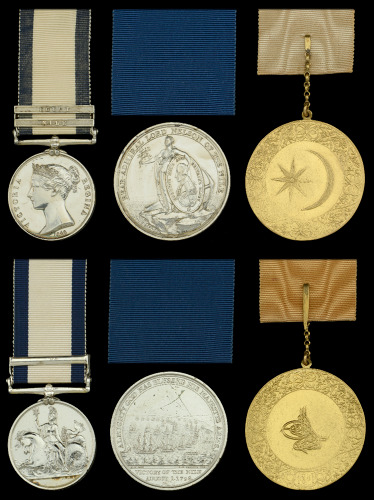
Now Noonans have the honour of presenting for sale his Naval General Service 1793-1840, with clasps for Nile, Egypt; his Alexander Davison’s Medal for The Nile 1798, in silver, and his Sultan’s Medal for Egypt 1801, 2nd Class, in gold, on its original gold chain and hook. The estimate is £10,000-14,000.
It is safe to say that naval career of Hill – later Rear-Admiral of the White Sir John Hill – coincided with arguably the most outstanding period of British naval history.
When Minotaur helped rescue Nelson’s flagship H.M.S. Vanguard at the Battle of the Nile, Nelson singled out his Captain for praise, while Hill himself was slightly wounded. Later his effective role in preparing the British army for Waterloo led to him being Mentioned by and earning the Duke of Wellington’s distinct thanks.
“Thus he secured the praise of both the foremost sailor and soldier of his day,” says Noonans Medal Specialist Oliver Pepys. Indeed, Hill not only enjoyed the patronage of the Duke until the end of the latter’s days, he also rode in the carriage for the captains of the Cinque Port castles at the Duke’s State Funeral.
John Hill set out on his naval career at the age of just seven in 1781, as a Captain’s Steward aboard the bomb vessel H.M.S. Infernal. The ship was commanded by his uncle, Commander James Alms and young John served in the ship until March 1783.
After service in various other ships, he was posted to the 24-gun frigate H.M.S. Proserpine, 24 guns, again under the command of his uncle , and was advanced Lieutenant on 28 July 1794, transferring to H.M.S. Minotaur as First Lieutenant in 1798.
The Battle of the Nile, fought over 1-3 August 1798, was the climax of a three-month campaign across the length and breadth of the Mediterranean. With the enemy fleet discovered moored in Aboukir Bay shortly after 2 p.m. on 1 August, Nelson’s fleet entered the bay just after 6pm and engaged Vice-admiral Brueys’ fleet directly.
Minotaur was sixth in the British line of battle, immediately astern of Nelson’s flagship H.M.S. Vanguard; those four ships immediately ahead sailed around the front of the French line, consequently engaging their enemy from an unprepared (and unexpected) direction. Brueys’ fleet was enveloped in deadly fire from all sides but fought back bravely. With the Vanguard coming under accurate cannon and musket fire from the Spartiate, the Minotaur came to their flagship’s aid and Hill himself later recalled his experiences in a fascinating eye-witness account of Admiral Nelson conveying his thanks to the Minotaur’s captain, Thomas Louis:
‘On the 1st of August when the Vanguard anchor’d alongside the Spartiate, she became exposed to the raking fire of the Aquilon, the next ship in the enemy’s line, by which the Vanguard had between fifty and sixty men disabled in the space of ten minutes. Captain Louis took his station ahead of the Vanguard; the Minotaur not only effectually relieved her from this distressing situation but overpowered her opponent. Lord Nelson felt so grateful to Captain Louis for his conduct, on this important occasion, that about nine o’clock, while yet the combat was raging with the utmost fury, and he himself was suffering severely in the Cockpit from the dreadful wound in his head; he sent for his Lieutenant, Mr Capel, and ordered him to go on board the Minotaur, in the jolly boat, and desired Captain Louis would come to him; for that he could not have a moment’s peace, until he had thanked him for his conduct. The subsequent meeting which took place between the Admiral and Captain Louis was affecting in the extreme, the latter being over his bleeding friend in silent sermon, “Farewell my dear Louis,” said the Admiral, “I shall never forget the obligation I am under to you for your brave and generous conduct, and now whatever may become of me my mind is at peace”.’
The fighting had been fierce: Minotaur lost 87 men killed and wounded but was overall only lightly damaged, but the Aquilon lost her captain and over 300 men killed and wounded, and was completely dismasted.
Promoted Commander as a reward for his services at the Battle of the Nile, Hill was ordered to take command of the captured Aquilon and sail her to Malta for repairs.
He spent the next two years on half-pay, before being appointed to the command of the troopship Heroine on 12 February 1800. As commander of Heroine, he spent two years in the Mediterranean conveying troops, and in this capacity he participated in the Egyptian Expedition and the landing of soldiers prior to the Battle of Abukir on 8 March 1801. The Log Book of the Heroine notes he also physically served ashore between 24 and 30 April 1801, and it was for these services that he was awarded the Sultan’s Gold Medal, Second Class.
For the remainder of his career, Hill had the command of various transport ships, punctuated with periods on the half-pay list, notably spending just over two years in charge of transport ships in the Baltic.
Recalled for duty closer to home, Hill then became responsible for transporting Lieutenant-General Sir Thomas Graham’s force to Holland for the abortive attack on Bergen-op-Zoom, and also for embarking the wounded after the attack and withdrawal, for which services he was specifically mentioned by General Graham in General Orders of 16 August 1814: ‘The Commander of the Forces is no less indebted to Captain Hill, of the Royal Navy, for that cordial co-operation which he has on all occasions experienced from him.’
More was to come with the Waterloo Campaign.
As principal Transport Agent at Ostend, Hill was responsible for the safe delivery of all British troops arriving in Flanders for the upcoming Waterloo Campaign. His own recollections note the following: ‘Disembarked the whole of the British Army and materiel prior to the Battle of Waterloo without a single accident to a soldier and the loss of only two horses. After that memorable Battle embarked all the wounded British soldiers and a large number of French wounded and prisoners.’
Hill was also mentioned by name in Captain Cavalie Mercer’s Journal of the Waterloo Campaign, which illustrates the tact required in his job:
’Our keel had scarcely touched the sand ‘ere we were abruptly boarded by a naval officer (Captain Hill) with a gang of sailors, who, sans ceremonie, instantly commenced hoisting our horses out, and throwing them, as well as our saddlery, etc., overboard, without ever giving time for making any disposition to receive or secure the one or the other. To my remonstrance his answer was, “I can’t help it, sir; the Duke’s orders are positive that no delay is to take place in landing the troops as they arrive, and the ships sent back again; so you must be out of her before dark.”; and I thought this a most uncomfortable arrangement.’
As well as Mentioning Hill in his Despatch of 16 October 1815, the Duke of Wellington specifically recommended to the Secretary of State for War, Lord Bathurst, that Hill be promoted to the rank of Post Captain.
Bathurst responded: ‘The Lords Commissioners of the Admiralty in consequence of your Grace’s recommendation have promoted Captain Hill to the Rank of Post Captain’. As a Post Captain, Hill could, in theory, find himself promoted one day, in order of seniority, to the very highest ranks of the Royal Navy. General Sir Thomas Graham, was one of the first to congratulate him in a letter of 12 December 1815: ‘I was extremely gratified to hear from Admiral Sir George Hope that at last your claim to promotion had been admitted at the Admiralty…Inasmuch as I consider your unremitting zeal and attention to the very arduous and often disagreeable duties of your situation most deserving of reward, I am most sincerely rejoiced to find that your claim for promotion has been admitted.’
Hill was next assigned to Calais where he spent three years commanding and co-ordinating the transportation of troops returning home, including the shipment of some 7,000 Russian soldiers back to Russia, for which services he received both a letter of thanks and the Order of St. Vladimir Fourth Class (although it is believed that he disposed of this Russian decoration upon the outbreak of the Crimean War).
In February 1820 he was appointed Agent Victualler at Deptford, one of the Royal Navy’s three yards responsible for feeding the entire fleet; he held this post until 1838 and whilst doing so rose steadily through the positions of Comptroller (1822), Patent Commissioner (1826) and Captain-Superintendent in 1832.
During the Irish Famine of June 1831 Hill was selected as government agent to oversee relief efforts and upon his return from Ireland in August of that year he was knighted by H.M. King William IV; as Captain Sir John he was next appointed Superintendent of Sheerness Dockyard and, in mid-1838, assumed responsibility for the disposal of the famous ‘Fighting Temeraire’, so memorably depicted at the same time by J. M. W. Turner.
After further periods of assistance with famine-relief in both Ireland and Scotland throughout the 1830s (earning him a pension of £150 per annum by Parliament for ‘Special services superintending the relief granted in times of scarcity in Ireland and Scotland’), Hill returned to Deptford in 1842 and eventually retired in 1851; in April the same year he was promoted, by seniority, to Rear-Admiral of the Blue and went to live at Walmer Lodge on the Kent coast, close to Walmer Castle, the official residence of the Warden of the Cinque Ports, who at the time was the Duke of Wellington. Indeed, just before his death Wellington secured a sinecure for Hill as Captain of Sandown Castle, and following Wellington’s death Hill participated in his State Funeral, riding in the carriage for the captains of the Cinque Port castles.
Advanced Rear-Admiral of the White in 1853, Hill died on 20 January 1855, aged 81, and was interred at St. Mary’s Church, Walmer, where a fine tablet is erected in his memory.
Share This Page