Article
29 January 2025
SAPCOTE HOARD INTRIGUES WITH PREVIOUSLY UNKNOWN COIN
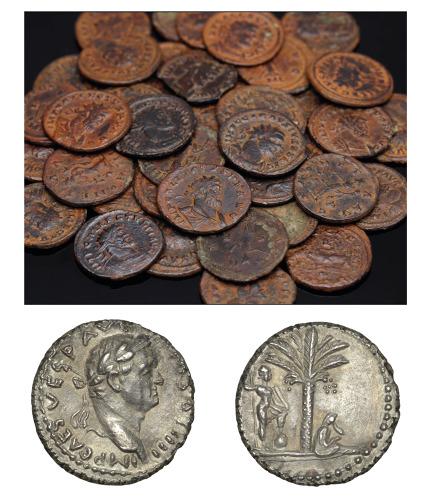
Found in south-west Leicestershire, the Sapcote Hoard has made its mark by revealing a new bust variety minted in the name of the Emperor Diocletian.
It is among 50 Antoniniani from the reigns of Allectus, Carausius, Diocletian and Maximian.
Minted under the reign of Carausius in the name of Diocletian, the first coin listed in the hoard has a radiate and cuirassed bust right, and IMP C DIOCLETIANVS P F AVG around. The reverse depicts a woman standing left, possibly Hilaritas, holding a palm and cornucopia, with [–]S AVGGG around, [S] P in field, and MLXXI in exergue.
In the current reference book, Roman Imperial Coinage Volume 5, first published in 1933, coins minted under Carausius with Hilaritas on the reverse are only known under Maximian’s name. Since then, coins of this type minted under Diocletian’s name have been unearthed, featuring a radiate, draped and cuirassed bust. This coin is a new bust variety for the type and will be included in the forthcoming second edition of Roman Imperial Coinage Volume 5 as number 3539var.
Most of the coins in the hoard were minted in London, with a few in Camulodunum (Colchester), with one of uncertain mint and others illegible because of wear. Five fragments are also included.
Ranging from poor to good fine, varied state, some with impressive portraits, the hoard is expected to fetch £1,200-1,500.
The remains of a Roman villa were discovered at Sapcote in 1770. A tessellated pavement and building foundations from a Roman building were found to the southeast of the site. In the 20th century more structural remains were unearthed as well as pottery, coins and tiles in the area of the former Calver Hill Quarry.
Archaeologists believe even more has yet to be found there.
Another coin of note in this sale is a Denarius, Antioch of Pisidia, 72-3, struck for Vespasian (69-79). With laureate head right surrounded by IMP CAES VESP AVG [P M C]OS IIII to the obverse, the reverse shows the figure of Judaea, veiled and draped, seated right under palm-tree, in an attitude of mourning. This reverse type commemorates the victory of the Romans over Jerusalem.
Behind the palm, Vespasian stands triumphant, in military dress, with his right foot on his helmet, holding a vertical spear in his right hand and a parazonium in his left. About extremely fine and toned, with slight porosity, it has a guide of £1,000-1,200.
Share This Page