Article
21 February 2025
SAPCOTE HOARD TREBLES HOPES THANKS TO KEEN BIDDING
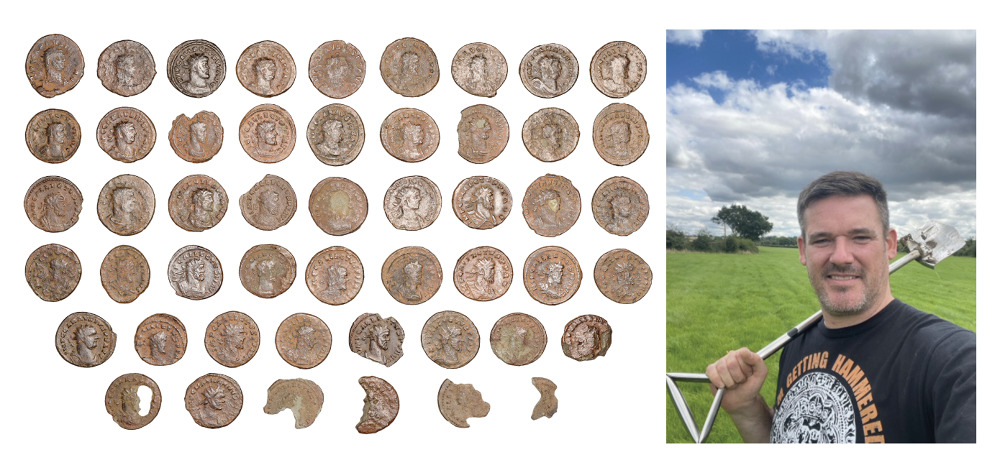
Found in south-west Leicestershire by 42-year-old bathroom fitter David Dunn, the Sapcote Hoard of Roman coins has sold to a buyer in the United States for £4,400, almost three times its high estimate.
Mr Dunn, who is married has been metal detecting for two years, made his discovery on 19 July, 2023, just 15 minutes’ walk from his house in a field.
A faint signal led to the discovery of a Roman coin and then another. "I was so excited that I went to get the farmer and then after digging down to about two feet, it then just snowballed from there over a 4m squared area and we found 50 coins in total… who knows what would have happened if we continued digging further!”
After reporting them to the local finds officer via the Portable Antiquities Scheme, they were disclaimed and he was able to consign them for sale at Noonans.
Before the sale, Noonans Coin Expert Alice Cullen explained: “This is a wonderful find of Antoninianus coins by David and we are very pleased to be selling them. The Antoninianus was a coin used during the Roman Empire thought to have been valued at 2 denarii. This hoard dates from the reigns of Carausius who usurped power in 286 after the Carausian Revolt, and declared himself emperor in Britain and northern Gaul; Allectus, who died in 296 and was a Roman-Britannic usurper-emperor from 293 to 296; Diocletian, nicknamed Jovius, who was Roman emperor from 284 until his abdication in 305, and Maximian who reigned from 286 to 305, sharing the title of Augustus with his co-emperor and superior Diocletian.”
Alice consulted Dr Sam Moorhead, who until recently was the National Finds Adviser for Iron Age and Roman coins with the Portable Antiquities Scheme at the British Museum and the writer of the forthcoming updated Roman Imperial Coinage volume 5. Following their discussions, the first coin in the hoard is going to be recorded in the new volume as a new variety. "It’s very exciting!" said Alice. "This particular coin is from the reign of Carausius (286-293) and is decorated with a bust of Diocletian on one side and a standing woman on the other.”
Most of the coins in the hoard were minted in London, with a few in Camulodunum (Colchester), with one of uncertain mint and others illegible because of wear. Five fragments are also included.
Ranging from poor to good fine, varied state, some with impressive portraits, the hoard had an estimate of £1,200-1,500.
The remains of a Roman villa were discovered at Sapcote in 1770. A tessellated pavement and building foundations from a Roman building were found to the southeast of the site. In the 20th century more structural remains were unearthed as well as pottery, coins and tiles in the area of the former Calver Hill Quarry.
Archaeologists believe even more has yet to be found there.
Share This Page