Article
13 March 2025
‘PIRATE OF BASRA’ VICTORIA CROSS LEADS SALE AT £200,000
The exceptional posthumous Victoria Cross from the Great War presented to 44-year-old Lieutenant-Commander Charles Henry Cowley of the Royal Naval Volunteer Reserve – “Pirate of Basra” – led this auction with a hammer price of £200,000.
With a hammer total for the auction of £1.96 million, this brings the amount raised by the Jason Pilalas Collection so far to £3.76 million.
The V.C. was not the only highlight.
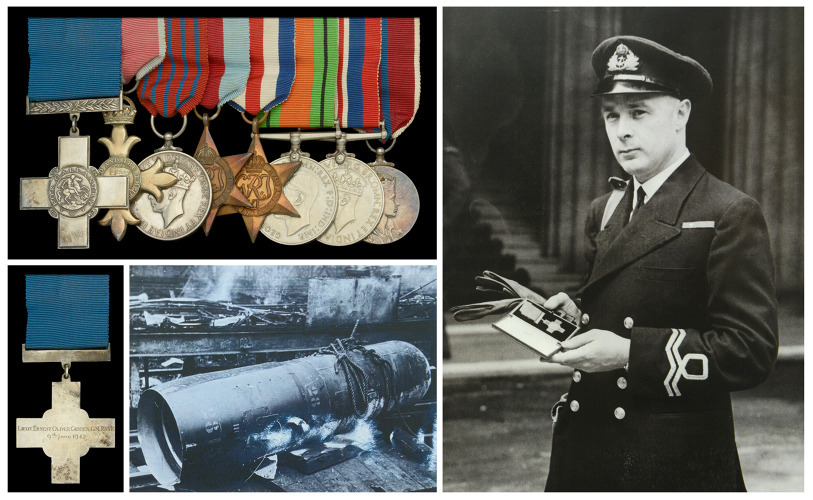
The unique Second War ‘London Blitz’ George Cross, O.B.E., George Medal group of eight awarded to Acting Lieutenant-Commander E. O. ‘Mick’ Gidden, Royal Naval Volunteer Reserve – ‘the man who saved Charing Cross’ – sold for £100,000.
Nimrod Dix, Deputy Chairman of Noonans and Director of the Medal Department explains: “Gidden, who was born in Hampstead, was a master of mine disposal operations and the first man to be awarded both the George Cross and George Medal, his gallantry in dealing with a parachute mine on Hungerford Bridge, outside Charing Cross Station, in April 1941, was among the great epics of the war: in a six hour operation, in which he was unable to apply a safety device for much of that time, he had to resort to using a hammer and chisel.”
He added: “Just eight men have been awarded the combination of the G.C. and G.M.; the addition of the O.B.E. makes this a unique combination of awards.”
Lieutenant Gidden arrived on the Bridge shortly after dawn and found the mine lying across a live electric wire at the foot of the main signal gantry, with the bomb fuse and primer release mechanism facing downwards. Before operations of any kind could be commenced the mine had to be turned to get at the bomb fuse.
Turning the mine was likely to detonate it, with disastrous results for railway communications and important buildings. In order, therefore, to be able to control the operation with accuracy, Lieutenant Gidden stood only 50 yards from the mine. He then attempted to remove the remains of the screw threaded ring (which holds the fuse in place) with a hammer and chisel. At the first blow the clockwork in the fuse started to run.
Lieutenant Gidden, who had kept his head close to the fuse, heard the ticking, and made off as best he could, but as it was necessary to jump from sleeper to sleeper, with a 10-foot drop below, there was little chance of escape. As it happened the “gag” held, and Lieutenant Gidden returned with a drill. He succeeded in removing the ring, but then found it necessary to prise the fuse out with a chisel. This he successfully did despite its dangerous condition. This operation took six hours to complete.
After the war, he returned to civilian life, working for the family saddlery firm W. & H. Gidden of Mayfair, but he died suddenly, aged 51, in December 1961.
The unique and quite outstanding Great War Q-ship ‘Baralong incident’ D.S.M. and Caspian Sea 1919 operations Second Award Bar group of seven awarded to Chief Petty Officer Harry Dickason, Royal Navy brought a bid of £65,000.
Dickason had earlier been a stoic member of the Northern Party in Scott’s Antarctic Expedition of 1910-13, when, over nine months, he shared in a story of endurance and courage rarely matched in the annals of exploration.
Seven years later, in 1920, he was an equally valued member of the North-West Persia Mission in 1920, when he became one of just four naval personnel awarded the related Medal and clasp ‘N.W. Persia 1920’.
Share This Page