Article
13 March 2025
HONOURING THE SELECTIVE ‘EYE’ OF A POLYMATH
The Hon. Robert William Hervey Erskine (1930-2024) was a polymath whose contributions to several fields of scholarship and the arts were outstanding – “supreme among the post-Kenneth Clark generation of aesthetic talking heads”, as his Times obituary concluded.
The son of Lord John Francis Ashley Erskine and Lady Marjorie Erskine (née Hervey), he spent his early years between London, Madras – where his father served as governor between 1934 and 1940 – and Ickworth House, his mother’s family seat. An education at Eton ensured a good grounding in the arts, aesthetics and all things of good taste. Coins, however, came first.
Even as a boy he approached collecting as a serious academic pursuit. His scholarship at Cambridge – to read archaeology at King’s – was won through a demonstration of his prodigious knowledge of Anglo-Saxon coinage.
Following his studies he also turned his attention to the revival of British print-making, founding the influential St George’s Gallery Prints in 1954, and helping to inspire a revival of the British print-making scene, “taking it out of the shabby 1950s and setting it on the road for the Pop Art boom of the 1960s”, as the Fry Art Gallery adjudged.
Later he was instrumental in the establishment of the Curwen Studio, which focused on artists’ lithography.
Alongside this Erskine pursued an ad-hoc career as a collector-cum-dealer in antiquities. This pursuit culminated in the discovery and reconstruction of the famed Sophilos vase, a signed masterpiece of sixth century Attic black-figure wear. Robert’s eventual sale of the vase to the British Museum (at a price far below market value) reflected his fundamental belief that the beautiful and interesting should be made available to all. It was this same principle that led him to print making, which he saw as a ‘democratic media of art’ and, of course, to his career as a television presenter.
To many of a certain generation Robert Erskine will be most familiar as one of Kenneth Clark’s contemporaries; a worldly ‘talking-head’ whose programmes on BBC and ITV sought not only to educate and entertain – aims which were easily achieved through his relaxed, jovial screen presence – but also to espouse the virtues of art and civilisation to all.
The 8 April auction is a reminder of Robert Erskine’s ‘eye’ for the aesthetic and interesting, the catalogue presenting a selection of the finest ancient coins from the Erskine cabinets, with the remainder set to follow in later sales at Noonans.
“In making this selection we have been most fortunate to benefit from the assistance of Robert’s widow, Lindy Erskine. Not only has Lindy lent us her own expertise as an Art Historian, but she has also provided considerable insight into Robert’s view on numismatics, and indeed collecting generally,” says Noonans’ Head of Coins, Bradley Hopper.
“To Robert, coins were both works of art in miniature and windows into a lost world. They are artefacts that provide a tactile link to the past.”
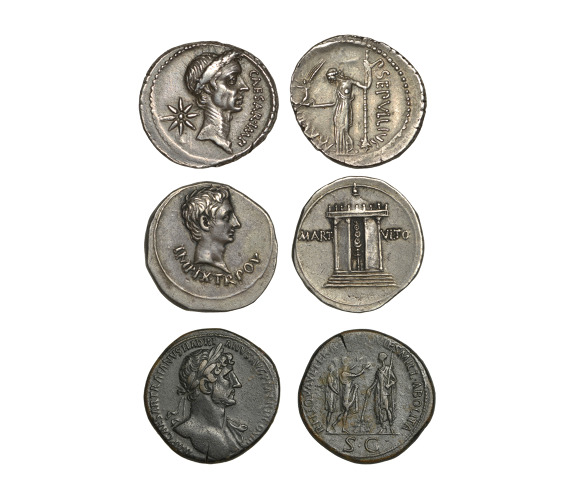
Highlights across a highly accessible range of prices start with a Denarius of Julius Caesar dating to January-February 44 and by the Roman moneyer P. Sepullius Macer. It depicts the wreathed head of Caesar right, with a star of eight rays behind and caesar imp before. To the reverse, Venus stands left, holding Victory in her right hand and a sceptre in her left, with a star at the bottom of the sceptre, and p sepvllivs macer around. In good very fine condition, with beautiful old dark toning across excellent surfaces, the obverse is well struck up, delicately modelled and of the finest style, and the estimate is £1,500-2,000.
A Cistophoric Tetradrachm of Octavian, Augustus (27 BC-AD 14), from the Greek city of Pergamon, dates to 19-18 BC and shows the emperor with bare head right, above imp ix tr po v. The reverse depicts a tetrastyle temple of Mars Ultor, with standard within. In good very fine condition, with beautiful old cabinet tone and a superb pedigree, it has a guide of £600-800.
An early (119-20 AD) Sestertius Hadrian of Hadrian (117-138) shows the laureate bust right, with the surrounding inscription imp caesar traianvs hadrianvs avg p m tr p cos iii. The reverse shows a lictor standing right, torching a heap of bonds, before him a crowd of plebs, with the inscription reliqua vetera hs novies mill abolita around.
This rare specimen of a small issue commemorates Hadrian’s writing off 9 million Sestertii in tax arrears in 119, owed to the state by private citizens. Records were publicly burned and an inscription celebrating Hadrian’s generosity was erected in the Forum of Trajan. A very fine, glossy green patina with some minor porosity adds to the appeal of this very rare and historically significant type. It carries hopes of £600-800.
Noonans will be holding further parts of the Erskine collection, including his very strong collection of Indian coins, possibly from the autumn.
Share This Page