Article
1 May 2025
A HERO FROM WHAT WELLINGTON PERSONALLY CONSIDERED HIS FINEST HOUR
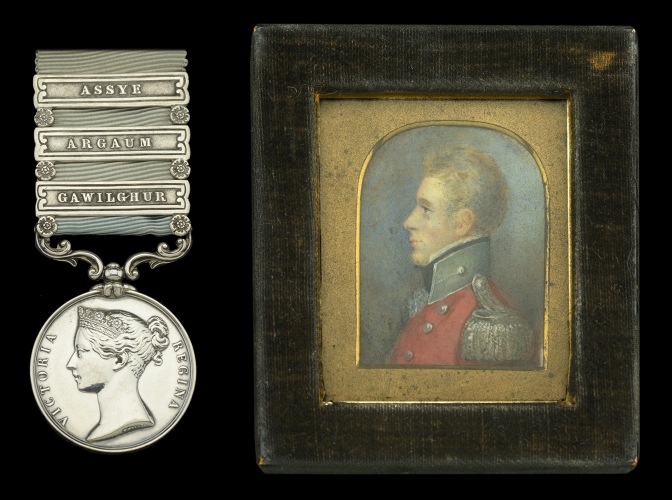
An extremely rare medal associated with the battle that became Arthur Wellesley's (later the Duke of Wellington) most famous victory in India provided a highlight for this auction.
It was awarded to Captain J. Smith, 12th Madras Native Infantry, one of only four officers who survived the battle to claim their medal.
Wellesley considered the Honourable East India Company Regiment the most effective of the HEIC regiments under his command in India. And he ranked his victory at Assye as a higher personal achievement than even Waterloo.
Born in 1784, James Smith had been serving as a Lieutenant with the 2nd Battalion, 12th Regiment, Madras Native Infantry for around two years by the time of the Battle of Assye on 23 September 1803.
Although outnumbered by three to one, Wellesley made an audacious frontal attack on the massed enemy regular battalions which were packed onto a battlefield running north to south, with both their flanks protected by converging rivers. The enemy’s northern flank was additionally anchored on the village of Assye, which had been turned into a heavily fortified stronghold, with heavy guns and infantry protected behind mud walls.
Wellesley’s intention was to stay well clear of Assye village and, if necessary, deal with it after the end of the main battle. Unfortunately, the commander of his right wing mistakenly advanced directly towards it, leading Smith’s regiment into a hurricane of fire which annihilated both the leading H.E.I.C. troops and the 74th Foot. The shattered remnants of the British right were then charged by enemy cavalry.
Wellesley’s cavalry retrieved the situation with a counter charge, his battered infantry surged forward, and the enemy swung back to a final defensive position arcing westwards from Assye along the northern river bank. As the 2/12th Madras N.I. moved up to take part in the last decisive attack, they were again bombarded by the guns in Assye village. Wellington’s men smashed the enemy infantry and captured all their artillery, at the cost of 27% casualties (compared with 24% at Waterloo). Many years after Waterloo, Wellington was asked to name the best thing he ever did in the way of fighting; he replied “Assye.”
The 2/12th M.N.I., in which Smith served, had the second highest casualties of all Wellesley’s units engaged at Assye, mostly from enemy artillery fire which was described by Wellesley as “the hottest that has been known in this country”. The battalion lost 212 men and six European officers, including the C.O., Lieutenant-Colonel Macleod, who Wellesley considered to be his best H.E.I.C. battalion commander.
Smith recovered from his injuries in time to take part in Wellesley’s next battle, at Argaum on 29 November 1803. The survivors of 2/12th M.N.I. proved somewhat shy, due to their shortage of European officers, their experience of suffering artillery bombardment at Assye and the presence of 1,500 highly professional Arab mercenaries among their adversaries. When the Maratha guns opened fire, two teams of ten bullocks pulling 6-pounder guns bolted, careering back through the infantry and causing several sepoy units including 2/12th M.N.I. to break and flee.
Wellesley was close at hand, but he could not stop the panic immediately and quietly ordered Smith and the other officers to lead their men into cover. There they re-formed their ranks, when Wellesley led them to their correct positions and ordered them to lie down. After a while, all his battalions began a steady advance through artillery fire towards the enemy line, and destroyed their adversaries, with repeated measured volley fire.
Lieutenant Smith participated in the audacious storming in December 1803 of the hilltop fortress of Gawilghur, which was garrisoned by 8,000 men armed with brand-new British Brown Bess muskets, 52 cannon and 150 light swivel guns.
He was promoted to Captain in June 1813 but invalided out of the Madras Native Infantry in April 1818, on account of his wounds. Smith’s rare ‘Assye’ three clasp Army of India Medal was one of only 52 issued with this combination, which is unique to the regiment. Arthur Wellesley (later Duke of Wellington) received these same three clasps, of which only 85 were issued for Assye. Around 149 medals issued with three clasps were issued in all.
Smith’s three-clasp medal, sold here for £20,000 against an estimate of £10,000-14,000, was issued from the Adjutant General’s Office on 1 April 1852. He had chosen to stay on in India rather than return to Britain and transferred to the 1st Native Veteran Battalion. He is still shown on the strength of this unit in 1856, when he would have been 70 years old. Captain Smith died on 5 June 1859, and is buried in St Mary’s Cemetery, Madras.
Share This Page