Article
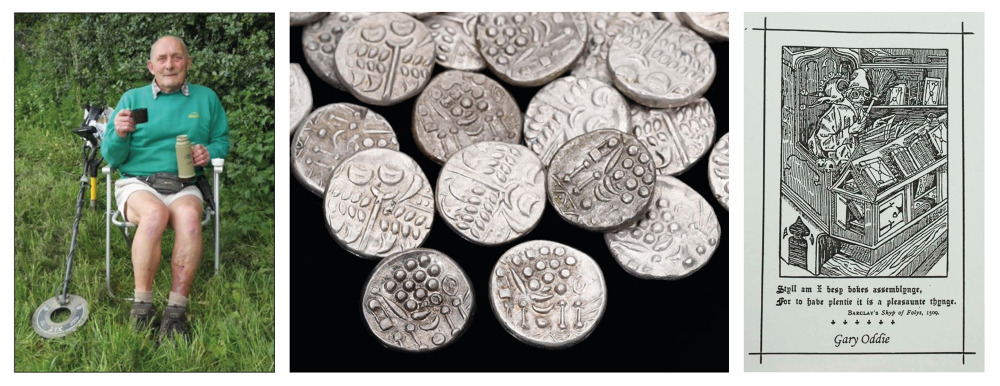
21 May 2025
CRANBORNE HOARD UNCOVERED AFTER THE CLEVEREST OF HUNCHES AND THE GARY ODDIE LIBRARY COMES UP FOR SALE
Lateral thinking played an important role in the discovery of the Cranborne Hoard of silver Staters from the Durotriges tribe, uncovered between 9 and 14 April 2022 in Dorset.
The thinker in question was detectorist John Hinchcliffe, who began by finding a Victorian penny buried by the gateway of a remote Dorset meadow. Retiring for lunch to a nearby tree, he started thinking about what else might be buried nearby.
He followed his hunch and continued digging, but rather than finding more pennies, something silver popped up. Without a doubt, he knew what he had found, a silver stater of the Durotrigan people, a Celtic tribe who lived in the area before Roman times.
His fellow detectorists offered their assistance and eventually 67 Staters were unearthed. The fence was wrapped in wire which confused the metal detector’s signals, but after removing the wire with permission from the landowner, no more coins were found.
It is known that the fence by the find spot was installed some time during the 1800s and this may be when the hoard was broken up. It would explain why many of the coins were found in clusters. If it as a single deposit, however, no vessel that might have contained it turned up.
Now aged 90 and having been a detectorist for 20 years by the time of the find, John must be one of the oldest detectorist ever to have discovered a hoard. To him the excitement was secondary to the questions the hoard raised: Who buried it? Why did they not return to claim it? Had something dreadful happened here? Unfortunately, these are questions we may never know the answers to.
The coins may have even been deposited as a ritual offering, suggesting that perhaps nothing untoward happened at all. Having been disclaimed as treasure after being assessed via the Portable Antiquities Scheme, it comes to auction here in its entirety, presenting an opportunity for a fascinating case study into this series of silver staters.
These coins were first struck in silver with a high gold content, known as ‘white gold’, but the precious metal content declined over time to silver and then to the alloy, billon. This fact can help date them and XRF analysis suggests that these were struck early the series, some having a little over 11% gold, some being as pure as 93% silver and some having a silver / copper ratio of approximately 70/30. In addition, the weights range significantly from 6.09g to 3.83g.
Dr John Talbot is currently working towards publishing a die-study of this fascinating series. Due to be published in 2-3 years, it will be similar to his fascinating book Made for Trade, published in 2017
“There is no place better to find Cranborne type staters, than in Cranborne itself,” said Noonans’ Coins specialist Alice Cullen.
Presented in 68 lots, the hoard has a combined high estimate of just under £22,000.
Other highlights include a selection of Olympic medals and an Irish Pattern Florin, of 1927, by P. Morbiducci estimated at £8,000-10,000.
The cover lot for the catalogue, a First Revolt, Shekel [Tetradrachm] of Judea yr 1 [66-7], is expected to fetch £5,000-6,000. The obverse carries the inscription ‘Shekel (of) Israel’ in Paleo-Hebrew script, surrounding a chalice with pearled rim and the date above. The reverse is inscribed ‘Jerusalem (the) holy’ [in Paleo-Hebrew script], around a stem with three pomegranates.
• The Numismatic Books from the Library of the late Gary Oddie (1965-2025) also promise to attract a great deal of interest. Offered across 98 lots, they represent the principal portion of the comprehensive library he formed that remained on his bookshelves at the time of his death.
Spanning titles published between 1653 and 2024, references here cover the principal British and British colonial series, and particularly British tokens of all periods.
Gary, a much-loved and respected collector and researcher, particularly of shillings but of many other series as well, was consulted by many of his peers and is acknowledged in several 21st century numismatic catalogues; many of those here include dedications to Gary by their authors.
Many (but by no means all) of the books here bear Gary’s bookplate, shown here, featuring a whimsical figure in a cloak and a stanza from Alexander Barclay’s 1509 satirical verse, Shyp of Folys, itself a translation of an original 1494 German text by Sebastian Brant.
Share This Page