Article
28 July 2025
HOW GRIMA AND HIS CONTEMPORARIES CHANGED THE FACE OF JEWELLERY DESIGN
Daring, colourful, exotic and certainly unexpected at the time, the innovative designs of post-War modernist jewellery found their apogee in Andrew Grima (1921-2007), the Anglo-Italian who grew up in London and opened his first store in Jermyn Street in 1966.
Awarded a Royal Warrant the same year, he proved popular with the Royal Family and designed dozens of pieces for them over the years.
One of the notable aspects of this latest jewellery outing for Noonans on 16 September is the wide selection of wonderful pieces by Grima and other post-war designers featuring in the catalogue.
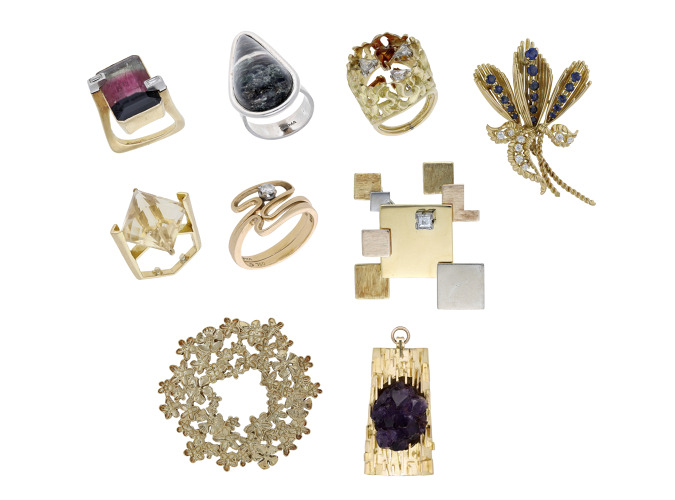
Leading the way is an 18ct gold watermelon tourmaline and diamond ring by Grima, dating to 1979. The rectangular step-cut tourmaline collet is set between asymmetric baguette-cut diamond shoulders to an angular shank. Signed ‘GRIMA’, and with the maker’s mark ‘AGLtd’ and London hallmark, the ring size is estimated at £3,000-4,000.
Another Grima creation is an 18ct white gold lodalite quartz dress ring, dating to 1973. An unusual stone, also known as ‘Garden quartz’, lodalite contains numerous mineral inclusions giving the appearance of a garden, or landscape within the stone. The ring’s large pear-shaped cabochon is collet set to a tapered band. Signed ‘GRIMA’, and with a London hallmark, the guide is £2,000-2,400.
John Donald (1928-2023) is seen by some as even more innovative than Grima – he certainly shared the limelight in 1960s and ’70s London and attracted Royal patronage, especially from Princess Margaret and The Queen Mother.
A contemporary with fellow designers Gerard Benney and Robert Welch, both of whom he shared digs with in Chelsea, he had to work as a model and in industrial design to make ends meet before he could establish himself as a jewellery designer.
This sale includes a ring with his signature ‘Crown’ mount. The 18ct gold and gem-set ring, dating to 1974, is of textured abstract design, the pierced mount with open circular bezel issuing triangular-cut citrine and diamond highlights. It carries the ‘JAD’ maker’s mark and London hallmark and hopes of £3,000-4,000.
Although he went on to redesign the crown for the Miss World competition in the early 1970s, and supply gems for use in the James Bond film Diamond Are Forever (1971), David Morris (b.1936) started as a humble apprentice goldsmith in Hatton Garden at the age of 15.
Founding his first store in Hatton Garden in 1962, David Morris later moved to Mayfair and now resides in New Bond Street, remaining a global luxury brand with stores as far as Hong Kong, Dubai and Baku.
This auction includes a sapphire and diamond brooch retailed by David Morris, in the form of a stylised floral bouquet, accented with graduated circular-cut sapphires and brilliant-cut diamonds. It carries the sponsor’s mark ‘DM’ and UK import mark. It is expected to fetch £2,000-3,000.
The bold geometric designs and talent of Gillian Packard (1938-97) didn’t just impress the public in the Swinging Sixties, they also led to her becoming the first female Freeman of The Worshipful Company of Goldsmiths.
Three lots in this sale illustrate Packard’s exceptional eye for design, starting with an 18ct gold citrine ring dating to 1967. The lozenge-shaped fancy-cut citrine is in a raised claw setting above an angular shank. It carries a London hallmark, and maker’s mark ‘GEP’. The estimate is £1,200-1,500.
A pair of interlocking whiplash design 18ct gold rings by Packard, dating to 1971, one set with a brilliant-cut diamond highlight, again shows off her creative flair. With maker’s mark ‘GEP’ and London hallmark, it is expected to fetch £1,200-1,500.
Exhibited in A Loan Exhibition of an Important Private Collection of British Designer Jewellery, held at Noonans Mayfair from 7 - 12 October, 2024, the third Packard piece dates to 1972. It is an 18ct gold and diamond brooch formed of overlapping polished and textured squares of vari-coloured gold, with a square-shaped diamond highlight. Bearing the maker’s mark and London hallmark, it measures 37mm wide and has expectations of £800-1,200.
Alongside Gerard Benney, Stuart Devlin (1931-2018) is arguably the greatest of the post-war gold and silversmiths working in London in the 1970s and ’80s. An Australian by birth, his tableware, works of art and jewellery combine traditional ideas (the ‘Surprise’ Easter eggs echoing those of Fabergé) with designs inspired by the Space Age.
An 18ct gold floral brooch dating to 1979 also appeared in the October 2024 loan exhibition at Noonans. The openwork circlet is formed of textured flowerheads, and it carries the maker’s mark ‘SD’ and London hallmark. It is estimated at £1,200-1,500.
The partnership of Frances Beck and Ernest Blyth emerged from the Andrew Grima workshop, and they set up on their own in Shepherd Market on the edge of Mayfair, concentrating on abstract designs that went on to win De Beers awards.
An 18ct gold and amethyst pendant by Beck & Blyth, dating to 1971, appears in this sale. It is of textured abstract design and centred with amethyst crystals. Complete with maker’s mark ‘B&B’ and London hallmark, it was also exhibited in the October 2024 loan exhibition at Noonans and is offered here with a guide of £1,000-1,500.
An 18ct gold ruby and diamond bracelet dating to 1962 by the Hatton Garden designer Ben Rosenfeld is sure to please. Formed of textured chevron-shaped leaves, with ruby and brilliant-cut diamond highlights, it is beautifully articulated. It carries the maker’s mark ‘BRLd’ and a London hallmark. At 22cm long, it is expected to fetch £6,000-8,000.
“This array of jewels demonstrates the high pitch of creativity among designers in London in the post-war era,” says Noonans’ head of Jewellery, Frances Noble. “Imaginations ran riot and these pieces, which were pushing the boundaries in the ’60s and ’70s, are still seen as inspiring today, and now attracting a whole new fan base.”
• Other major highlights in the sale include:
– A Sri Lankan sapphire and diamond necklace by Wempe, the sapphire weighing 21.80 carats. Bezel-set within a pavé diamond surround and leading to a curb-link neck chain with graduated brilliant-cut diamond highlights, signed ‘WEMPE’, it has a total diamond weight of approximately 9.50 carats and is 40.5cm in length. The estimate is £12,000-15,000.
– A stylish gold and gem-set evening bag, circa 1960s, purchased by the vendor’s grandfather from Vacheron Constantin. It is of woven design, with repeating chevron motif and ruby and diamond flowerhead clasp, opening to reveal a bevel-edged mirror. It has a guide of £8,000-12,000.
A diamond ring, the heart-shaped brilliant-cut diamond weighing 3.01carats, with GIA
certificate confirming D colour and SI1 clarity, carries an estimate of £14,000-16,000.
Share This Page