Article
28 July 2025
THE CRISIS THAT ENGULFED KING CAROL II OF ROMANIA AFTER HE RETURNED FROM EXILE
Central Europe faced a banking crisis in 1931 as private enterprise struggled to adapt to the realities of post-war economics, the global impact of the US Great Depression and its impact on Austria.
Liquidity became a problem, dousing the fires of economic activity and the spectre of insolvency shadowed the banks, which faced a run on their reserves, with defaults making matters even worse.
Post-war Romania had expanded its territory and needed investment to back growth. An updated banking system was part of that drive, with foreign backing and an open-door policy to investment leaving them vulnerable, especially considering the devalued leu.
The biggest bank at the time, Marmorosch Blank Bank, was caught in the middle of a storm as it became clear that its director, Aristide Blank, had misled potential rescuers about the value of its collateral – it was far more exposed than at first thought. This undermined the efforts to bail out the bank.
Complicating matters was Blank’s close friendship with King Carol II, who had returned from Parisian exile after three years in 1930. The king, whose Foundation held large deposits with the bank, is considered to have overreached himself in his attempts to rescue it and, with it, the reputation and career of his friend Blank.
Ultimately, intervention came, but at the cost of removing Blank from office.
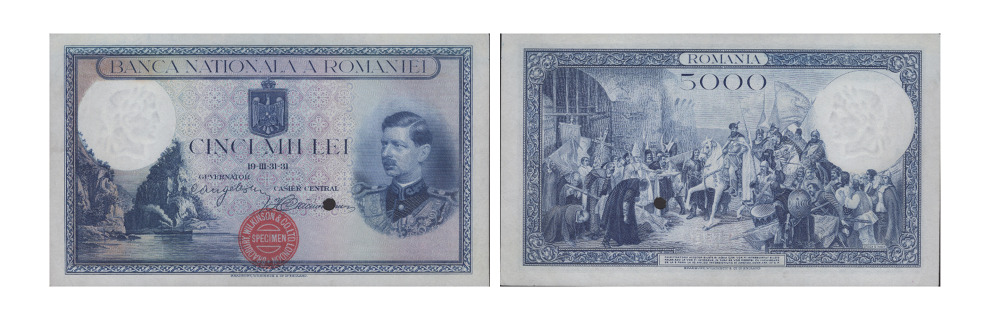
As this crisis emerged, the country’s national bank, established in 1880, produced an uncirculated specimen 5,000 Lei note that forms a highlight of Noonans’ 27 August auction.
Dated 31 March 1931, and with no serial number, the Banco Nationala a Romaniei note depicts a steamship in Danube Canyon at Cazane at left, with the bust of the king right. A rare note indeed, the estimate is £10,000-£15,000.
Share This Page