Article
28 July 2025
HOW RESOURCEFUL SCOTTISH BUSINESSES RESOLVED A CIRCULATION CRISIS
As the saying goes, necessity is the mother of invention. In the case of Scotland’s coin shortages of the 17th and 18th century, the solution not only solved the issue of circulation and payments, it also unwittingly created a fascinating collecting field.
Now the Giezelt Collection illustrates how that solution worked and who was involved.
Small change in copper and silver proved hard to come by because the Royal Mint failed to supply enough during the period. This created an opportunity for counterfeiters, creating further problems. The result was the creation of a variety of tokens to cope with the demands of the economy.
At the time, Spain’s huge reserves in silver from its mines in central and South America, together with its dominance in global trade, effectively made the Spanish silver dollar the international currency of choice.
They became known as Pieces of Eight because it was relatively commonplace for them to be cut up into eight pieces or ‘bits’ for change. In turn, this gave rise to the American term ‘two bits’, meaning a quarter of a dollar.
These dollars were widely available in Scotland and provided an ideal base to work from in the absence of alternatives. Thus, Scottish Merchant Dollars came into being.
As the lots in this sale illustrate, businesses such as factories short of cash to pay workers overstamped the dollars with their own marks, creating proprietary tokens, allowing them to be exchanged for goods and services locally.
Depending on which employer created their own token currency, surviving examples have differing degrees of rarity.
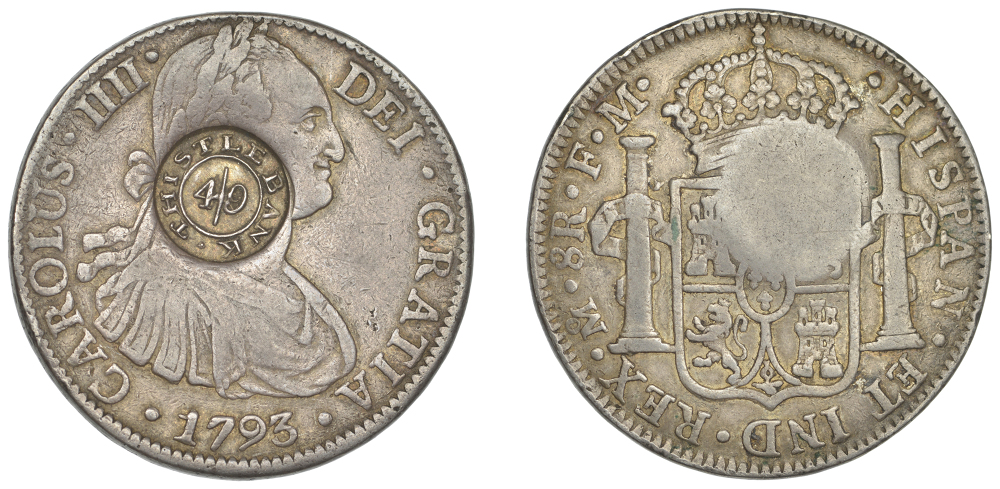
Among those lotted for this sale is a 1793 Mexico, Charles IIII 8 Reales countermarked for the Thistle Bank of Glasgow, Lanarkshire. The obverse countermark punch puts the value at 4 shillings and nine pence, while the reverse countermark remains blank, dating lot to soon after 1803 – later versions included a thistle in the reverse stamp.
The slightly distorted 9 in the obverse punch might have been caused by overpunching a lower value (4/6) to take account of rising bullion prices.
With a provenance to several prominent collections, it is in fine condition with an about very fine countermark, and toned, and carries an estimate of £1,500-2,000.
Share This Page