Article
19 August 2025
HE SURVIVED THE PERILS OF RORKE’S DRIFT BUT FACED HIS GREATEST PERIL WHILE IN BARRACKS
He served at in the Anglo-Zulu War of 1879 and was present at the Battle of Rorke’s Drift, which resulted in the award of 11 Victoria Crosses. But Private Thomas Lockhart’s military career was to end in tragedy after an unprovoked attack in his barracks back in England.
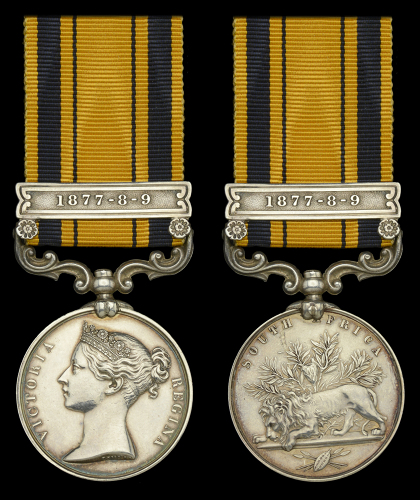
Now his South Africa 1877-79 medal, with 1 clasp, 1877-8-9, comes to auction in this sale with an estimate of £16,000-£20,000.
Lockhart was a member of “B” Company, 2nd Battalion, 24th Foot, under the command of Lieutenant Gonville Bromhead, when a British force of around 150 men successfully repelled between 3,000 and 4,000 Zulu at the Rorke’s Drift garrison on the night of 22nd-23rd January 1879.
He had joined the Regiment at Brecon, aged 19, on 10 February 1877, where he was assigned to the 2nd Battalion 12 days later. Serving at the Cape of Good Hope from 1 February 1878, he took part in the Kaffir War of that year and the Zulu War of 1879. His presence with “B” Company at the defence of Rorke’s Drift is confirmed on Chard’s roll, Bourne’s amended roll, and on Dunbar’s list.
Lockhart later served at Gibraltar and returned to England on 11 August 1880.
Having survived in the field, Lockhart was to face severe danger where he might have expected it least: at his Colchester barracks. In September 1881, he was attacked and badly beaten by other soldiers and received a blow on the head which caused him to suffer from epilepsy.
Following an examination by an invaliding board at Colchester on 30 January 1882, his epilepsy was found to be of a ‘permanent nature’, being “induced by an injury to the head received at the hands of soldiers of the Colchester Garrison who waylaid and maliciously ill-treated him without provocation and notice – causing a fracture of the orbit and displacement of certain other bones”.
Such was the severity of his disability, it was considered to “very seriously interfere with his powers of supporting himself”. He was consequently found unfit for further service and discharged on 18 February 1882, stating his intention to reside at 41 Butler Street, Manchester, the home of his mother. A second Injury Assessment Board held at the Royal Hospital, Chelsea, on 13 June 1882, confirmed the above medical findings.
The Court of Inquiry found the injury had taken place when absent when not on duty – he had broken out of barracks. He was awarded a pension of 6 pence per diem for 8 months. According to the Regimental Journal of 1938, Thomas Lockhart was then still alive.
The medal is being offered with research conducted by Peter Gaston for Messrs. Peter Ireland Ltd in July 1976, together with Registered envelope from Peter Ireland addressed to the late R. Hopkins with original Invoice for £1500, and some additional research including copied discharge papers and correspondence with a Lockhart descendant, all contained in a Peter Ireland stock file for this medal.
Share This Page