Article
20 August 2025
SNAPSHOTS OF HOW THE ECONOMY SURROUNDING GLASGOW COPED WITH THE SHORTAGE OF SILVER UNDER THE THREAT OF POST-REVOLUTIONARY FRANCE
It is at times of crisis that we innovate most effectively, and when silver and copper coinage was in short supply in the latter half of the 18th century, it was the growing centres of the early Industrial Revolution that stepped in.
Unable to rely on the Government for a ready supply of change, the mines and mills of Cornwall and the Midlands took matters into their own hands and started to issue copper tokens as replacements.
This did not solve the problem of silver, however, and the shortage led to the repurposing of foreign coins, notably those from Spain, whose imperial ambitions had enriched it from the mines of Spanish-America.
It was a complicated system because silver coins were normally traded at or close to their intrinsic value and this could often differ from the weight and fineness of the local currency that they were introduced to support.
Traders devised their own solution by stamping the coins with a value in local currency, normally pitched just above the intrinsic value of the metal. This system, begun in the 1780s and 1790s in the newly built mills in Cark-in-Cartmel, East Retford, Lanark and Rothesay amongst others, was even briefly (and unsuccessfully) adopted by the government.
“We can probably detect here the influence of the new industrialists like Richard Arkwright Jr., Robert Owen and particularly David Dale, men committed to improving the conditions of their workers by providing housing and education, and improving factory conditions,” said Noonans’ Coins Specialist Jim Brown.
The threat of invasion from France after the Revolution of the early 1790s added to the pressure on Britain’s coinage and by March 1797 the Treasury decided to tackle the problem by authorising the Bank of England to create emergency coinage using its large reserves of Spanish Dollars.
Initially stamped with the value of 4/6, within days it became clear that this was a mistake: that value was below the intrinsic bullion value of each coin, and so they had to be restamped at 4/9. It then became clear that it was easy to forge these coins and the whole scheme had to be abandoned within months. Two further attempts in 1799 and 1804 were short-lived and largely unsuccessful.
While the government scheme proved a failure, the private sector persisted in issuing coins for circulation, albeit in relatively small quantities and in a restricted geographical area – much of the issue taking place within 40 miles of Glasgow, which had access to a large supply of Spanish silver.
“The Clyde ports of Greenock and Port Glasgow as well as the nearby town of Paisley, could boast numerous issuers providing coinage for local trade,” said Jim Brown.
By the late 1820s, the financial crisis had passed, and the nation’s shopkeepers had sufficient coinage to meet their needs; the call went out for the public to exchange their counter-stamped Spanish dollars for shillings and sixpences.
The emergency system had lasted for around 35 years and in doing so had created a marvel of issues and varieties for today’s collectors, some of the finest and rarest accruing to the collection of Michael Gietzelt.
Offered here, they provide an insight into the range of commercial enterprises adopting the alternative coinage.
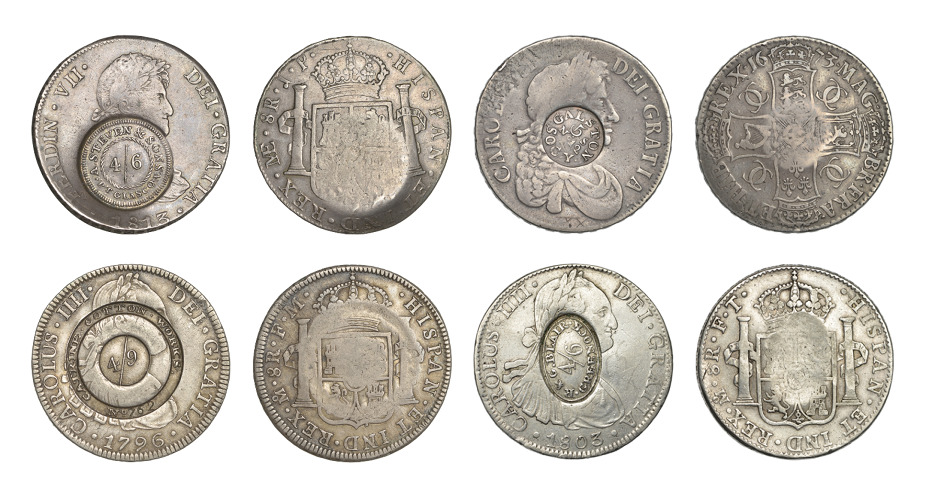
James Steven and Alexander Steven Jr. ran Alexander Steven & Sons, grocers and wine and spirit merchants in King Street and Church Street, Port Glasgow. They issued a counter-stamped 8 Reales of Ferdinand VII, of Peru, dated 1813.
This was the second issue from the business, the first coming from the brothers’ father, of which the only known specimen is in the British Museum.
In good fine condition, the second-issue coin in this sale has a good very fine and toned countermark. An extremely rare coin and one of very few specimens known, the estimate is £5,000-7,000.
Galston, a few miles to the east of Kilmarnock, was a centre for weaving and textile manufacture, but the workforce suffered poor working conditions and insecurity. Several benefit societies set up to cope with these challenges, including a Dollar Society in January 1812. Those with income would donate a Dollar (presumably Spanish) towards the provision of necessities for the very poor.
This sale includes a Galston Society, Charles II Crown, of 1673, the obverse countermarked galston socy 5s. The only known example of this mark on a Charles II crown, it comes with exceptional pedigree and is the earliest known host coin in the entire series, It is expected to fetch £4,000-£6,000.
Another pair of wine merchants, Robert and George Blair, ran their business from West Burn Street, Greenock from around 1820. They issued a counter-stamped 8 Reales of Charles IIII of Mexico, dating to 1803. In nearly very fine condition – the countermark better – it is one of only six known and has a guide of £4,000-6,000.
The Catrine Cotton Works was set up by Claud Alexander of Ballochmyle, the landowner, and Glasgow merchant David Dale in 1787. Various mills and works were built over the next few years powered by water from the River Ayr. Workers were housed in a purpose-built village, similar to Dale’s development at New Lanark where conditions were unusually good for the period. The mills had gas lighting installed in 1814, four years before gas appeared on the streets of either Glasgow or London.
The Catrine Works also introduced a counter-stamped coinage and an example here – also an 8 Reales of Charles IIII but dated 1796 – forms another highlight, with an estimate of £4,000-6,000.
Share This Page