Article
13 September 2025
QUEEN ANNE FIVE GUINEAS SOARS TO £80,000 AND THE WHITWELL HOARD EXCEEDS EXPECTATIONS
The Whitwell Stater Hoard certainly made its mark in this auction, all five lots doing well. Discovered by detectorists David and Judy Haigh in two parts, four years apart, it is the largest hoard of Corieltauvian staters found in Derbyshire.
The five staters of the Corieltauvi, a Celtic tribe occupying the East Midlands before the Roman occupation, made a combined £6,050 against a total high estimate of £5,100.
As expected, two gold staters, each with a devolved head of Apollo right, in the form of a wreath, cloak and crescents, led the way, taking £1,600 against hopes of £800-1,200. The reverse had a disarticulated horse left, charioteer’s arms and pellets above, and solar pellet below, with coffee bean motif behind, two pellets before, and zigzag and pellet pattern between two exergual lines below. One was centrally struck on a slightly oval flan, and well-centred, toned and good very fine; the other was struck on a flan of lovely light yellowish gold, as also well-centred and good very fine.
Also among the detectorist finds, an extremely rare Eadgar (959-975) Penny found in Thetford in 2023 left its 3,000-£4,000 estimate far behind to sell for £9,000,
A King John (1199-1216), mule Penny, struck at Lincoln by Ricard, soared to 12 times its upper estimate at £1,800. It was very fine, prettily toned and very rare.
Classical coins included a gold stater for Alexander the Great, struck at Tarsus, c.333-327, showing the head of Athena right, wearing a crested Corinthian helmet, that had been expected to sell for £1,000-1,500, but went on to make £7,500.
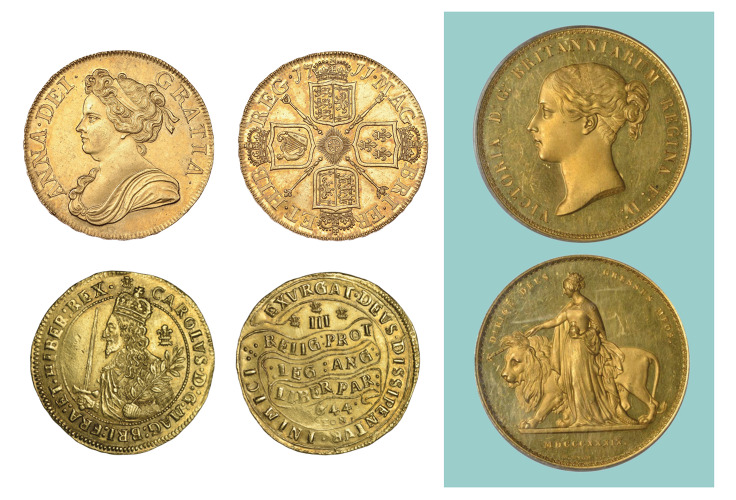
Going considerably over its upper estimate of £60,000 to sell at £80,000, The Queen Anne (1702-1714) Five Guineas of 1711, showed the queen’s crowned bust right, surrounded by ANNA DEI GRATIA, and the royal coats of arms for England, Ireland and France to the reverse. With the most trifling hairlines, but otherwise in better than extremely fine condition and well struck up, this was a rare example of this fine coin.
A Victoria (1837-1901) Proof ‘Gothic’ Crown, of 1847, doubled high estimate at £20,000.
Share This Page