Article
2 October 2025
NO ORDINARY LIFE, NO ORDINARY COLLECTOR
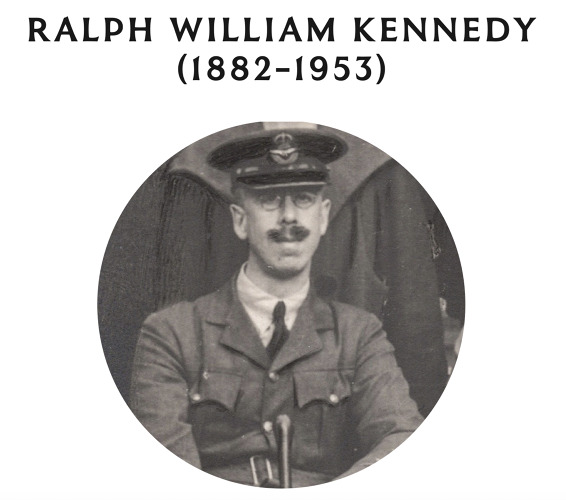
Ralph Kennedy (1882-1953) may have been constrained as an ‘ordinary collector’ by the lack of a fortune to pursue his interests, but he did not lack imagination or determination.
He also encountered a series of notable figures thanks to his parents’ standing as the Royal Society’s ‘housekeepers’ and his consequent birth and upbringing at Burlington House, Piccadilly. Among them was the astronomer Sir William Huggins (1824-1910) and Lord Lister (1827-1912), the world-famous surgeon, to whom he was introduced by his father.
“Lister patted him on the head and, fumbling in his pocket, pressed a sovereign into his hand. What the young Ralph did with it he could not remember, but he thought it was taken away from him by his father and ‘banked’,” says Noonans’ Special Projects Director, Peter Preston-Morley.
Kennedy also knew Sir Hiram Maxim (1840-1916), inventor of the revolutionary machine gun that transformed warfare, and visited his factory in Pimlico several times.
At the age of 14, he witnessed the Emancipation Run, the first London-to-Brighton motoring event held on Saturday 14 November 1896, walking in the rain to Northumberland Avenue to see the start outside the Metropole Hotel, and later writing about the repeal of the law which required a man with a red flag to walk in front of any motorised carriage.
His career included stints as an assistant in the then newly established Wellcome Chemical Research Laboratories in Smithfields; private assistant to Revd. Dr T.C. Porter (†1933), Senior Science Master at Eton College; sub-editor of the newly-named Electrical Industries trade paper; and an examiner in the Aeronautical Inspection Department at the British Aero Varnish Co, Hebburn-on-Tyne, where he rose to become Assistant Inspector on 1 April 1917, and was gazetted as a Temporary Hon. Lieutenant, General Service.
Although later transferred to the Royal Flying Corps as a Flying Officer, he never flew, but eventually oversaw the production processes for all non-metallic materials for aircraft construction – fabric, parachute silk, timber, glue, dope, paint, fuel and rubber among them.
After the war, he became editor of The Electrical Contractor and was one of the first amateurs in England to hold a Post Office ‘experimental licence’, with a large receiving aerial in his garden in Wimbledon Park.
During the General Strike in 1926 he served as a special constable, based in Wandsworth.
If Kennedy’s career was eclectic, so were his collecting interests, which numbered coins, commemorative medals and stamps. He disliked the designs brought in under George VI, instead recalling the halcyon days of Victoria. “Never before, or since, have we been provided with anything to equal the superb artist-craftsmanship of her ‘Gothic’ coinage – the work of that greatest of all British medallists, William Wyon, R.A.”
“In all likelihood Ralph began his serious interest in numismatics in the 1920s although, with one
exception (Lot 2 in this auction, bought from Spink in 1937), he kept no surviving record of his medallic acquisitions,” says Peter Preston-Morley. “As a fan of the Wyons, it is hardly surprising that his cabinets held several specimens of this dynasty’s work, along with representative commemoratives of events from the time of Charles I to the end of the 19th century.”
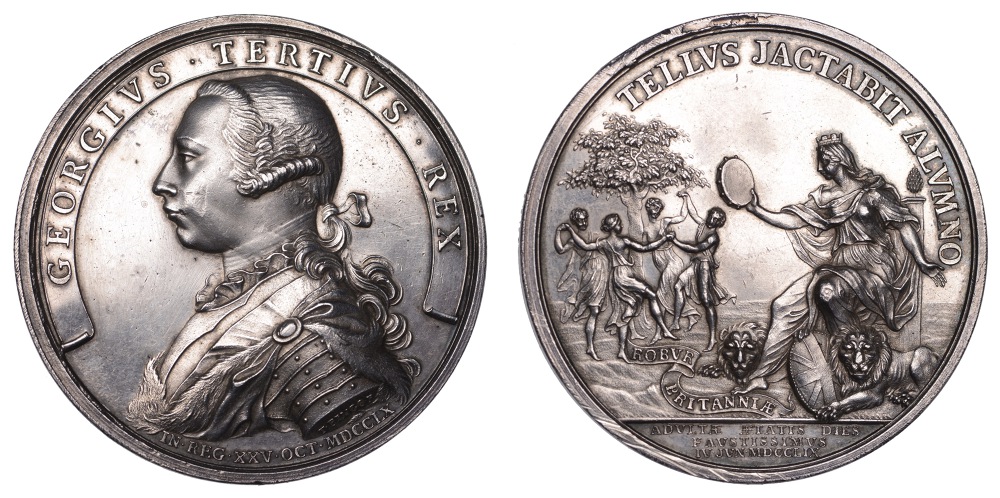
Among the highlights in this sale is a silver medal by the die engraver and medallist Thomas Pingo (1714-74) to mark the Majority of the Prince of Wales, 1759, later George III (he turned 21 on 4 June that year). The Prince’s bust is depicted armoured and draped left, while the reverse shows Tellus seated left between two lions, holding a tambourine, with four females dancing around oak tree in background to left. The 55mm diameter medal has minor rim marks, but is otherwise about extremely fine and rare, and comes with a guide of £900-1,200.
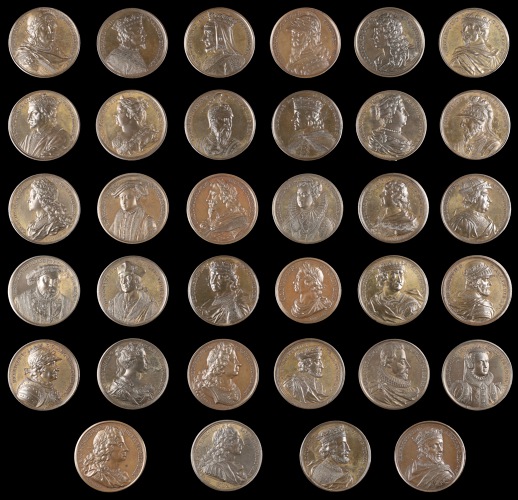
A complete Kings and Queens of England set of 34 copper medals by the Geneva engraver and medallist Jean Dassier (1676-1763), featuring every monarch from William I to George II, dates to 1731. It includes a slightly smaller (38mm) medal for Cromwell, with all others at 41mm or 40mm. This is an extremely fine and attractive, original matching set, and is also estimated at £900-1,200.
Share This Page