Article
26 October 2025
CLUES TO WHY AND WHEN THE CHILFROME HOARD WAS CONCEALED
The condition of a single coin, together with the lack of anything issued later, points to a concealment date of around AD 50 for a hoard discovered in Dorset in March 2021.
Named the Chilfrome Hoard, it is also notable because unlike most recovered Romano-British hoards, it lay for 2,000 years undisturbed by agricultural activity and emerged in a single tight nucleated group.
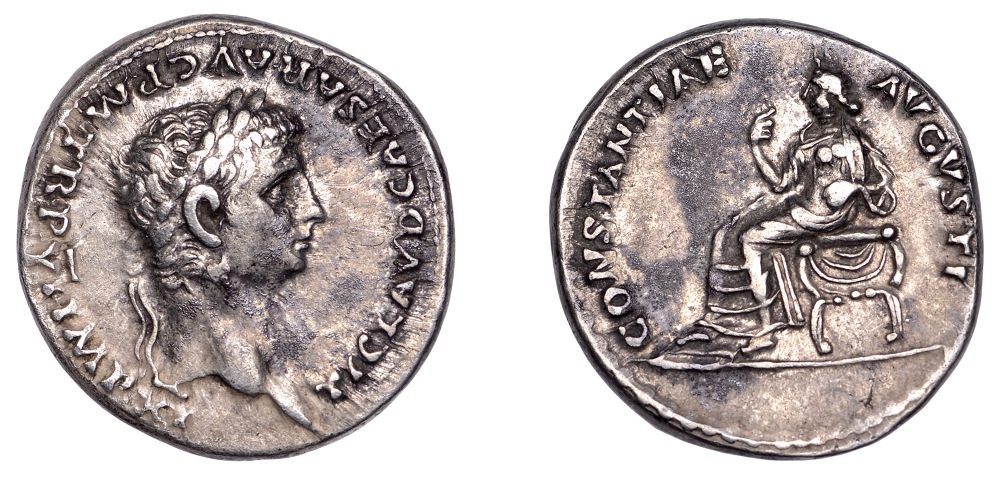
The single coin in question was a Denarius of Claudius (41-54 AD), struck at Lugdunum (modern-day Lyon) in 46-7. The lack of damage or wear points to it being hidden with the hoard relatively soon after being struck. The estimate is £600-800.
The burial of the hoard would have come not long after the Legio II Augusta, commanded by Titus Flavius Vespasianus, arrived in Britain as one of four legions given the task of subduing the island and securing for Claudius the triumph that his imperial reputation so desperately needed.
The legion landed at Richborough, north of Dover, and headed west to Dorset, where in AD 43-44 it engaged with the Durotriges in a major campaign which involved in the construction of fortresses and the occupation of Iron Age hill forts.
The Chilfrome hoard was deposited right at the heart of this activity, lying almost equidistant between the important hill forts of Maiden Castle and Waddon Hill (about 12-14 km as the crow flies), and also close to the Roman road which ran from Dorchester up to the Mendip lead
mines which the Legio II Augusta began to exploit in the late 40s.
“This hoard is typical in containing a preponderance of worn Republican issues,” said Noonans Head of Coins Bradley Hopper. “These serve as a useful reminder of two monetary constants; that coins could, and often did, circulate for centuries; and that current issues often formed a small proportion of the total circulating medium.”
Although the identity of the person who concealed the hoard can never be known, certain clues point to its possible origin: the complete absence of any native specie and relatively high proportion of recent Imperial issues, together with its location, make it plausible that it represents an army stipendium, or pay packet.
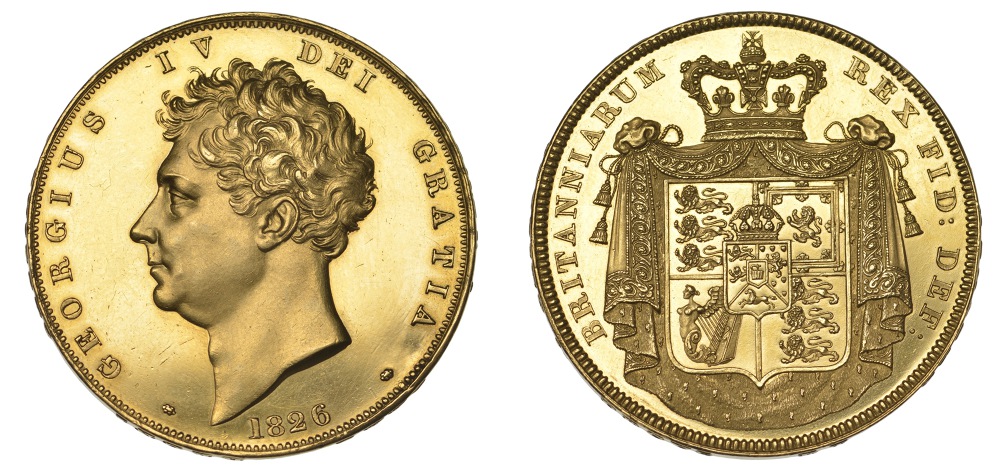
Leading highlights in this sale are much more recent, starting with a George IV (1820-1830), Proof Five Pounds, of 1826. Its condition showing an area of smoothing, but otherwise lustrous and sharp, and about as struck, it is guided at £15,000-18,000.
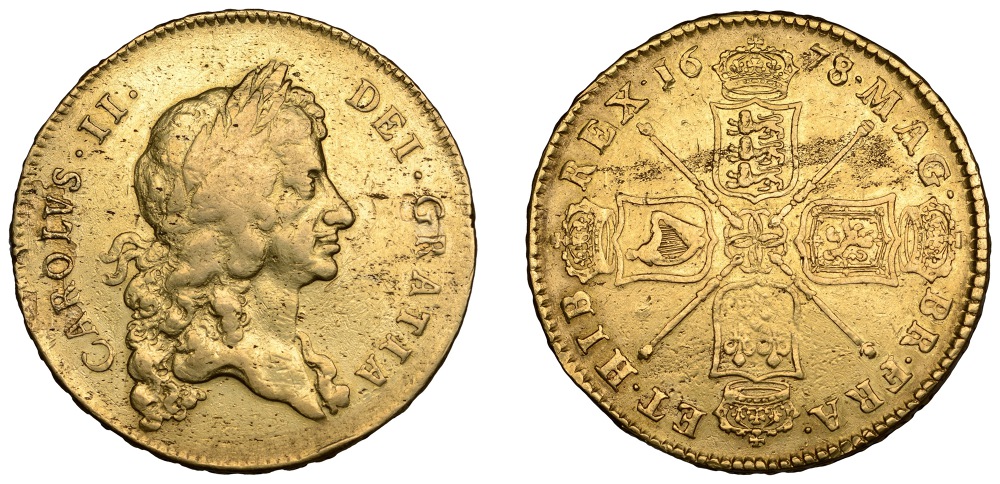
A Charles II (1660-1685) Five Guineas, dating to 1678/7, displays some roughness in the reverse field, but is otherwise good fine and very rare, and is expected to fetch £6,000-8,000.
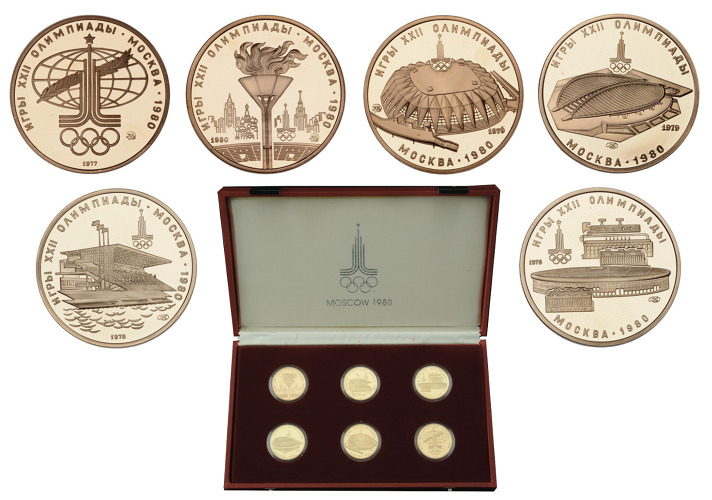
Condition is again an outstanding feature of a Moscow Olympics Presentation Set of Proof 100 Roubles, 1977-80. All six coins are as struck, and they come in their original red case of issue accompanied by a Certificate of Authenticity. The estimate is £10,000-12,000.
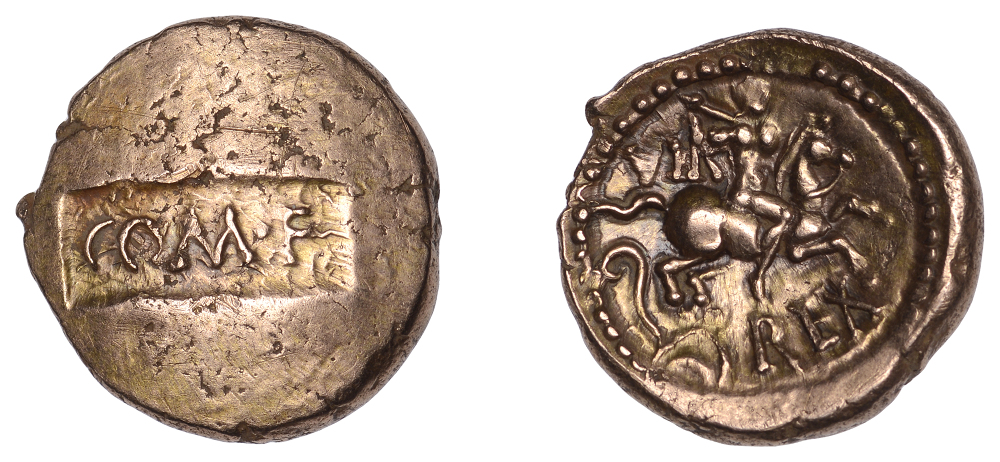
Notable, too, in this sale are coins from the Auckland Collection, which passed through these rooms five years ago. Among the highlights is a c.AD 10-40 gold stater class 4 [Warrior Rex type] of Verica, last king of the Atrebates, a Belgic tribe that occupied part of the Thames Valley and West Sussex midway through the first century and co-operated with the Romans.
The obverse is stamped com f in a tablet, while the reverse shows a warrior riding a horse right, while holding a spear, with the words vir and lituus behind, and rex below. With some trifling marks, this is an otherwise better than very fine coin with the reverse well centred, and the estimate is £900-1,200.
A Penny of Edward the Confessor (1042-1066) from the Lockett and E. Elmore Jones Collections also features here. Of the Expanding Cross type, this Heavy issue from Canterbury is inscribed Eadweard, edperd on cntperee. A little crimped, but otherwise in good very fine condition with a beautiful iridescent tone, it is very rare and pitched at £400-500.
Share This Page