Article
26 October 2025
A COLLECTION BUILT OVER 65 YEARS AND COVERING FOUR CENTURIES
The collection which supplies this sale was formed across the generations of an English family, largely from 1870 to 1935, with very few or no acquisitions coming after the Second World War. Resting in Noonans’ vaults awaiting this moment for 25 years, it was catalogued originally by the late Michael Sharp back in 2007.
As the title of the sale attests, the collection spans a period that begins with the reign of Edward I (1272-1307) and ends after the restoration as the reign of Charles II gets underway.
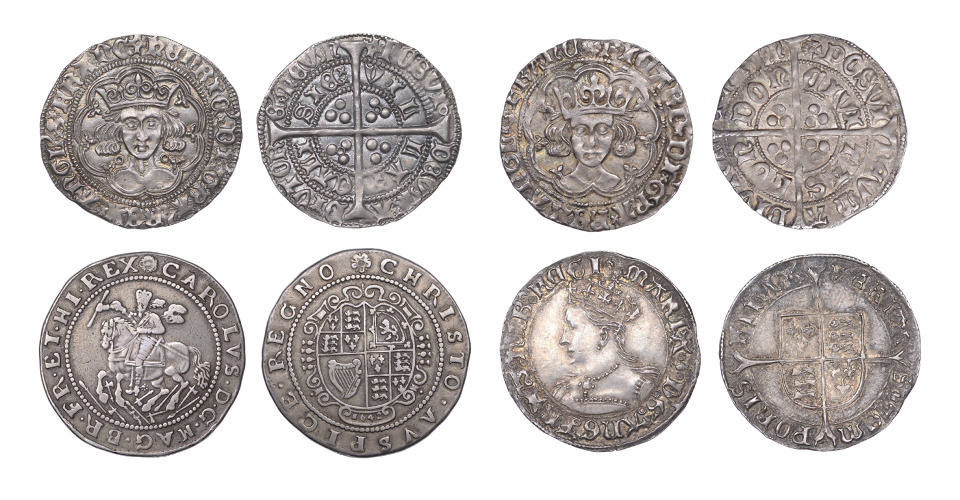
A spread of highlights across 200 years or so sheds light on the quality on offer, starting with an ‘annulet’ issue groat from the first reign of Henry VI (First reign, 1422-1461). Struck at Calais, the obverse shows the bust of the king while the reverse has the cross with annulets in the second and third quarters. Although there is a touch of weakness in some of the legends, the portrait is excellent and the coin attractively toned. It is expected to fetch £400-500.
A rare groat of Richard III (1483-1485), issued in London, is in good very fine condition and attractively toned. It has a guide of £1,500-2,000.
Particularly striking is the portrait of the queen on a groat of Mary (1553-1554), which includes the pomegranate, symbol of the house of Aragon, from which her mother Catherine hailed. About extremely and attractively toned, it carries hopes of £1,000-1,500.
The Halfcrown of Charles I (1625-1649), struck at the Exeter mint in 1642, shows the king holding his marshal’s baton aloft, galloping over the arms of his enemies. The obverse carries the Truro rose, while the reverse carries the Exeter rose above a scroll-garnished oval shield with lion’s paws at the sides and date in cartouche below. With a tiny rim knock on the obverse at 5 o’clock, the coin is in otherwise good fine condition and very rare. The estimate is £3,000-5,000.
Share This Page