Article
15 November 2025
HOW A 1993 HOLIDAY TRIP CHANGED EVERYTHING
Laurence Pope began collecting paper money in January 1992, but it was while holidaying the following year that he found his true métier – in Portugal.
“I fell in love with her beautiful banknotes. Later I discovered that she had issued paper money for eight of her colonies and began collecting everything I could from her overseas bank, the Banco Nacional Ultramarino.”
As he goes on to explain, most of this bank’s notes were printed by Bradbury Wilkinson, which had a unique system of recording serial number and signature runs in their archive.
“As I grew fascinated by the printing process, I avidly acquired many of these specimens, proofs and archival photographs and began detailed research, which much later led to collaboration with others to author the recently published catalogue, The Portuguese African Paper Money of the Banco Nacional Ultramarino.
Part sponsored by the third party grading company PMG, it now forms a useful reference work, especially as PMG agreed to add the catalogue’s numerous sub-references in green print in the lower right corners of the holder strips.
Pope’s collection includes numerous complete runs of printer’s archival specimens and, as only two copies of these were ever printed, this sale of more than 420 lots from the collection provides a unique opportunity to acquire the complete record of many note issues.
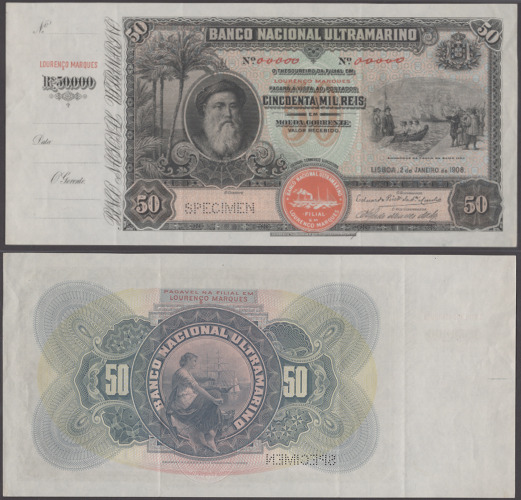
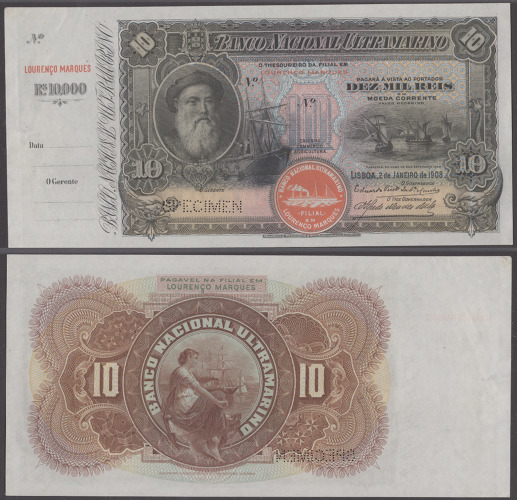
Highlights begin with two Banco Nacional Ultramarino, Mozambique specimen notes, one for 10 Mil Reis, the other for 50 Mil Reis. Both carry the Alfredo Mendes da Silva signature, and the ship seal Type I, are perforated SPECIMEN and dated 2 January 1908.
The first has no serial number and is a choice uncirculated and extremely rare specimen note, it is estimated at £1,000-1,500. At the same guide, the 50 Mi Reis is about uncirculated, extremely rare and an impressive early specimen.
Share This Page