Article
5 December 2025
GAUGING THE IMPACT OF THE RAILWAY OVER 200 YEARS
Two hundred years after the Stockton & Darlington Railway first hauled coal wagons along its tracks, this auction provides a wealth of evidence as to the rich railway heritage that has developed since. If the railways were a huge advance in transport, they also created a whole new world of collecting.
The selection here includes medals struck for the owners of the railways, and others to commemorate Royal occasions, the opening of lines, and administrative bodies, as well as for the workers and the unions that were to become such a salient feature of the industry.
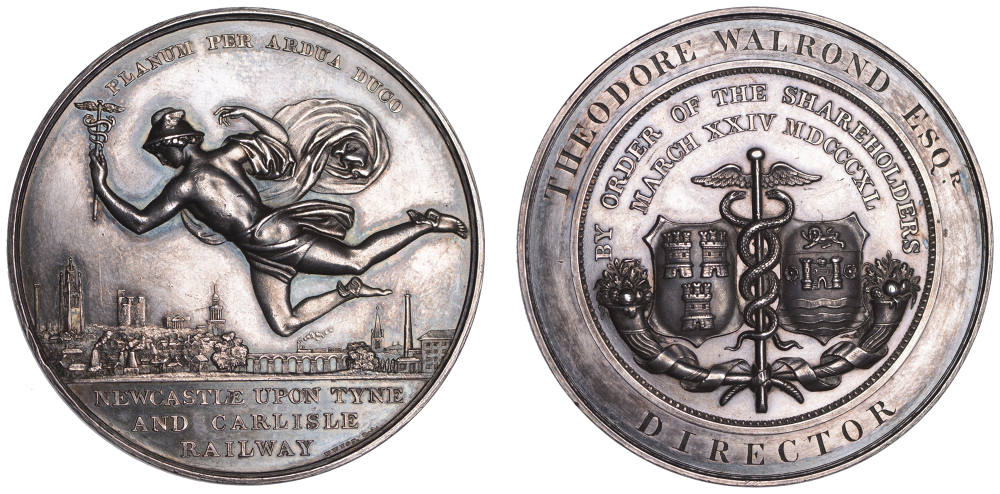
One of the earliest is a silver medal struck for the directors’ and shareholders of the Newcastle-upon-Tyne to Carlisle Railway Company in 1840. The company had been operational since 1838, but ran its first Sunday excursion for over 300 passengers in 1840. Designed by W. Wyon, the obverse depicts Mercury flying left over Newcastle and Carlisle skylines, with a train travelling over a viaduct between the two. The reverse features the company arms, and an inscription in two lines above, and the name of the director being honoured (Theodore Walrond Esq., Director). A superb example with a deep cabinet tone, and in about extremely fine and very rare condition, the estimate is £800-1,000.
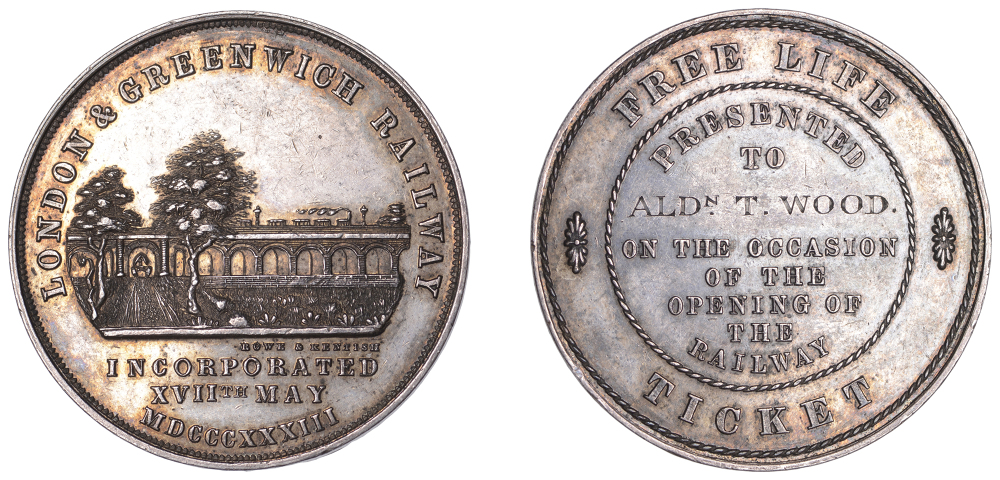
Even earlier, at 1833, is a silver presentation ticket or medal by Rowe & Kentish to mark the opening of the London and Greenwich Railway. Depicting trains in motion across and under a viaduct, with trees in the foreground, the reverse inscription in eight lines within inner circle declares the token to be a free life ticket for inscribed recipient, Alderman T. Wood. Toned and extremely fine, it has guide of £100-120.
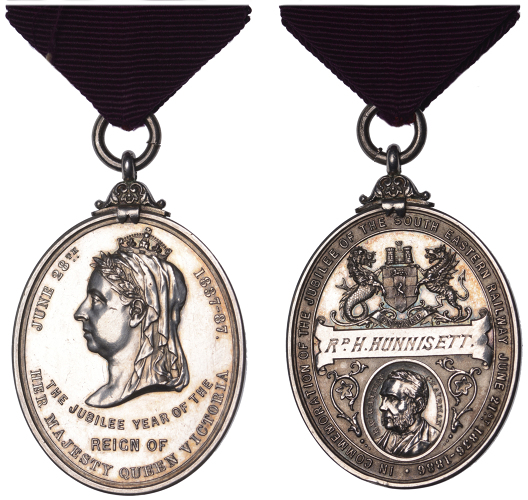
More than 50 years later, an oval silver medal was struck to celebrate both the Golden Jubilee of Queen Victoria and the South Eastern Railway, 1886. Created by Pinches, the obverse shows a veiled bust of Victoria left, with the reverse depicting a portrait of the railway entrepreneur E.W. Watkin, who became chairman of nine different railway companies. Inscribed with the name Rd. H. Hunnisett below the company arms, it is looped at 12 o’clock and suspended on a maroon ribbon. In good extremely fine condition, the asking price is £100-120.
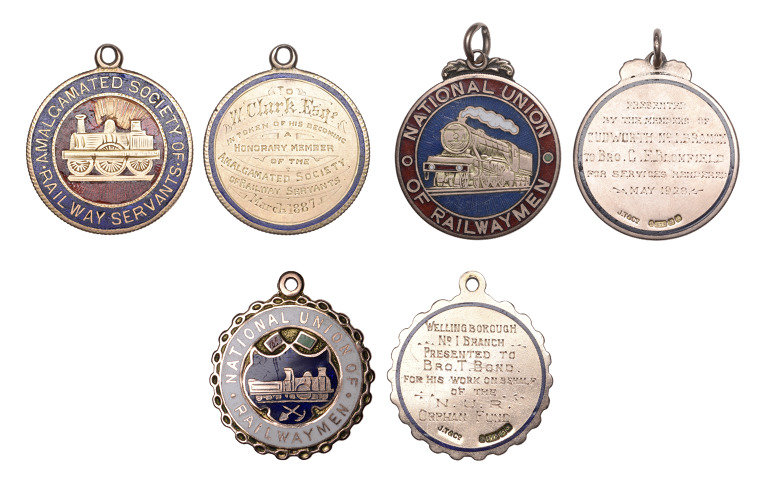
Enamelled and coloured medals relating to the railway unions can make substantially more, as three examples here show. The first is a 9ct gold and enamel medal for the Amalgamated Society of Railway Servants, dating to 1887. Unsigned, it shows a steam locomotive left on a red enamel field, surrounded by a blue border. The reverse named for W. Clark Esqr, reveals it to have been engraved for him becoming an Honorary Member of Society of Railway Servants. Looped at 12 o’clock for suspension, and in good very fine condition, it is expected to fetch £400-500.
A National Union of Railwaymen 9ct gold and enamel medal by John Taylor & Co., and dated May 1926, shows a three-quarter length locomotive in full steam left on a blue enamel field, inside a red border. The reverse commemorates the service to the union of Bro. G. E. Blomfield, as presented by the Members of Cudworth No.1 Branch. Looped at 12 o’clock for suspension, and in good very fine condition, it also has hopes of £400-500.
A c.1920s National Union of Railwaymen 9ct gold and enamel medal, also by John Taylor & Co., is another commemorative presentation, this time to Bro. T. Bond from Wellingborough No.1 Branch for his work on behalf of the N. U. R. Orphan Fund. Showing a steam locomotive right on a blue enamel field, with red and green signal flags above, and a white border. Also Looped at 12 o’clock for suspension, it has some marks on the reverse, but in very fine condition, with the enamelling better. The estimate is £300-400.
Share This Page