Article
8 January 2026
EXTRAORDINARY HEROES AND EXTRAORDINARY TALES – NO WONDER CAMPAIGN MEDALS ATTRACT SUCH A KEEN FOLLOWING
The Pirate of Basra, a Blitz George Cross, Judy the heroine Boxer, and the Military Medal won by a 19-year-old during The Falklands War.
All of these singular characters were responsible for highlights at Noonans in 2025, which sold for extraordinary prices and showed why the field of Campaign medals collecting and awards attracts such an ardent following.
Two of these exceptional consignments appeared in the same sale on 11 March. Both were from the outstanding Naval Medals Collection of the late Jason Pilalas, the first part of which sold for just over £1.8 million hammer in July 2024.
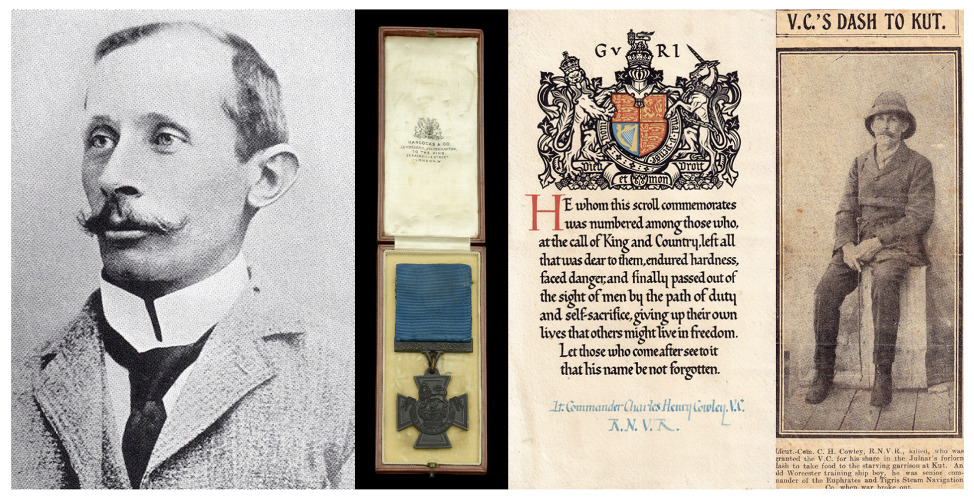
The first was the posthumous Victoria Cross from the Great War presented to 44-year-old Lieutenant-Commander Charles Henry Cowley of the Royal Naval Volunteer Reserve – the “Pirate of Basra”.
As a commercial steamer captain and then a Royal Navy ship’s captain, the fluent Arabic speaker was to become such a thorn in the side of the Ottoman Turks as he traversed the major rivers of Persia during the First World War that they sentenced him to death in absentia and dubbed him the Pirate of Basra – resulting in him flying the skull and crossbones whenever he returned to Basra. The Turks even sent an assassin to kill him in his bed. The assassin failed, but the Turks would succeed in killing Cowley in the end.
In August 1914, as commander of the steamer Mejidieh, Cowley was sent by his employers from Basra to Baghdad to evacuate all British nationals who wished to leave. His command having then been formally requisitioned by the Royal Navy, he went on to play a critical role in carrying troops back and forth on the Euphrates and Tigris.
In August 1915, in an effort to protect Cowley in the event of capture, he was appointed to the temporary rank of Lieutenant-Commander in the “Wavy Navy”, and duly borne on the books of H.M.S. Espiegle for service with river steamers in Mesopotamia. It was at this point that the Turks dispatched their assassin to kill him on the Mejidieh. By chance, however, the knife attack one night in November 1915 seriously wounded Captain Wingate, who was occupying the bed normally used by Cowley.
When Cowley set out on the mission that culminated in his Victoria Cross, he must have been well aware of just how the odds were stacked against him.
Charged with taking 270 tons of supplies on the Julnar to the Kut garrison, Cowley and a hand-picked crew of volunteers – all unmarried men in recognition of the dangers they faced – set off from Falahiyah at 8 p.m. on 24 April 1916, covered by artillery and machine-gun fire so as to distract the enemy.
Despite this she was shelled on her passage up the river and by 1 a.m. the next day, General Townshend reported she had not arrived, and that at midnight a burst of heavy firing had been heard at Magasis, some eight and a half miles from Kut by river, which had suddenly ceased.
There could be but little doubt that the enterprise had failed, and the next day the Air Service reported the Julnar in the hands of the Turks at Magasis. Cowley, and his expedition commander Lieutenant H. O. B. Firman, R.N., were reported killed. The surviving crew were made prisoners of war.
Later investigations revealed that he Cowley been shot in cold blood while a prisoner. With such a dramatic tale, involving this unique figure, the £200,000 hammer price can be seen as fully justified.
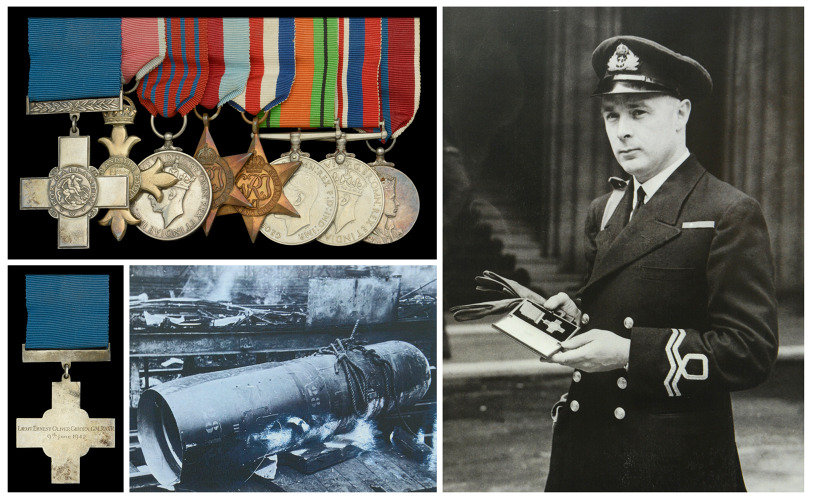
The second highlight from the Jason Pilalas Collection to reach a six-figure sum was the unique Second War ‘London Blitz’ George Cross, O.B.E., George Medal group of eight awarded to Acting Lieutenant-Commander E. O. ‘Mick’ Gidden, Royal Naval Volunteer Reserve – ‘the man who saved Charing Cross’. It sold for £100,000.
As Nimrod Dix, Deputy Chairman of Noonans and Director of the Medal Department explained before the sale: “Gidden, who was born in Hampstead, was a master of mine disposal operations and the first man to be awarded both the George Cross and George Medal, his gallantry in dealing with a parachute mine on Hungerford Bridge, outside Charing Cross Station, in April 1941, was among the great epics of the war: in a six hour operation, in which he was unable to apply a safety device for much of that time, he had to resort to using a hammer and chisel.”
Lieutenant Gidden had arrived on Hungerford Bridge shortly after dawn and found the mine lying across a live electric wire at the foot of the main signal gantry, with the bomb fuse and primer release mechanism facing downwards. Before operations of any kind could be commenced the mine had to be turned to get at the bomb fuse.
Turning the mine was likely to detonate it, with disastrous results for railway communications and important buildings. In order, therefore, to be able to control the operation with accuracy, Lieutenant Gidden stood only 50 yards from the mine. He then attempted to remove the remains of the screw threaded ring (which holds the fuse in place) with a hammer and chisel. At the first blow the clockwork in the fuse started to run.
Lieutenant Gidden, who had kept his head close to the fuse, heard the ticking, and made off as best he could, but as it was necessary to jump from sleeper to sleeper, with a 10-foot drop below, there was little chance of escape. As it happened the “gag” held, and Gidden returned with a drill. He succeeded in removing the ring, but then found it necessary to prise the fuse out with a chisel. This he successfully did despite its dangerous condition. This operation took six hours to complete.
“Just eight men have been awarded the combination of the G.C. and G.M.; the addition of the O.B.E. makes this a unique combination of awards,” said Nimrod Dix.
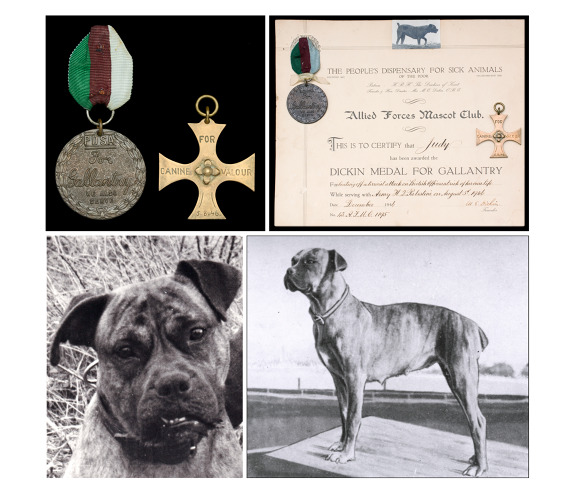
Noonans set a new auction record at £140,000 for a Dickin Medal in October 2022. On 11 June another of these ‘Animals’ V.C.’ made £22,000.
The recipient had been Judy, a boxer bitch, who thwarted a night-time terrorist attack on British officers in Palestine, during which she protected and undoubtedly saved the life of her severely wounded brother Punch, at risk to her own life.
Judy and Punch belonged to Lieutenant-Colonel A. H. K. Campbell, the Deputy Judge Advocate General of the Jerusalem Military Court, and Lieutenant-Colonel H. G. G. Niven, the Adjutant General, who shared a house in a Jerusalem suburb.
On the evening of 5 August 1946, at about half past ten, the two officers were relaxing at home with their two dogs. The front door was open. All was quiet and they had no suspicion that any danger was threatening them.
Suddenly the dogs became aware of intruders within the compound. Racing into the darkness and barking furiously, they were met with a burst of sub-machine gun fire from one or possibly two terrorists within the barbed wire protected perimeter. Apparently, the intruders were stealthily creeping towards the house with the intent to kill the officers. The barking and gunfire, alerted the officers, thwarted the attack and thus saved their lives.
Police and military parties arrived and, following a trail of blood, found the seriously wounded Punch. He had been hit four times and lay in a pool of blood, apparently dying. His sister, Judy, also covered in blood, stood protectively over him.
Punch was badly wounded but recovered. Judy was covered in blood, but was found to be unwounded except for a long bullet graze to her back. It was obvious that she must have covered Punch protectively with her body when he fell, and having stemmed the flow was smothered with his blood. The following morning nine expended rounds were found in the garden.
Both dogs made a full recovery from their wounds, and for their great gallantry in protecting their masters were both awarded the P.D.S.A. Dickin Medal. Returning to the U.K., and after undergoing quarantine, both dogs were presented with their Dickin Medals during the Royal Tournament at Olympia on 14 June, 1947.
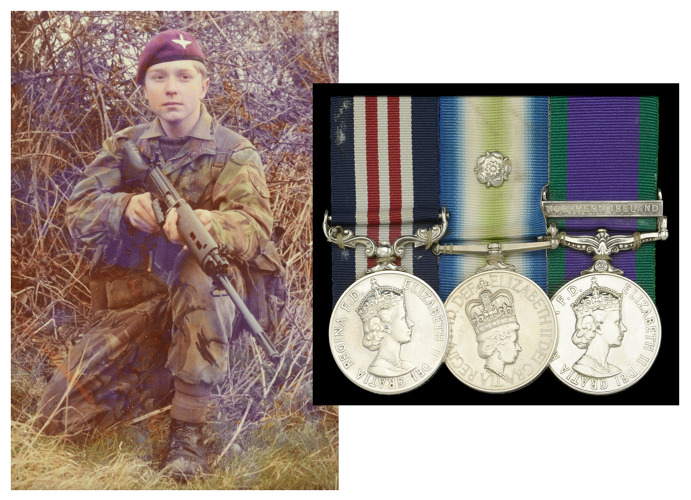
One of the youngest recipients of a significant Campaign medal in recent times must be Corporal B. J. ‘Baz’ Grayling, who was just 19 years old when he made a frontal charge on an Argentine machine-gun post during the Battle of Goose Green in The Falklands War.
Grayling, of 11 Platoon, ‘D’ Company, 2nd Battalion, The Parachute Regiment made the assault in company with his best friend, Corporal ‘Gaz’ Bingley. While Grayling was hit at close range in his water bottle, shattering his hip, Bingley was cut down by the enemy fire and did not survive.
What made their actions especially heroic was that they launched the assault without knowing quite where the enemy machine-guns were. They then found themselves virtually overlooking the position and the two of them took the five-strong position between them.
Of the epic frontal assault on Coronation Point in the dark hours of May 28, the London Gazette of October 8 recorded: “Private Grayling and Lance Corporal Bingley moved to a position where they thought they could put down suppressive fire. Instead, they found themselves within ten metres of the enemy. With a total disregard for their own safety they immediately attacked and destroyed the enemy machine gun position. Lance Corporal Bingley was killed, and Private Grayling continued and successfully pressed home the assault.”
Lance-Corporal ‘Bill’ Bentley M.M., 2 Para medic, later retrieved Bingley’s body from the battlefield. “It was a moving moment for everyone,” he said. “Gaz was the first of our dead to be recovered. The story of his last few minutes of life had already reached us through Baz Grayling. They had been making a frontal charge on an Argie machine-gun post. Grayling was hit at close range in his water bottle; it exploded shattering his hip. As Grayling collapsed, still firing, they silenced the Argie MG. But as fate would have it the last few rounds squeezed off by the Argie gunner ripped through Gaz Bingley’s head, killing him instantly.”
Grayling’s M.M group of three – to include the South Atlantic 1982, with rosette with official corrections; General Service 1962-2007, 1 clasp, Northern Ireland – sold for £65,000 at Noonans on 8 October.
Corporal G. D. ‘Gaz’ Bingley was awarded a posthumous M.M. for his gallantry at Goose Green, and his medal group appeared at public auction in 2018.
Napoleonic War medals featured strongly once more, with £32,000 paid on 5 November for an extremely rare M.G.S. Waterloo and St Sebastian ‘Forlorn Hope’ medal group of Corporal Carpenter Cheeseman, 52nd Foot.
Among the bravest of the brave in battle are those who volunteer in the face of almost certain defeat and death. Singled out among them are those of the ‘forlorn hope’, men whose task is particularly dangerous and against the odds. Cheeseman earned his as a member of the volunteer group of around 100 men during the Siege of Badajoz (1812) as they led a perilous assault on the breached walls of the city.
He went on to serve throughout the Peninsula campaign, and at Waterloo, before being discharged aged 33 in 1822.
His group of three is extremely rare. His M.G.S. comes with seven clasps: for Ciudad Rodrigo, Salamanca, Vittoria, Pyrenees, St. Sebastian, Orthes, Toulouse (Corpl. C. Cheesman, 52nd Foot.). His Waterloo 1815 medal is fitted with a steel clip and ring suspension, while his 52nd Foot Forlorn Hope Medal, in silver, has the Light Infantry bugle and ‘LII’ surrounded by a laurel wreath on the obverse, with ’31st Aug. 1813’ above. The reverse is embossed ‘A Volunteer in the Leading Column of Attack at the Assault of Ciudad Rodrigo. The Officers 52nd Regiment to Carpentr. Cheeseman Cpl. 52nd Regiment’.
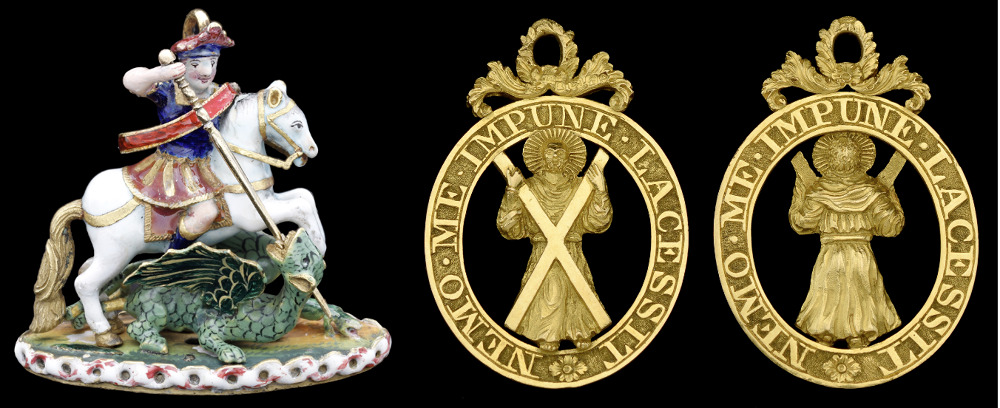
Two order badges made their mark in style. The first was one of the finest examples known of an 18th Century Order of the Garter ‘Great George’ pendant collar badge, showing the saint killing the dragon, which sold for £46,000 on 10 September. The second was an extremely rare 22 carat gold Georgian Knight’s Investiture sash badge from the Most Ancient and Most Noble Order of the Thistle, with the hallmarks for London 1821 and the maker’s mark ‘JJE’ for John James Edington. It sold for £70,000 on 3 December.
“It’s been a memorable year for our department and we are already preparing for early 2026 with a notable medal group belonging to Florence Nightingale’s Crimean War bodyguard,” said Medal specialist Oliver Pepys.
Share This Page