Article
8 January 2026
HISTORY IN THE MAKING, FROM THE WAR OF 1812 TO A SERIES OF CORONATIONS
Triumph among the commemorative medals came early in the year thanks to the exceptional bidding on 6 March for pieces relating to the War of 1812.
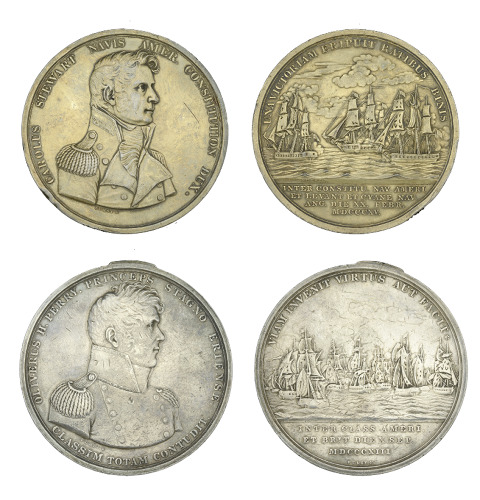
The Ship’s Surgeon’s Own Medal was awarded to Dr John A. Kearney, surgeon of the USS Constitution, which was victorious against HMS Cyan and HMS Levant about 100 miles east of Madeira on 20 February 1815. This was three days after the war had officially ended via the Treaty of Ghent, but before word had come through of the fact.
The silver-gilt medal, engraved by the Hungarian-American engraver Moritz Fürst, depicts the uniformed bust of Captain Charles Stewart of the USS Constitution right, with battle scene to the reverse. An extremely rare medal, the hammer fell at £34,000 against a guide of £8,000-12,000.
Pitched at the same estimate was the silver medal, also by Fürst, commemorating an important battle on Lake Eyrie on September 10, 1813, when the United States defeated the British who, as a result, became isolated on Lake Huron.
The commander of the U.S. naval forces at the battle was Master Commandant Oliver H. Perry, depicted on the medal, the reverse giving a view of the American and British fleets. The successful bid was for £24,000.
The Silich Collection of Historical and Art Medals (Pt II), the day before on 5 March, proved to be another eclectic and fascinating catalogue showcasing the discerning eye of the late David Nicholas Silich (1944-2018).
The sheer artistry of these pieces is well illustrated by the leading two lots in this auction.
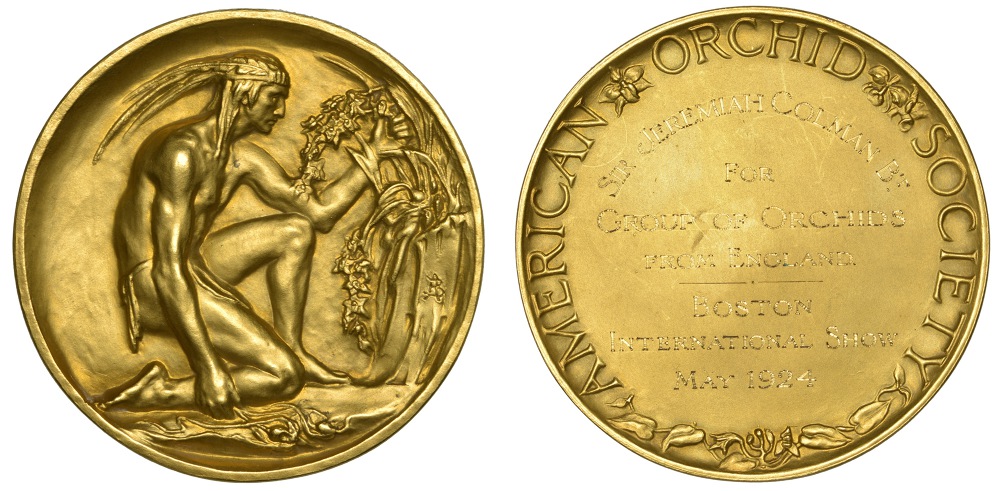
The first was the 51mm gold award medal created by Blanche Ames for the Medallic Art Co on behalf of the U.S.A., American Orchid Society.
The American Orchid Society’s Gold Medal of Achievement, for distinguished work in orchid culture, in scientific research on orchids or for outstanding service, was first awarded to Blanche Ames herself, along with her husband Oakes Ames, and Guerney Wilson on 9 May 1924.
A Renaissance woman, as well as being an orchid expert, Blanche was an artist and illustrator, and mastered the craft of copperplate etching. A women’s rights activist, during the Second World War she also invented a device for snaring low-flying aircraft.
Her design here, depicted a native American brave kneeling, tending to an orchid on the obverse, and the reverse was inscribed for Sir Jeremiah Colman, Bt, for Group of Orchids from England, Boston International Show, May 1924.
Sir Jeremiah Colman, 1st Bt (1859-1942), was the scion of the Colman’s Mustard company, and lived at Gatton Park, Reigate, where he amassed one of the world’s largest collections of orchids.
The medal in its original green fitted case with a relevant label taped to the lid, sold for £4,200.
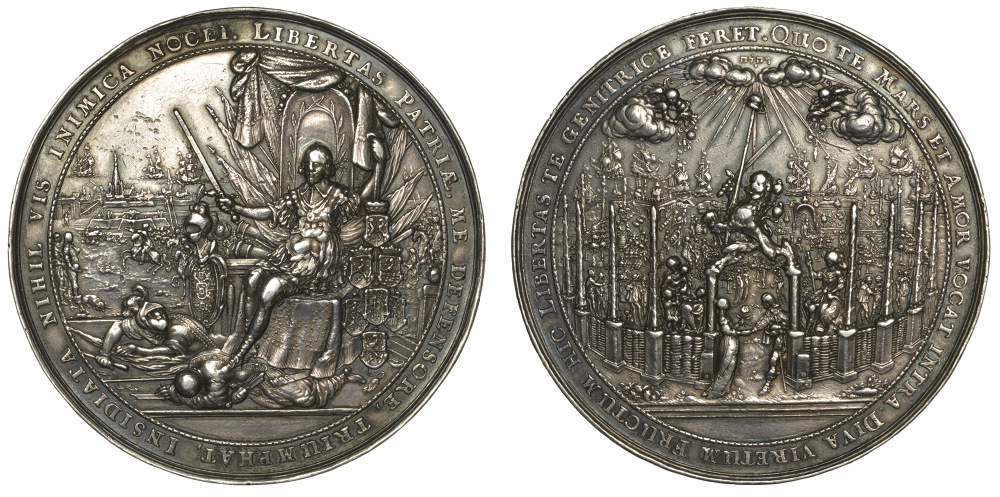
The second medal was struck in 1642 to honour a largely overlooked but nevertheless key figure in how history and the fate of England would unfold. Designed by the German medallist Sebastian Dadler (1586-1657), the 73mm diameter silver medal celebrates the arrival in Holland of Princess Mary, eldest daughter of Charles I and sister to Charles II.
The medal depicted Frederick, Prince of Orange, seated left, trampling his enemies while holding a sword in his right hand and a band with shields of the seven United Provinces in his left. Prince William and Princess Mary were shown at left, with the cityscape in the background. The reverse depicted a pleasure garden within a wattled fence, the Belgic lion above the entrance at which Prince William receives his bride.
The union between the two royal households was to prove crucial. Princess Mary (1631-60), the 9-year-old eldest daughter of Charles I, was married to Prince William II of Orange, then aged 14, in May 1641 but, by the terms of the marriage contract, she was expected to remain in England until the age of 12.
As the political situation in England deteriorated, the royal family moved to Hampton Court and, in February 1642, Mary and her mother, Henrietta Maria, left for The Hague.
Mary would only end up spending a few years in the Netherlands with her husband before he died of smallpox in November 1650, and only eight days after losing him did she give birth to the future king of England, William III of Orange.
This rare medal had minor surface marks in the fields, but was otherwise very fine and toned and sold for £3,000.
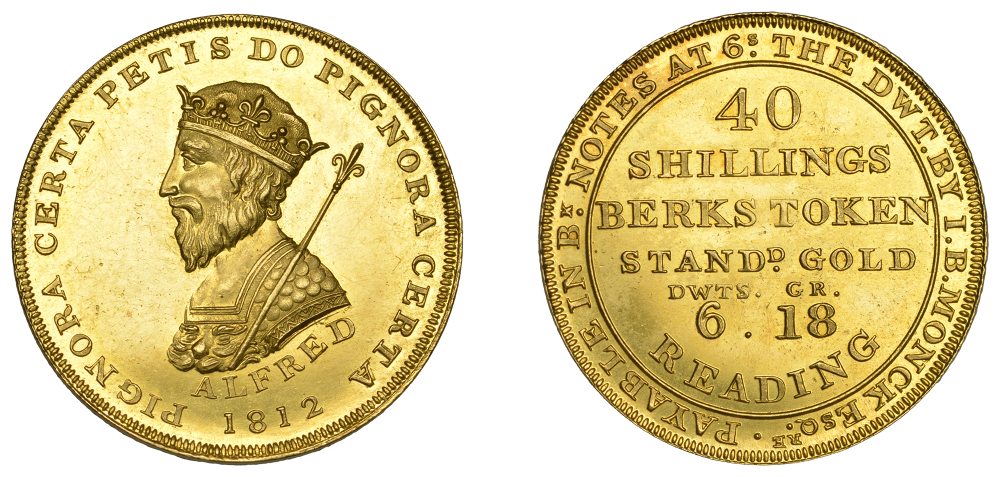
An 1812 gold token for landowner John Berkeley Monck of Coley Park, Reading, amounting to 40 Shillings, and depicting the bust of King Alfred left, was an extremely fine, an attractive piece and very rare. On 13 May it went comfortably over estimate at £11,000.
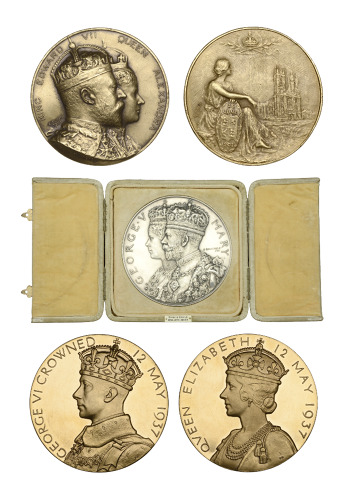
Pick of the medals on 10 June was a gold medal by D.I. Adzer, depicting the bust of Christian VII of Denmark, dating to 1771 that sold for £18,000, while on 9 September a 22ct gold medal by E. Fuchs for Elkington marking the 1902 Coronation of Edward VII, depicting the conjoined busts of Edward and Alexandra right made £7,500 in its original green fitted case of issue. It was followed on 14 October by another Coronation Medal, this one for George V, 1911, in silver, that confounded a £340-400 estimate to sell for £7,000 as the star lot of the third part of the Silich Collection. A George VI, Coronation gold medal by P. Metcalfe from 1937 went to £10,000 on 12 November. Here, instead of conjoined busts, the King and Queen each took a side of the medal.
Share This Page