Article
19 February 2026
THE MOST BEAUTIFUL ENGLISH ECCLESIASTICAL COIN IN PRIVATE HANDS
William MacKay has collected coins since he was a teenager in the 1970s. Since then, he has worked with Spink, served as Director of the British Numismatic Society and, most recently, been preparing several volumes of the SCBI series dedicated to the collection of Scottish coins formed by the late Lord Stewartby.
As the catalogue to this auction sets out, his list of publications stretches across the past 20 years – the collection itself extends over a far greater period, covering six decades; the objective is to give as complete a cross section of the Anglo-Saxon period as possible, whilst also reflecting the vendor’s personal specialisation.
Coins are sometimes the only surviving documents of a period, and can impart clues to changes in the way societies were ruled. The introduction of Christianity to England by St Augustine and his missionaries from 597 ultimately led to changes in the social order and the unity of the nation.
“These developments helped to crystallise Bede’s ‘English People’ and it is to our great benefit that the social, political and religious changes of the seventh to eleventh centuries are consistently reflected in the coinage of the period,” said Noonans’ Head of Coins, Bradley Hopper.
The Mackay Collection reflects these developments, starting with the earliest of its English coins, the extremely rare gold Shillings, whose iconography draws heavily on late Antique prototypes, and demonstrate the Anglo-Saxon preference for expressions of Romanitas.
Silver started to replace gold around 100 years after the arrival of Augustine in the late seventh century, a gradual transition accompanied by the emergence of a wide variety of designs influenced by Roman, pagan and Christian traditions.
After another half century, further changes took place during the time of the Mercian king Offa (d.796), when coinage became a symbol of the ruler’s power, with designs including the king’s name.
As well as complementing the written records of the time, coins could challenge them. This sale has a fine example of this. Whereas the Chronicler portrayed Burgred of Mercia (c.852-888) as a weak, ineffectual ruler, his coinage reveals that he exerted great influence over Wessex monetarily.
Coinage also shows that Æthelberht (860-865) and his Archbishop attempted to restore standards in Wessex during the years Viking induced crisis; and that Alfred the Great (871-899) held London throughout the early 880s.
Æthelstan’s (924-939) pre-eminence as the ruler of all England can also be seen in his coinage, which carries the legend Rex Totius Britanniæ.
The Mackay Collection moves on from Æthlestan and his network of mints, through Eadgar (943-975) and the establishment of the tradition that all coins should carry a royal portrait on their obverse and both the moneyer’s name and a mint signature on their reverse.
The collection ends with an attractive penny of Harold II (1066).
Highlights are numerous, but of particular note are the following three coins.
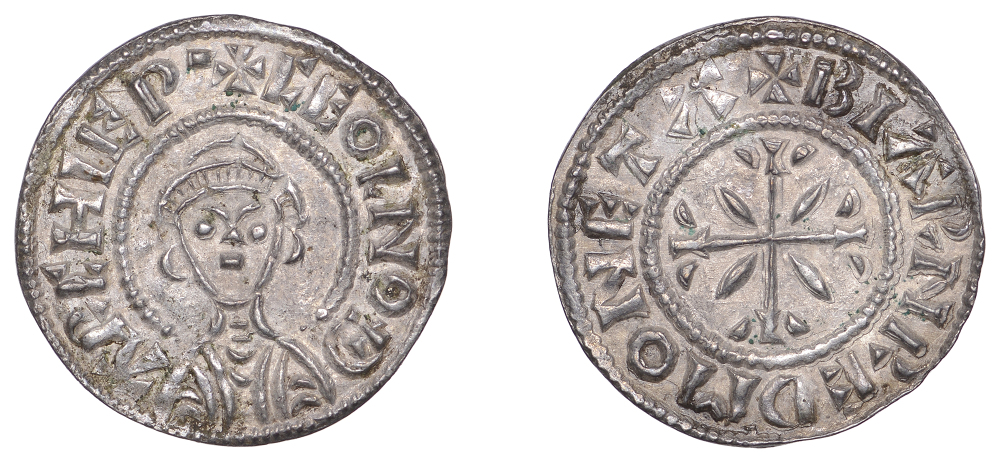
The first is a c.864-65 penny of Ceolnoth (833-70) Archbishop of Canterbury. Struck at Canterbury by Biarnred, the obverse shows the tonsured and draped facing bust of the Archbishop, with +ceolnoð-archiep around a beaded inner circle. The reverse depicts the Floreate Cross with leaf-shaped wedges in angles, +biarnred moneta around beaded inner circle.
“Today Floreate Cross pennies are amongst the most difficult of all the ninth century types for collectors to acquire, particular in high grade,” says Bradley Hopper. “Perhaps only 25 specimens exist in total, the vast majority of which are in institutional collections. Of these, only three are of Archbishop Ceolnoth; an early variant housed in the Hunterian, a rather sorry fragment in the British Museum and the current coin, which must be fairly regarded as the most beautiful English ecclesiastical coin in private hands.”
Well struck up on a broad flan of excellent metal, lightly toned over residual lustre, this extremely fine coin represents a hugely ambitious but ultimately failed attempt to restore the coinage to standards seen during the early years of the ninth century. Analysis of the present coin shows it to be comprised of 81.85% silver, which stands far above other contemporary issues from Wessex and Mercia. Excessively rare, it is estimated at £8,000-12,000.
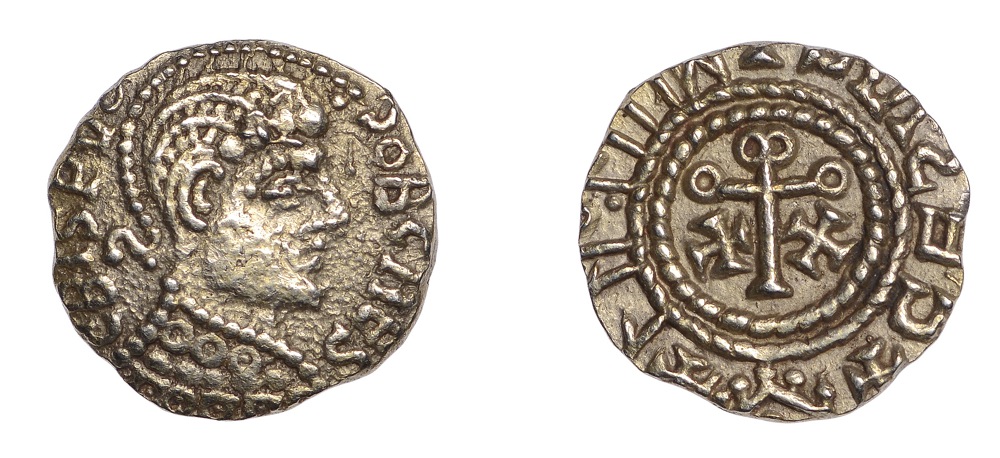
An early Anglo-Saxon period shilling of the Crispus Type forms another highlight. Dating to c.650-60, it is from the Post-Crondall Phase when gold content was gradually debasing. Struck in East Anglia, the obverse shows the helmeted and cuirassed bust right, with crispvs dob ches around, the reverse with an annuleted cross, flanked by crosses at base, within a double beaded border, +cesiar ᛞᛖᛋᚨᛁᚨᚾᚨ [de saiana] around. In good very fine condition, with slight die rust on the obverse, it has a delightful buttery tone over excellent surfaces. Very rare thus, it is guided at £7,000-9,000.
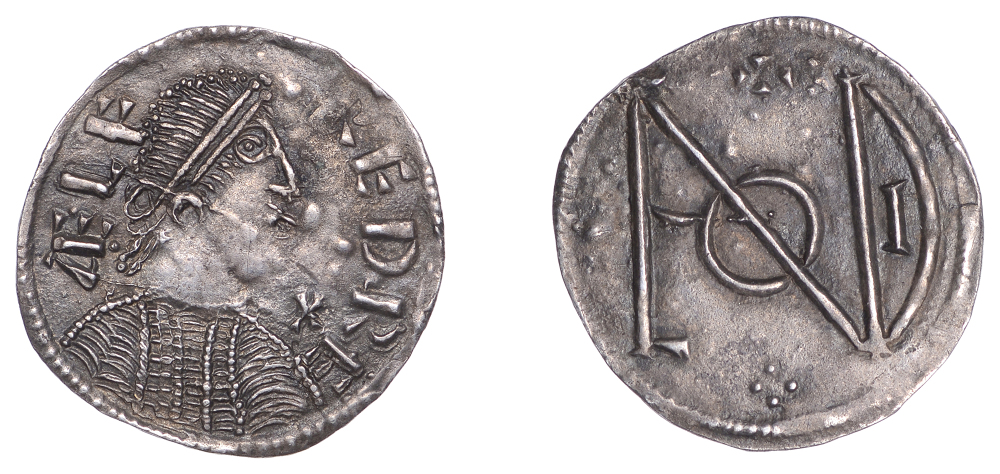
A London Monogram Penny from the Third Coinage of Alfred the Great, shows the draped and diademed bust right, the tunic divided into five panels, with ælf-red rex around. The reverse has the letters of Londonia formed into a monogram, with cross above and below. As with most such coins, the moneyer is not known. “Such an omission was remarkable in this period, and typically indicates production under either direct royal or ecclesiastical authority,” says Bradley Hopper.
“The London Monogram demonstrates that the city was in English hands during the early 880s. Given the early dating of the issue, it probably reflects an official recognition of Alfred as overlord immediately following the demise of Ceolwulf II.”
In good very fine condition, with a superb portrait on a full broad flan, this handsome example of a rare and iconic type is pitched at £6,000-8,000.
Share This Page