Article
19 February 2026
ANOTHER LANDMARK HOARD HELPS SHED MORE LIGHT ON THE IRON AGE
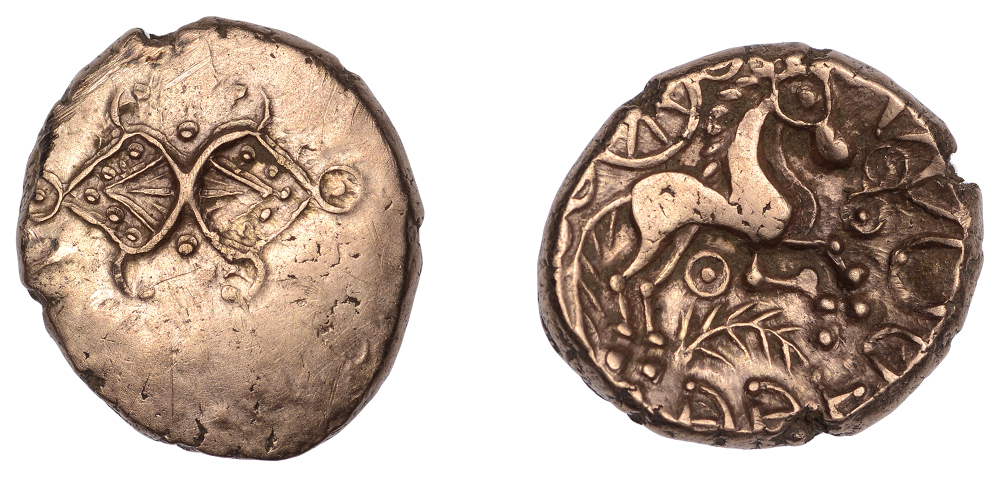
The largest known hoard of Iron Age gold coins deposited during the reign of Dubnovellaunos, who ruled the Trinovantes from 25BC-10AD, comes to auction at Noonans in this sale. Together, the 16 coins – to be sold individually – are expected to fetch £25,000.
They came to light in two parcels uncovered by Tom Licence, Professor of Medieval History and Literature at the University of East Anglia. He was searching a field in Babergh, south-west of Bury St Edmunds, and made the finds between October 24 and 26, 2024. They comprised 16 full gold Iron Age Staters and one quarter-Stater. All were promptly reported to the FLO and and declared treasure.
On a further visit to the site in April 2025, Tom found another Stater, and together these comprise the largest known hoard of gold coins to be deposited in the reign of the Trinovantian King Dubnovellaunos, far surpassing in size and significance that found in September 2017 at Braintree, Essex.
All of the Staters in the hoard are inscribed and can be attributed to two figures: Addedomaros and Dubnovellaunos of the Catuvellauni and the Trinovantes respectively.
Addedomaros’ kingdom appears to have expanded to include much Trinovantian territory and it is possible that he was Dubnovellaunos’ father, an argument supported by stylistic links between their coinages. Addedomaros was probably the first king north of the Thames to produce an inscribed coinage, but beyond that we know frustratingly little about him.
Dubnovellaunos ruled the Trinovantes, and at some point held sway in Kent as well; he is mentioned in the Emperor Augustus’ Res Gestae as having sought refuge in Rome.
The findspot of this hoard – a day’s walk from Colchester to the south and Bury St Edmunds to the north – is directly at the heart of Trinovantian territory. John Sills has suggested, on account of die sequencing, that Bury St Edmunds Hoard was concealed during the reign of Dubnovellaunos, for the hoard omits the ruler’s last two issues.
Tom Licence started metal detecting as a young boy, but took a more serious interest in the hobby in 1994 as a young man. Whilst walking through Rye in East Sussex, he found a Charles I Rose Farthing in a flower bed, which immediately captured his imagination.
A keen detectorist, Tom also writes about his finds in the Searcher magazine, and Tom plans to use his share of the proceeds of the sale to support local archaeological work in Suffolk.
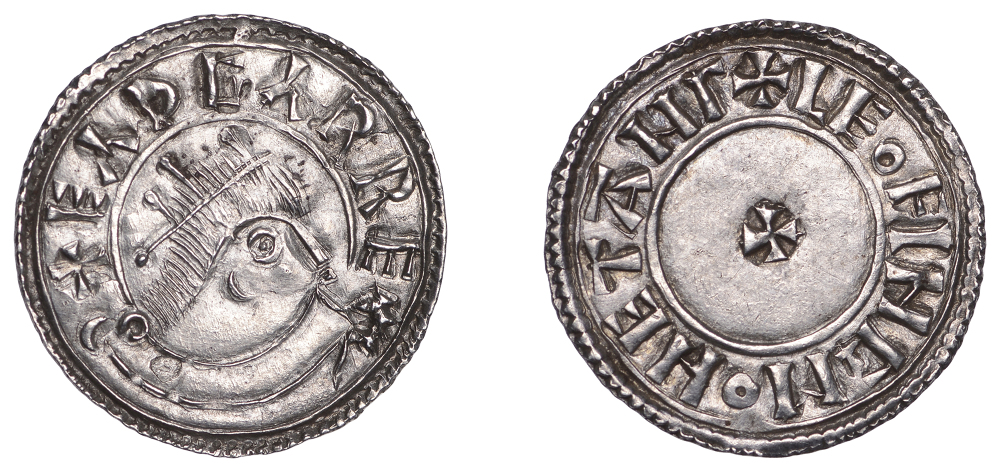
Another detectorist find is also expected to do well. This is a Penny of the Bust Crowned type for Eadgar (959-975). With +eadgar rex around a crowned and draped bust of East Anglia style right to the obverse, the reverse is stamped Leofing + leofing moneta nt, with a small cross. Stylistically similar to other coins from Neatishead in Norfolk, it has not been confirmed that an Anglo Saxon mint existed there, nor who the moneyer might be. Extremely rare, the esti8mate is £4,000-5,000.
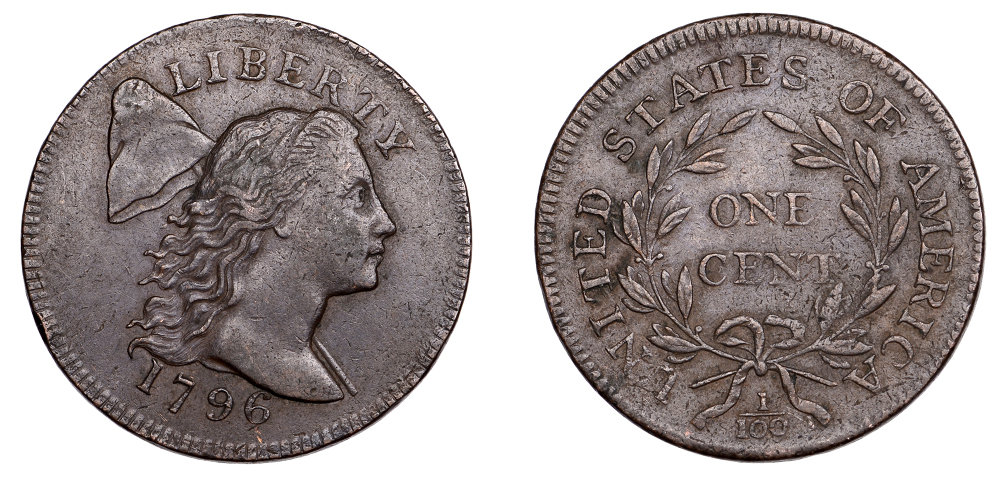
Considerable interest in the run-up to this sale has been shown for a United States of America, Cent of 1796. In good very fine for its issue and very rare, two weeks before the auction it had already attracted a bid of £13,000 against its £3,000-4,000 estimate.
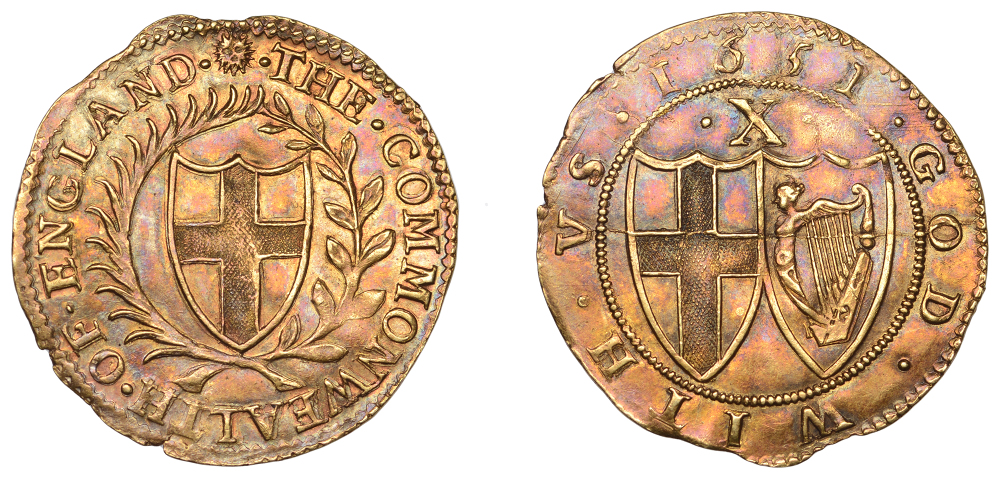
A Commonwealth (1649-1660) Double-Crown of 1651, with a die break across reverse and a trifle crimped, was nonetheless in almost extremely fine state with beautiful rich toning and expected to do well with a guide of £3,000-4,000.
Notable medals include and 1883 Coronation gold medal for Russian Tsar Alexander III by A. Grilliches. With conjoined busts of the Tsar and Tsarina right, and the reverse showing the crowned double-headed Romanov eagle, the edge has a bruise at 12 o’clock, with some surface marks and nicks, but it is otherwise in good very fine condition. It has a guide of £12,000-15,000.
A group of 46 Agricultural Medals belonging to the amateur naturalist Lord Rowland Hill, 2nd Viscount Hill (1800-1875) provide another highlight.
From a family of decorated army officers who served with distinction during the Napoleonic Wars, all three of his uncles were present at Waterloo in 1815 and his uncle, Rowland, personally led a cavalry charge against the Imperial Guard, and even took their surrender.
Hill himself was an MP for Shropshire in 1821, whilst simultaneously undertaking a short stint in the Royal Horse Guards, and later Lord Lieutenant of Shropshire.
Keenly interested in the management of his and his wife’s inherited estates near Shrewsbury, he took a great interest in the local wildlife, particularly the birds. He made great efforts to commercialise his estates and improve the quality of his livestock, attending agricultural fairs up and down the west of England throughout the 1840s and 50s with his tenant farmers.
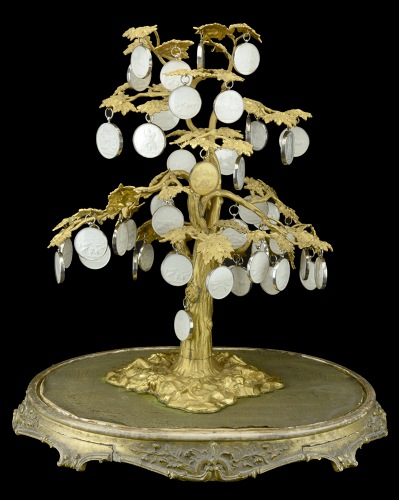
The numerous awards in this collection bear testament to the success of his endeavours. They range from a Liverpool Agricultural Society silver medal by Faulkner F., named (Presented to the Rt. Honble Lord Viscount Hill for the Best 2 years old Heifer, Exhibited 1844) to a Birmingham & Midlands Counties Exhibition silver medal by Ottley, Birmingham, named (To The Rt Hon Viscount Hill for American Turkeys, 3rd Prize Class 54, 1854). All the medals are as struck and mounted in silver and glass cases and are looped at 12 o’clock for suspension on decorative display tree. Together they are estimated at £8,000-10,000.
Share This Page