Article
24 April 2026
FARTHING FROM MORAT’S COFFEE HOUSE, DESTROYED IN THE GREAT FIRE OF LONDON, LEADS ON £1,500
Destroyed during the Great Fire of London, Morat’s Coffee House in Exchange Alley near Cornhill in The City, was one of the original coffee houses that became meeting places for business, socialising and political debate.
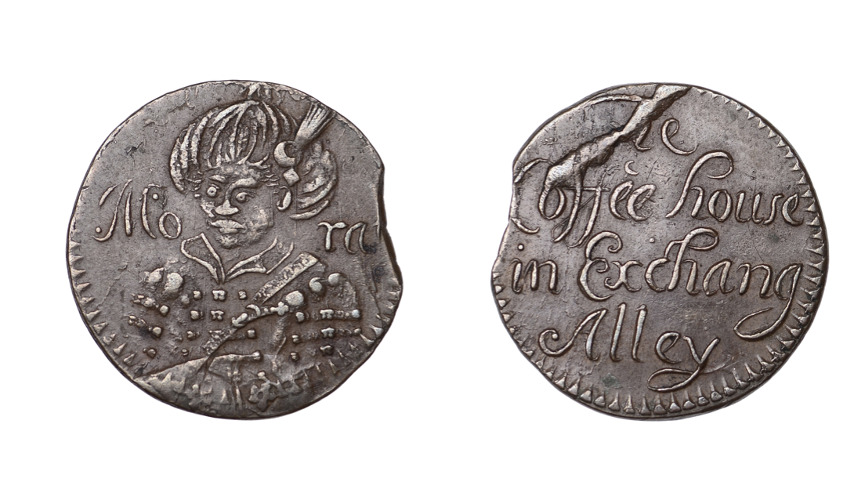
It was known for its sign depicting Morat the Great, a Turkish Sultan, and tokens issued for it by Walter Elford point to its significance in the locale.
One such led this sale, a Halfpenny carrying the image of the Sultan to the obverse. With the flan clipped and a die flaw on reverse, it remained a very fine piece and was pitched at £300-400; it sold for £1,500.
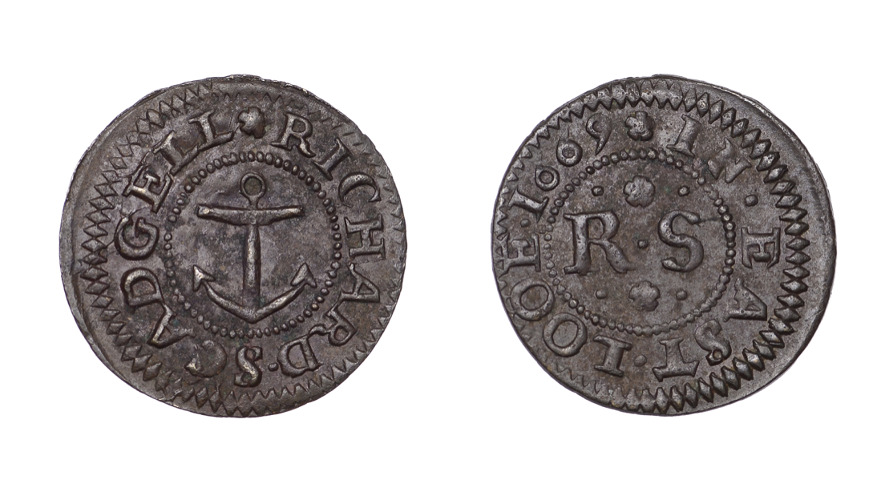
Other four-figure highlights included a Farthing from the Collection of 17th Century Tokens of Cornwall formed by Mac McCarthy. Issued by Richard Scadgell of East Looe, and dated 1669, it had light verdigris spots, but was otherwise good very fine and exceptionally rare. In the 1664 Hearth Tax returns Richard Scadgell was taxed on three hearths, with one returned short in East Looe, and one hearth in the neighbouring hamlet of Pelynt. The Farthing was estimated at £500-700, but went for £1,000.
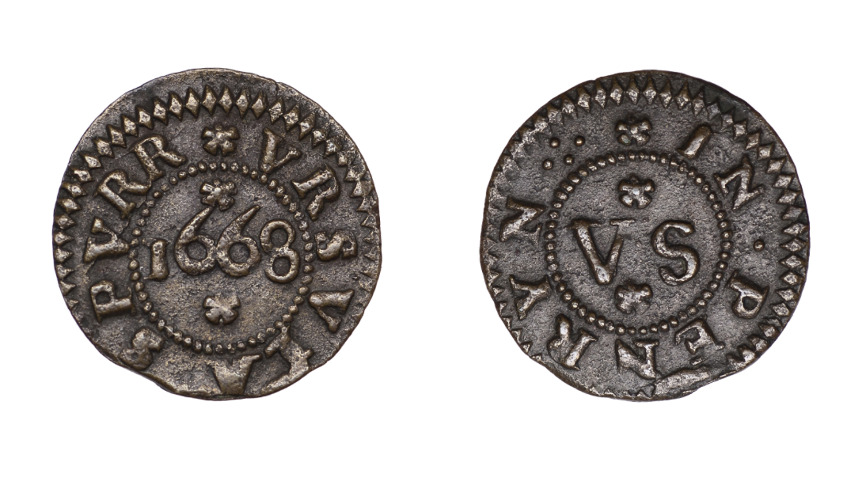
Another highlight from the McCarthy collection was the 1668 Farthing of Ursula Spurr of Penryn, previewed in the last newsletter. McCarthy was able to glean a great deal of detail about her life, not all of it complimentary.
“There is evidence in the 1658 Will of Vincent Smaley, father of Ursula Spurr, that she was married to an unsatisfactory husband,” the catalogue explains.
“Smaley left his daughter £8 per year during her husband’s life, but if he died, she was then to have £100 per year – presumably he felt the husband was not competent to handle such a large amount of money.”
Another point of interest is the silver sugar box, left to Ursula by her father, “which was Lady Killigrews”. Jane Fermor (1584-1648) married into the family and, as Lady Killigrew, later escaped to Penryn in 1633. Could its association with the notorious Killigrew family have had any influence on Ursula? Regardless, as Mac McCarthy concludes, Ursula appeared very ready to cheat the authorities.
“In 1653 it was reported from Pendennis Castle that some bags containing 2,709 louis and 718 pieces of eight, taken from a prize ship, had been embezzled by one Captain William Wheatley and conveyed by him to the house of Richard Lobb. Benjamin Sergeant had also embezzled four bags of louis which he conveyed to the house of Christopher Lee in Smithicke, and he exchanged 1,000 of them at 4 shillings a piece with Ursula Spurr.”
The records also show that Ursula’s husband, Henry, described as a Gentleman, was buried at St Gluvias, north of Penryn, on 15 June 1663. The 1664 Hearth Tax returns read “Henry Spurr (Mr) 7 ret 2 too many b.m. & now Mrs Ursula Spurr New tax payer”. Ursula Spurr, described as a widow, was buried at St Gluvias on 16 May, 1678.
Very fine and extremely rare, the Farthing was estimated at £400-500 and rose to £850.
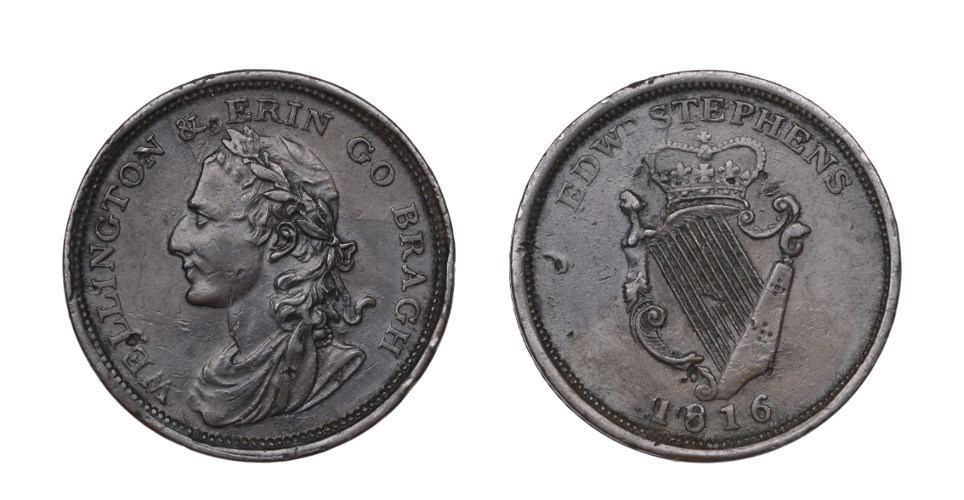
A Parkes’ Penny, issued in Dublin by Edward Stephens in 1816, shows a laureate and draped bust of the Duke of Wellington left, with long hair, the reverse carrying the image of a crowned harp. Sold as part of a collection Irish tokens of the 19th century, this extremely rare piece left its £400-600 guide behind to take £1,100.
Share This Page