Article
24 April 2026
ASIAN NOTES TO THE FORE WITH A FASCINATING RARITY FROM THE KINGDOM OF SERBS, CROATS, AND SLOVENES
Asian Banknotes lead the way at this latest outing of World Banknotes, anticipating other fine examples from this banking tradition at Noonans’ auction in Hong Kong on 19 June.
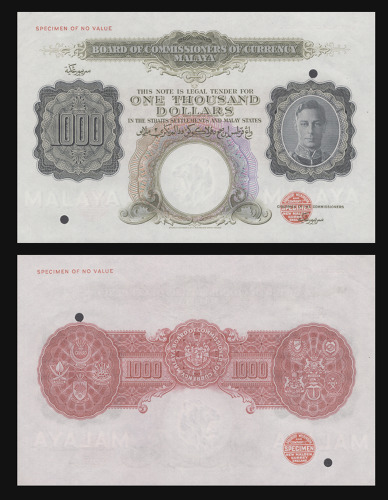
Two Colour trials from the Board of Commissioners of Currency Malaya stand out. The first is a $1000, ND (1942), without serial numbers, but carrying the Weisberg signature. In green, white, orange, and lilac, it is overprinted in red SPECIMEN OF NO VALUE and has the Bradbury Wilkinson seals, and two cancellation holes. Very choice new, this is a truly lovely note and very rare. It has an estimate of £12,000-14,000.
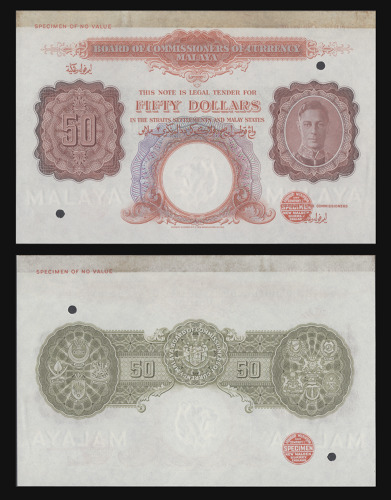
The second of the Malaya Colour trials is a $50, ND (c.1942). Also without serial numbers, and carrying the Weisberg signature, it has the same overprints, seals and cancellation holes, but displays mounting remnants. Again, very choice new, this rare and handsome note has a guide of £7,000-9,000.
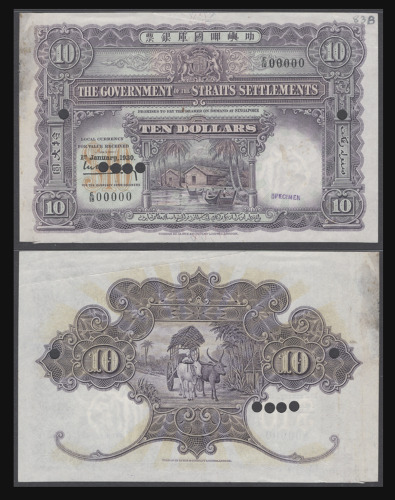
A specimen $10, dated 1 January 1930, comes from the Government of the Straits Settlements. With serial number E/18 00000, and the Weisberg signature, it features a purple SPECIMEN stamp at lower right, six cancellation holes, and a printer’s annotation. Previously mounted, this uncirculated note is very rare and attractive, and the sole example graded by PMG at the time of cataloguing. The estimate is £9,000-11,000.
The Kingdom of Serbs, Croats, and Slovenes was formed after the First World War in 1918 in an effort to unify The Balkans. It lasted for 11 years. When early currency notes appeared, they carried the values of the Austro-Hungarian krone stamped or overprinted alongside the Serbian dinar. This reflected the transitional status of the new nation.
The two values displayed required a fixed exchange, but while the government stated an exchange at par, it was practically applied as 1 Serbian dinar = 4 Austro-Hungarian krone.
By 1920, the government had started to replace these overprinted notes, removing the krone entirely within two years to leave the dinar as the sole legal tender.
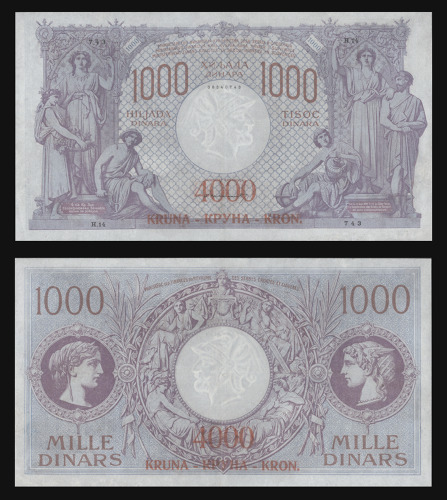
Thus the dual value notes are rare. Rarer still are the highest denomination issued in this form: the 4,000 krone/1,000 dinar note.
A very fine example offered here carries modest repairs. Seldom seen in any grade and an absolutely glorious note, it is one of just five graded by PMG, and is expected to sell for £4,600-5,500.
Share This Page