Article
14 May 2026
LESSER KNOWN CASUALTIES OF THE FIRST GULF WAR
When Saddam Hussein’s invasion of Kuwait in August 1990 sparked the First Gulf War, one of the casualties was the Iraqi leader’s newly planned issue of banknotes.
De La Rue had already produced the commissioned specimens, trials, and proofs, but the conflict meant that actual Central Bank of Iraq issues never came to pass.
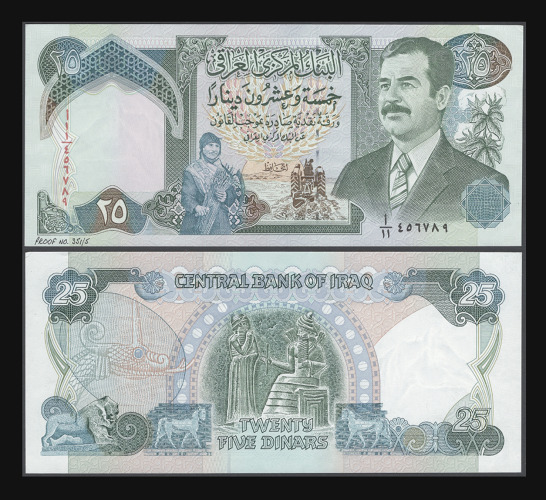
Now a full set of trial notes for a 1990 Central Bank of Iraq issue featuring Saddam Hussein has come to light and is presented in this sale. While the 5 and 10 Dinars are known, albeit very rare, the 25 Dinars is a new discovery and is sure to cause significant excitement.
The fully-printed proof for the unadopted 25 Dinars, ND (1990), serial number A/11 456789, has no signature, and pictures Saddam Hussein at right, with a tractor and female Kurdish wheat farmer at centre. The estimate is £5,000-7,000.
The specimen 10 Dinars, 1990, serial number AD/391 000000, has the Frankool signature, is perforated SPECIMEN OF NO VALUE, and has Saddam Hussein at right, with Marsh Arabs at centre. It is expected to fetch £4,000-5,000, the same guide as for the specimen 5 Dinars, 1990, serial number KH/462 000000, also with Frankool signature, and perforated SPECIMEN OF NO VALUE. With Saddam Hussein at right, it also features a statuette of Ur-Nammu and unknown buildings at centre.
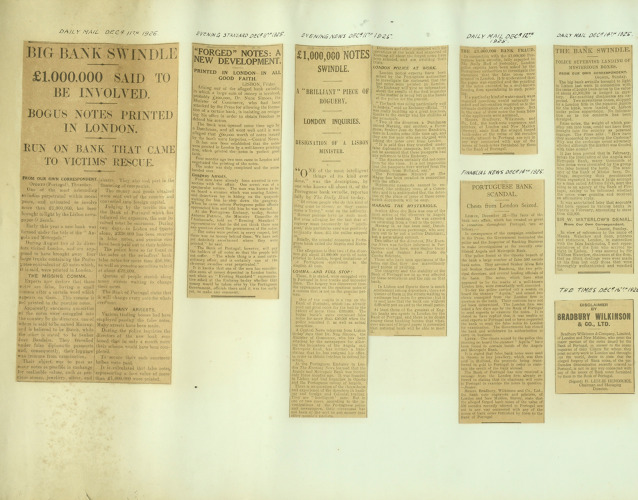
An unusual lot is the collection of newspaper cuttings from 1926 detailing the entire course of the Alves Reis scandal. Reis (1896-1955), a Portuguese criminal, perpetrated one of the largest frauds in history. In a complex web of deceit and forgery, he succeeded in fooling legal and diplomatic staff of several embassies, bank officials and the London banknote printers Waterlow & Sons.
In doing so he managed to secure the printing of false banknotes with a total face value of 100 million escudos, the equivalent of almost 1% of Portugal’s nominal GDP at the time. Reis then laundered the notes into gold-backed foreign currencies and smaller denominations of Portuguese currency, keeping a quarter of the proceeds for himself.
So vast was the scheme that Reis created his own bank to manage the fraud and was responsible for a mini boom in the Portuguese economy, and with his investments in Angola was hailed as ‘Portugal’s own Cecil Rhodes’.
Reis went as far as trying to acquire a controlling interest in the Bank of Portugal to retroactively legitimise his fraud. Suspicions soon arose over the activities of his bank and the deception unraveled, with Reis eventually being sent to jail for 20 years in 1930. He was released after 15 and died of a heart attack ten years later.
The collection of cuttings is estimated at £300-400.
Share This Page