Article
8 June 2026
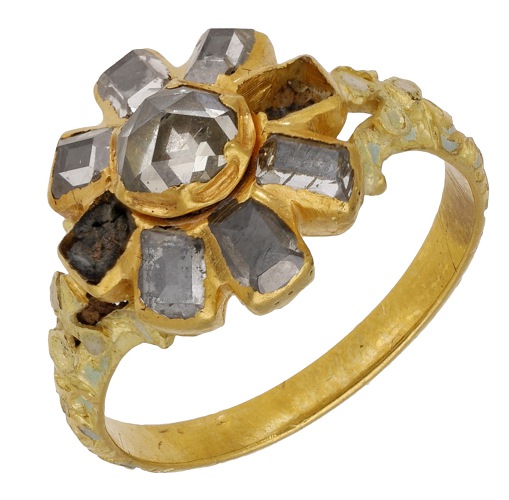
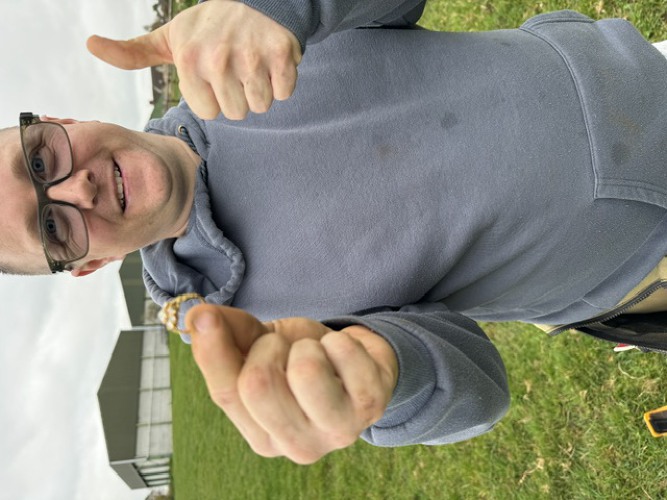
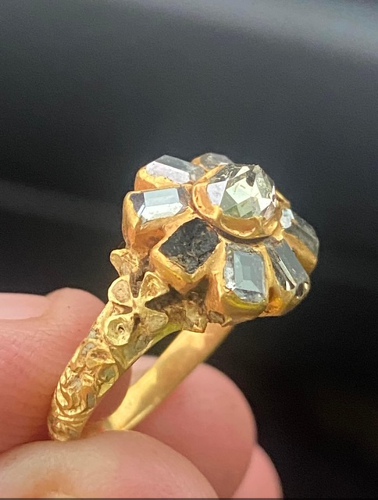
A late 16th-early 17th century diamond cluster gold ring, that was discovered in Wormington in Gloucestershire – just four miles from Broadway, in November 2024 by 42-year-old Stuart Jones, a metal detectorist from Solihull will be offered for sale at Noonans in an auction of Jewellery on Tuesday, June 23, 2026. It is expected to fetch a total of £15,000-20,000 [lot 106].
Stuart, who works as a welder fabricator at Jaguar Land Rover in Solihull, is engaged to Iren, and they have a two-year-old son called Leonardo. He said: “I have been metal detecting for several years and am a member of multiple detecting groups. I have always been fascinated by history, archaeology and the possibility of finding treasure. What first inspired me was watching videos of people out in the countryside discovering historical coins, artefacts and relics. Seeing those discoveries made me want to get involved in the hobby myself.”
He added: “The location where I found the ring was somewhere I had never detected before. Although there had been a dig there several months earlier, I did not attend that event. On the day I found the ring, I was detecting on my own. I had been detecting, with my Garrett ACE 400i fitted with a Tornado coil, from around 9:00am until approximately 4:00pm. The find came during the last hour and a half of the day. The weather was slightly warm but overcast.”
He recalls: “When I recovered the ring, I was absolutely overwhelmed with joy. I was over the moon. Everyone around me was congratulating me and taking photographs while I held the ring. One of the club administrators suggested that I take home all the soil from around the find spot in the hope of locating the missing diamond, so I carefully collected the surrounding dirt to search through later. Without any doubt, the ring is the best find I have ever made. I describe it as my “once in a lifetime find”. Like many detectorists, I have always dreamed of finding something truly special, but I never imagined I would discover an item of this significance.”
As Laura Smith, Jewellery Specialist, Noonans explains: “As Stuart mentioned, one diamond came loose and fell into his hand as he lifted the ring from the earth. It was clear a second setting was also vacant. Mr. Jones had the forethought to collect all the soil around the find site and take it home with him. Having previously attempted gold panning, he had suitable equipment to hand - he washed and sieved the retrieved soil and found the missing diamond!”
The proceeds of the auction will be shared equally with the landowner. As Stuart explains: “I have maintained close contact with the landowner throughout the entire process and have personally updated him with every development, from the ring’s examination by the British Museum through to the present day. We are both very excited and looking forward to auction day.”
He finished: “Finding the ring has not made me want to give up. If anything, it has increased my enthusiasm for getting out into the countryside and searching for history. I know I may never find anything that surpasses this discovery, but that is part of what makes it so special. Whatever happens at auction, finding the ring has already been an unforgettable experience and a moment that I will treasure for the rest of my life.”
This ring was discovered in Wormington, near Evesham, situated 4 miles from Broadway on the London to Worcester road. Two important manor houses, existed in the 16th century, were situated within 5 miles of Wormington. The first, Snowshill Manor, was given by Henry VIII to Catherine Parr upon their marriage in 1543. The estate passed to Francis Bulstrode MP, and in 1561 was purchased by Henry Willoughby. The second, to the west, is Wickhamford Manor, originally belonging to the Abbey at Evesham. Seized during the Dissolution of the Monasteries, in 1562 Elizabeth I granted it to Thomas Throckmorton, MP. In 1594 Wickhamford Manor was purchased by Sir Samuel Sandys (d. 1623), MP, son of the Archbishop of York. The Sandys family already owned Ombersley Court, north of Worcester. Samuel Sandys was married to Mercy Culpepper, the daughter of Thomas Culpepper, a once friend of Henry VIII (executed for his attempted seduction of Queen Catherine Howard). Samuel and Mercy are interred together, in a grand marble tomb with effigies, in the church of St. John the Baptist, Wickhamford.
Laura Smith notes: “Metal detecting finds always attract a lot of attention when they come up for auction, and in this sale, we have 14 metal detected jewels!”
She continues: “Early 17th century baroque taste required grand rings to make an impression from a distance. Fashions in diamond rings moved from solitaires towards groups of small stones arranged in decorative patterns: rosettes, pansies, crosses, fleur-de-lys, etc. This ring has a flowerhead bezel composed of a cluster of eight ‘hogback’ diamonds (which is very rare), although two are loose. According to a PMI test on the XRF Analyzer, the gold is testing as 19.2ct. This exact gold standard was set by Edward I in 1300; goldsmiths were forbidden to work gold of less than “the Touch of Paris”, being 80% pure gold (or 19.2ct).”
Share This Page