Article
29 June 2026
HEROES OF QUATRE BRAS AND WATERLOO APPEAR SIDE BY SIDE
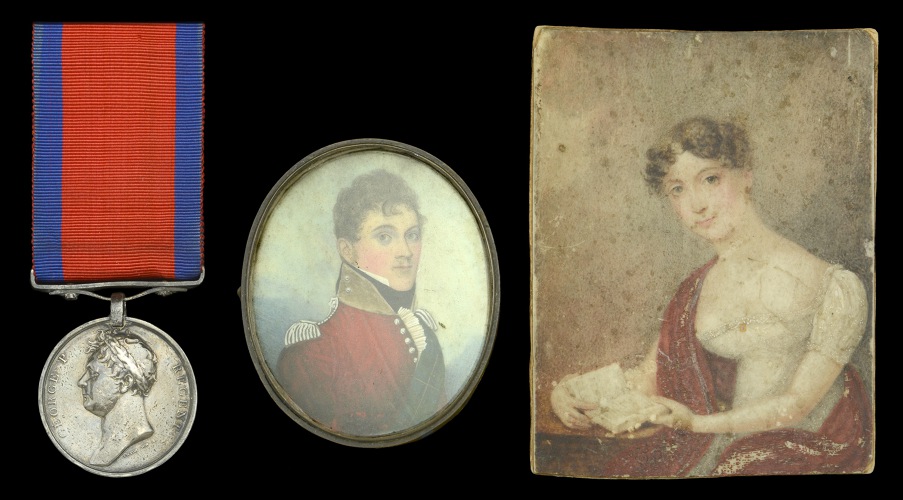
By the time he was severely wounded at Waterloo on 18 June 1815, Lieutenant George Lane, of the 1st Foot or Royal Scots, had already fought at Osma, Vittoria, St Sebastian, Nivelle, Bayonne and Quatre Bras.
No Regiment suffered higher casualties amongst its officers, as a percentage, at Quatre Bras and Waterloo, than the Royal Scots, with only four of its 37 combatant officers unwounded or killed.
Lane saw action before engaging in the Peninsula, having served with the 3rd Battalion in the Walcheren Expedition in 1809, when the British attempted to open up a new front against Napoleon in Holland.
He had been appointed Ensign with the Regiment on 28 February 1812, becoming Lieutenant on 26 July 1813. He left the Army when the Battalion disbanded in April 1817.
Now his Waterloo Medal comes to this auction with an estimate of £6,000-8,000.
We have some idea of what Lane looked like because the consignment includes an oval portrait miniature of him in uniform, attributed to Frederick Buck (1771-1839). In watercolour and gouache, it comes with a portrait of his wife in Regency dress reading a book – the artist is unknown. The second portrait is inscribed inscribed on verso Jane Belinda Lane, Cheltenham April the 6th 1816.
The lot includes Lane’s original vellum commission as Lieutenant in the First (or the Royal Scots) Regiment of Foot, dated Carlton House, 26th day of August 1813; and another document on vellum appointing him as a Master Mason of Lodge No. 25 at Cork, 27th October 1814.
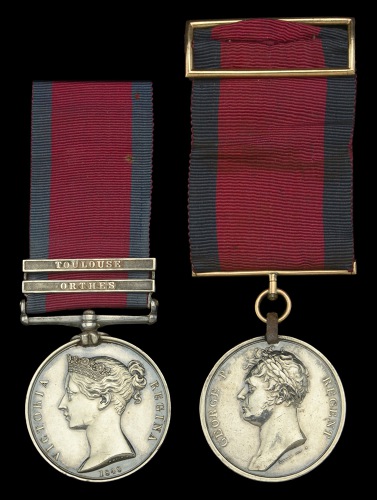
Also at Quatre Bras and Waterloo was Standish O’Grady, 2nd Viscount Guillamore, a Lieutenant (later Colonel) in the 7th Light Dragoons, whose Military General Service Medal 1793-1814, with two clasps for Orthes and Toulouse, as well as his Waterloo Medal 1815, are on offer here with an estimate of £5,000-7,000.
A letter to his father recalls O’Grady’s part at Waterloo on 18 June. There he was stationed on the ground above Hougoumont on the British left. “The 7 had the opportunity of showing what they could do if they got fair play. We charged 12 or 14 times and once cut off a squadron of cuirassiers, every man of whom we killed on the spot except 2 officers and one Marshal de Logis, whom I sent to the rear.”
Two letters of his to Captain William Siborne, describing the planning and movements of his regiment on 17 and 18 June 1815, provide a vivid and visceral account of O’Grady’s experience in the field. They were published in Waterloo Letters, edited by Major-General H. T. Siborne (London 1891).
O’Grady had had command of the troop of the 7th Hussars on the high road from Genappe to Quatre Bras on 17 June 1815 where they were covering the British march from Quatre Bras to Waterloo.
Sir William Dörnberg left O’Grady outside the town on the Quatre Bras road to hold in check the advancing French cavalry while the main body of the regiment proceeded in file across the narrow bridge of Genappe and up the steep street of the town. O’Grady advanced at the head of his troops as soon as the French appeared, and presented so bold a front that, after a time, they retired.
When they were out of sight, he crossed the bridge at the entrance of Genappe. He took his troop at a gallop through the town, rejoining Sir William Dörnberg, who had drawn up the main body of the regiment on the sloping road at the Waterloo end of Genappe. A severe cavalry combat ensued when the French lancers reached the top of the town, in which O'Grady's regiment made a gallant charge, with considerable loss. O’Grady’s action earned him promotion to Captain.
Learning that the Prussians had been beaten back, the 7th had the task of covering and protecting the main road, while O’Grady’s squadron was to skirmish and hold the ground.
He held the high road with the left Troop, supporting the right Troop where possible, advancing to help them hold their ground “as their movements were difficult through ploughed fields so soft that the horses were sunk up to their knees always, and sometimes to their girths,” according to the Waterloo Letters account.
“Whilst I was so employed Sir William Dörnberg joined me. Thus we continued to dispute every inch of the ground until we came within a short distance of the town of Genappe. Here Sir William Dörnberg told me that he must leave me; that it was of the utmost importance to face the Enemy boldly at this spot, as the bridge in the town of Genappe was so narrow we must pass it in file; that I should endeavour if possible to obtain time for the skirmishers to come in, but that I was not to compromise my Troop too much. Sir William had been riding with me some hours, and when he bid me farewell he shook my hand, and I saw plainly he never expected to see me again.”
O’Grady called in the skirmishers and advanced at a trot up the road.
“The troops opposed to me went about, and as I followed them they did not stop as soon as I did. I continued advancing and retiring alternately, until I saw all my right Troop safe on the road in my rear, and then I began to retire at a walk, occasionally halting and fronting until I turned the corner of the town of Genappe. I then filed the men from the left and passed through the town at a gallop, no enemy in sight. When I arrived at the opposite entrance of the town I found the 7th drawn up on the road in a column of divisions, and having re-formed our Squadron we took our place between those already formed and the town.
“Here I met Sir William Dörnberg, who appeared surprised to see me, and asked me how we had effected our retreat, and if we had saved any of the skirmishers, and when I told him we had not lost a man or a horse, he exclaimed, ‘Then Buonaparte is not with them; if he were, not a man of you could have escaped.’
Remaining in position, they waited about twenty minutes before any of the enemy appeared; when they did they comprised only a few stragglers, “some of whom rode into us and were found to be quite drunk”.
Soon after O’Grady counted 14 to 18 squadrons of enemy cavalry on the high road. Before long, the head of the column arrived in the town.
“This head consisted of a Troop of Lancers, all very young men, mounted on very small horses, and commanded by a fine-looking and a very brave man. For about fifteen minutes they remained in the jaws of the town, their flanks being protected by the houses; and the street not being straight, and those in the rear not knowing that the front were halted, they soon became so jammed that they could not go about.
“In this state of affairs Lord Anglesey gave us orders to charge them, which we immediately did. Of course, our charge could make no impression, but we continued cutting at them, and we did not give ground, nor did they move. Their Commanding Officer was cut down, and so was ours (Major Hodge), and this state of things lasted some minutes, when they brought down some Light Artillery, which struck the rear of the right (the charging) Squadron and knocked over some men and horses, impeding the road in our rear. We then received orders to go about from Lord Anglesey, who was up with us, but not on the road during all this time. The Lancers then advanced upon us, and in the mêlée which ensued they lost quite as many as we did, and when at last we were able to disengage ourselves they did not attempt to pursue us.”
O’Grady and his men retired through a Regiment of Light Cavalry, taking the first pass off the road to form in a field by the road side.
“I then got the remnant of the right Squadron and moved them down towards the town of Genappe to look after any of our wounded, whom it might be in our power to save. When I saw the ground upon which we had charged it was strewed with men and horses, but I saw very few fighting men of the Enemy. In the meantime the Light Brigade having been removed from the road where they were when we passed through them, the Life Guards came down the road and charged into the town.
“I could not, of course, see what they did, but I believe they fell upon the rear of a retiring Column, impeded by the narrowness of the bridge, and did their duty manfully.
“The Enemy did not again attempt to molest us, and we reached our position without further interruption, except some picket affairs in taking up our respective Lines, in one of which Captain Heyliger of the 7th made a very brilliant charge with his Troop, and when the Duke of Wellington sent to stop him he also desired to know his name. I thought at the time, and I still think, that when we charged the Enemy at Genappe their entire Column was in the town, and that being the case it is clear that as soon as they found the head of their Column engaged, they commenced clearing their rear out of the town.
“If this be the case it is obvious that the success or failure of the 7th in their charge was simply a matter of time. A little delay and they would not have had to charge, but to pursue. This as well as I recollect was Sir Wm. Dörnberg's opinion at the time when he objected to charging before their flanks were open to us. I feel, however, that I have no right to pursue this, and satisfy myself that I have given you, as well as I can now recollect them, all the facts as they came before me. A few minutes before we charged, one of the heaviest showers of rain I can remember fell, which, as it wet everybody and everything, rendered fire-arms useless, and though the French fired a few pistol shots, I don’t think they did any damage; our engagement was therefore one of sabre and lance.”
Sold with the lots is a series of prize medals awarded to O’Grady’s descendants for various achievements, from writing poetry to success in athletics and rowing for Oxford in the annual varsity boat race.
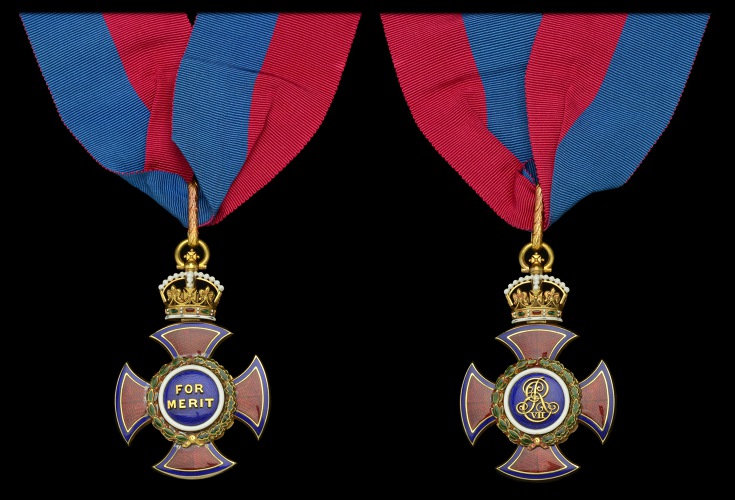
• A rare Order of Merit from the reign of Edward VII forms another highlight in the sale. With a (Civil) Member’s neck badge, gold and enamel, with neck riband, in a Collingwood, London, embossed case of issue, it is expected to fetch £10,000-£14,000.
Share This Page