Auction Catalogue




 Create new list
Dadler, Sebastian (German, 1586-1657); b. Hamburg
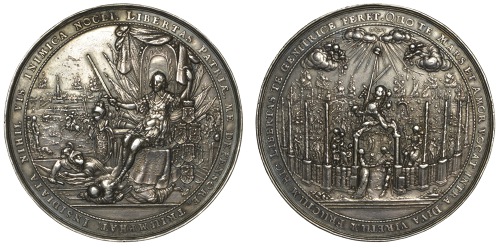
NETHERLANDS, Aankomst van Prinses Mary in Holland [Arrival of Princess Mary in Holland], 1642, a struck silver medal by S. Dadler, Frederick, Prince of Orange, seated left, trampling his enemies while holding a sword in his right hand and a band with shields of the seven United Provinces in his left, Prince William and Princess Mary at left, cityscape in background, rev. pleasure garden within wattled fence, Belgic lion above the entrance at which Prince William receives his bride, 73mm, 112.88g (Wieçek 107; Maué 47; van Loon II, 257; MI I, 290/105; E 138; BDM I, 496; cf. Morton & Eden 68, 592). Minor surface marks in fields, otherwise very fine and toned, rare £2,000-£2,600
This lot was sold as part of a special collection, The Silich Collection of Historical and Art Medals.

View
Collection
Baldwin Auction 87, 7 May 2014, lot 1788.
Princess Mary (1631-60), the 9-year old eldest daughter of Charles I, was married to Prince William II of Orange, then aged 14, in May 1641 but, by the terms of the marriage contract, she was expected to remain in England until the age of 12. However, the increasingly serious political situation in England forced the royal family to move to Hampton Court and, in February 1642, Mary and her mother, Henrietta Maria, left for The Hague. Mary would only end up spending a few years in the Netherlands with her husband before he died of smallpox in November 1650, and only eight days after losing him did she give birth to the future king of England, William III of Orange. She gave great support to her older brother, the future Charles II, while he was in exile and was an avid supporter of the restoration of the monarchy; however, this made her increasingly unpopular in the Netherlands, as did her strained relationship with her mother-in-law, Amalia of Solms-Braunfels (1602-75), who thought the princess young and inexperienced. At the restoration of the English monarchy in 1660 Mary returned to London for celebrations, but contracted smallpox and died on Christmas Eve
For further background on this medal, see Parsons, The Medal 82, pp.4-17
Share This Page