Special Collections
Foreword
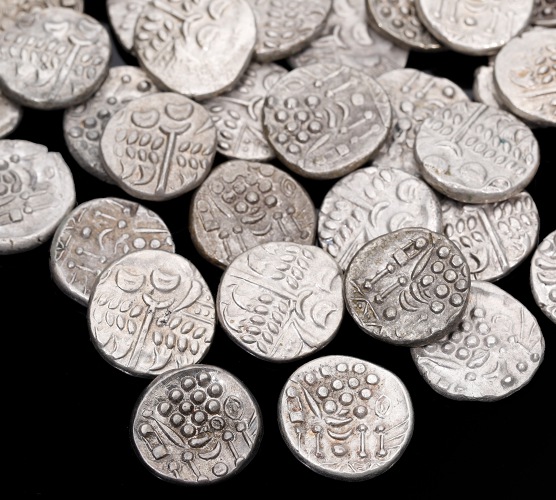
The Cranborne Hoard of silver Staters from the Durotriges tribe was found between the 9th and the 14th of April 2022 by John Hinchcliffe, buried by a fence within a remote Dorset meadow. John recalls that whilst out detecting he found a Victorian penny buried by the gateway. He sat by a nearby tree for lunch, and pondered whether there would be more in that spot.
He decided to persevere and continue digging, but rather than finding more pennies, something silver popped up. Without a doubt, he knew what he had found, a silver stater of the Durotrigan people. His fellow detectorists offered their assistance and eventually 67 Staters were unearthed. The fence was wrapped in wire which confused the metal detector’s signals, but after removing the wire with permission from the landowner, no more coins were found.
The fence by the find spot was placed at some time during the 1800s. During this process, there is a good chance that the hoard was broken up. Thus suggesting that they may have initially been buried together as one deposit, supported by the fact that many of the coins were found in clusters. However, no vessel was found.
There is no place better to find Cranborne type staters, than in Cranborne itself. At the incredible age of 90, John still goes out detecting in the fields whenever he can, acting as a testament to the wonders of metal detecting. Thus proving that at any age, anyone can pick up a detector and start exploring.
John had waited 20 years for this moment, having started detecting in 2002. However, unlike many who discover hoards, he was not “over the moon”. He considered the importance of such a find, and the historical and archaeological implications. Who buried this hoard? Why did they not return to claim it? Had something dreadful happened here? Unfortunately, these are questions we may never know the answers to. The coins may have even been deposited as a ritual offering, suggesting that perhaps nothing untoward happened at all.
The hoard was recorded with the Portable Antiquities Scheme (DOR-B9F003) and thus passed through the treasure process (2022T507); it was thenceforth disclaimed and is now presented here, in its entirety. This hoard in particular offers unto us the opportunity for a fascinating case study into this series of silver staters. These coins were first struck in silver with a high gold content, known as ‘white gold’, however the precious metal content declined over time to silver and then to billon. XRF analysis suggests that these were struck early the series, some having a little over 11% gold, some being as pure as 93% silver and some having a silver/copper ratio of approximately 70/30. In addition, the weights range significantly from 6.09g to 3.83g.
Dr John Talbot is currently working towards publishing a die-study of this fascinating series. Due to be published in 2-3 years, it will be similar to his fascinating book ‘Made for Trade’, published in 2017, however with a focus on Durotrigan coinages. I would like to sincerely thank him for his help analysing the hoard, offering valuable insight into Iron Age coinages and for identifying the dies as seen in the online catalogue.
Share This Page