Special Collections
Gerry Buddle
Sometime in 1961 my parents and I paid a visit to my Uncle Reg, during which he gave me an old leather wallet containing half a dozen coins. One of these was a worn lump of copper with George III’s head on one side and the date 1797 on the other. I’d always been interested in history but this was amazing! Here was a direct link to a point in the past which I could actually hold in my hand! That was it, I was hooked. And today, more than 60 years on, my fascination with coins and medals continues unabated.
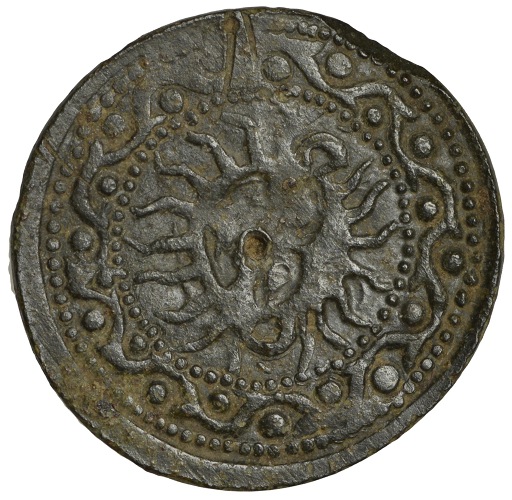
The genesis of my Scottish collection came in December 1974 during a visit to friends in Glasgow for the New Year. I had already amassed a modest collection of English hammered coins but a visit to Hamiltons in the city centre yielded a bawbee of Mary Stuart for the princely sum of £7. This prompted me to look further into the Scottish series to discover that in many ways it was more varied and innovative than the English. Portraits were not simply full-face but sometimes profile or even three-quarter and the first Renaissance portrait appears 20 years before England caught on to the new trend. The Scots also flirted with a token copper coinage nearly 150 years before Lord Harrington hit on this new way to fleece the poor (and even then he got his contract from a Stuart king). There was also a marked continental influence in the 16th century pieces with lovely designs like a half-length portrait of the monarch, swords, balances and tortoises climbing palm trees.
My collection grew from there. I joined the London Numismatic Club in the early 1980s just as the club auctions included a number of Scottish pieces from the collection of Mr A F Amman, some of which I was lucky enough to acquire. I also bought a lovely group of James V groats from the Murray collection which included the Standard Catalogue plate coin. My Scottish collection covers the period from William the Lion to the union of the crowns in 1602. After that the coins seemed to me less individual and closer to their English equivalents.
My interest in jettons began in the early ‘80s. I was a regular at the old Hungerford Lane Saturday market under Charing Cross station and at that time there was a lot of construction happening along the Thames. The spoil heaps from this were yielding much numismatic material including a lot of jettons - and much of it was circulating through the market. The more of the jettons I saw the more interesting I found them, both from the point of view of their varied heraldry and also their use. As a practicing scientist, I liked handling these “medieval computer cogs” and learning how they were operated. The lack of a suitable catalogue was often a challenge, though for the English series Philip Mernick’s excellent computer based catalogue has largely addressed this.
My collection covers the period from the 13th century through to the movement of manufacture to Tournai sometime in the mid to late 15th century. At this point and particularly later with the Nuremberg issues the jettons have a more ‘mass-produced’ feel which I personally found less appealing, though the “Rechenmeister” jettons are hard to resist!
Despite being a collector for nearly 65 years, I hesitate to call myself a numismatist. I have scant interest in die-links, over punches, odd mulings etc., as my interest has never been in the bits of metal themselves but rather in how they reflect and relate to the historical, political, social and geographical context from which they come. I remember an article in a Seaby Bulletin from the 1960s which exactly expressed this view, where the author suggested that he could perhaps be called a NUMISMOPHILE. That is a designation I would happily embrace.
Share This Page