Special Collections
Foreword
The French revolutionary Bertrand Barère, in a speech to the National Convention in June 1794, made the following rather derogatory remark about the British victory over the French at the Battle of the Glorious First of June, “Let Pitt then boast of his victory to his nation of shopkeepers”. To add further insult, he might well have added …“who are running out of small change”. As most numismatists well know, the shortage of circulating coinage was a major problem twice in the past 400 years and on both occasions it was manufacturing and commercial classes who were left to find a solution to the problem.
From the end of the Civil War in 1648 until 1672, the prolific issues of tradesmen’s tokens filled the gap left by a lack of official government backed coinage. A century later, the same cycle was beginning to repeat. While the production of a gold coinage was reasonably well maintained throughout the reign of George III, the issues of silver coinage became very sporadic. Two tiny issues of Shillings in 1763 and 1798 and a larger coining of Shillings and Sixpences in 1787 did little to address the shortage of a silver circulating medium. By the mid 1770s, the official copper coinage was in a similar state and no base metal issues were struck during the twenty years after 1775. The huge international disruption caused by the revolution in France served to exacerbate these problems. As on the previous occasion, it was the merchants and manufacturers who provided a solution.
Things, however, had changed considerably in the century since 1675. The arrival of the industrial revolution brought about considerable advances in mechanised production, mining techniques and chemical manufacturing process. In the late eighteenth century it was no longer local merchants, innkeepers and tradesman who stepped in to correct the absence of circulating specie caused by an inept government, but rather the industrial pioneers of the day. From copper mines in Anglesey to cotton mills in Scotland, from tin mines in Cornwall to iron foundries in Warwickshire, it was businesses at the forefront of the industrial revolution that began issuing copper tokens.
Whilst the private provision of copper tokens aided in the conduct of low value, local exchange, it failed to address the pressing issue brought about by a general lack of silver coinage on these islands. When insufficient domestic silver specie is produced by a government, the gap tends to be filled by the import and use of foreign silver.
Centuries of economic mismanagement in Ireland meant that for much of the period from 1650-1900, foreign silver coins filled the void. Spain had vast resources of silver from its New World possessions and Spanish silver was a common circulating medium in Ireland. So much so that until 2002, the Reul was still a denomination on the coins - the Spanish Real being roughly equivalent to sixpence. And so to fill the silver gap in Britain, Spanish and Spanish-American coins were utilised, although circulating in much smaller quantities than the copper tokens.
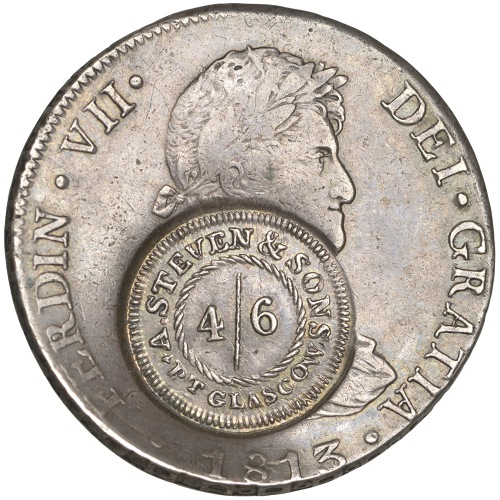
Unlike copper, which almost always was used as a token coinage, silver coins were normally traded at or close to their intrinsic value and in this lies the problem that their weight and fineness differed from the accepted local coins. Their face value had to be continually assessed and agreed for every individual transaction with all the resultant opportunities for confusion, disagreement and error that that entailed. To avoid this, various merchants and manufacturers decided to stamp the coins with a value in local currency, normally pitched just above the intrinsic value of the metal. This system, begun in the 1780s and 1790s in the newly built mills in Cark-in-Cartmel, East Retford, Lanark and Rothesay amongst others, was even briefly (and unsuccessfully) adopted by the government.
By the mid-1790s, with a government pre-occupied by the threat from a hostile revolutionary regime in France, regal coinage was no longer fit for purpose. In March 1797, the Treasury authorised the Bank of England to utilise the large quantities of Spanish Dollars it was holding in its vaults to provide an emergency coinage. These coins were to be hallmarked with the largest of the current hallmark stamps used by the Goldsmiths Hall. Unlike the private issues, no value was stamped on the coins and this was set by a government proclamation at 4/6. Three days later on March 9, having realised that the original price was below the intrinsic bullion value, the tariff was raised to 4 Shillings and 9 pence. However, these coins were easily forged and counterfeited and within months, the whole scheme had to be abandoned. Two further attempts in 1799 and 1804 were short-lived and largely unsuccessful.
The private sector, however, continued with this method of providing coins for circulation, albeit in relatively small quantities and in a fairly restricted geographical area. A cursory glance at the coins in this catalogue reveals how many of the issuers were within a 40 mile radius of Glasgow. This might seem obvious, given the city was a major Atlantic-facing port with connections all over the New World, and had access to a regular supply of Spanish silver, providing the host coins for such issues. Yet, the same could be said of Liverpool and Bristol, without the same result.
We can probably detect here the influence of the new industrialists like Richard Arkwright Jr., Robert Owen and particularly David Dale, men committed to improving the conditions of their workers by providing housing and education, and improving factory conditions. The provision of a local coinage went hand-in-hand with these philanthropic efforts. Having begun thus in the 1790s, other manufacturers followed suit, along with numerous local merchants and benevolent societies. The Clyde ports of Greenock and Port Glasgow as well as the nearby town of Paisley, could boast numerous issuers providing coinage for local trade. By the late 1820s however, the Michael Gietzelt was born in Berlin in 1954, the son of a doctor. Educated at Berlin Secondary School, he performed his military service in the DGR Medical Corps, attaining the rank of Sergeant, before entering Berlin University to study medicine in 1975. Within two years he had decided that medicine was not the career choice for him and he opened his antique shop on the Frankfurter-Alle in Berlin in 1977.
Encouraged by his mother, who made him a present of some worn Victorian pennies, and his great-grandfather, who gave him his first serious financial crisis had passed and the nation’s shopkeepers had sufficient coinage to meet their needs. The following announcement in the Greenock Advertiser provides a brief but eloquent coda to the entire counterstamped dollar series: Notice: The subscribers will thank those persons holding the Spanish Dollars issued by them at four Shillings and sixpence, to send them in to their place of business as early as convenient to be exchanged, silver being now so plenty that they are no longer required for the convenience of trade. Mcfie Lindsay & Co., 15 William Street, Greenock, 28th August 1828.
The cataloguers would like to thank Eric Hodge and Ken Eckardt for sharing with us their expertise on the coinages contained within.
Share This Page