Special Collections
Foreword
Tokens have been issued by traders at various times in our history, either in addition to official money or as its substitute.
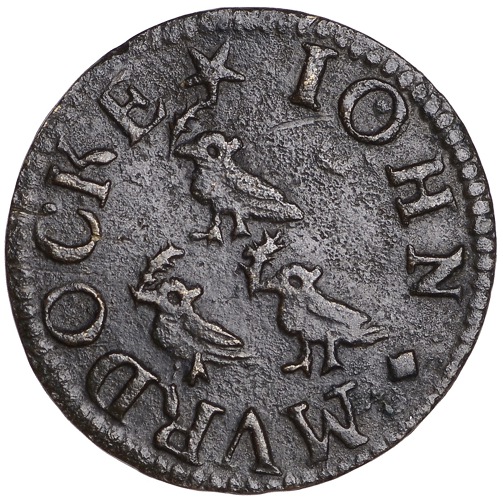
There are three periods in particular when tokens were used on a large scale: the middle of the 17th century; the end of the 18th century at a time of great industrial expansion; and, by extension, the beginning of the 19th century, during the Napoleonic wars. They circulated as current coins and were essential to the local economy during these periods of political, social and economic unrest, when insufficient small-denomination coins were issued by the government. They mostly bore the name of the issuer and were accepted on the understanding that they would be redeemed by him or her for coin of the realm on demand.
The use of tokens has developed in more recent times, not to replace normal money as such, but as a means of boosting trade. In my lifetime I saw the brass and tin co-op dividend tokens, Green Shield stamps and their electronic equivalents, loyalty cards. But I am going to concentrate on the tokens of the 17th century, as this series enables us to focus on Yoxford in a unique way.
Most of the Suffolk tokens were issued by individual traders, ranging from 42 in Bury St Edmunds and 37 in Ipswich, down to, in our locality, five in Framlingham, three in Saxmundham, two in Halesworth and one each in Dunwich, Sibton and Yoxford. The municipal authorities in Lowestoft, Southwold, Bungay, Beccles, Ipswich and Woodbridge also issued tokens. Some show a landmark of the town, such as the house and sheep-pen which form the arms of Beccles, Bigod’s Castle for Bungay, the rose and crown arms of Lowestoft, and three ships and a lion for Ipswich. The Southwold and Woodbridge civic issues also bear the legend ‘For the Poores Advantage’ which sounds rather superior and patronising, an attitude which some detect in those places up to the present day.
The source of tokens in Yoxford is William Smith, who issued a farthing in 1666, and a halfpenny in 1667, for use in the village. Investigating William Smith provided me with several fascinating hours in the Suffolk Record Office in Ipswich, where helpful staff soon located his original Will, dated 25 August 1682, and a probate inventory of his goods and chattels, dated 14 August 1685. These amounted to £522 18s, a very large sum at the time, and indicate that William was a man of considerable substance in Yoxford at that time.
In his Will, William left everything to his wife Margaret for life, out of which she must pay for the education of their daughter, also Margaret, until the age of 21. He also left an annuity of £3 per annum to his mother-in-law, Olive Smith, setting an example relating to mothers-in-law not everyone follows! Robert Smith, his brother, received £20 “for the paines of being an executor”.
Microfiches of the parish register of baptisms, marriages and burials of that period were more difficult as the originals had, in part, suffered damage. From them I learned that William had married, firstly, Mary on 28 April 1631 and their daughter, also Mary, was baptised on 18 May 1636. They also had a son, James, baptised on 26 July 1642, but his wife was buried on 15 March 1658 and his daughter on 14 May 1659. After these tragedies William married a second time, to Margaret Smith, possibly a cousin. Their daughter Margaret was baptised in 1671. William was buried on 26 July 1685 when his daughter was 14, hence the provision for her education. His son, James, was not mentioned in the Will so probably pre-deceased him.
Unfortunately no information was available on the location of William’s home and business, but he obviously had considerable trade interests to warrant issuing his own tokens. He was also in the position of being the person authorised to certify the completed Register books.
William lived through a momentous period of English history and his life was a not uncommon mixture of success, tragedy and service to the community. It is ironic that he has a place in local history in this corner of Suffolk over and above everyone else who had similar lives, due to the shortage of small change.
Another interesting story is associated with a token issued by Israel Barrel, a grocer. The Barrel family lived in Stowmarket, where in 1641 Israel contributed three shillings to fund a lecture at the church. In 1651 he collected 15s 10d for the lecture from adjacent villages, and in 1652 and 1653 he paid the balance of arrears due for the annual lecture (it is a matter of speculation why he was so devoted to this lecture and what the subject was). About 1644, when Matthew Hopkins, the Witch Finder of the Eastern counties, proceeded to Stowmarket, Israel Barrel was one of the receivers of “the rate for the discovery of witches”. Not a nice-sounding character!
Another line of research would be to ascertain which of the many inns issuing tokens are still in existence, and perhaps having a drink in each. An apt token of Bury St Edmunds was issued by Henry Headach, vintner. A salutary warning not to visit too many in one day!
While the squirearchy has ample memorial in churches and history books, the token coinage of England was essentially democratic. It was issued by ordinary people for ordinary people, and it is of the people that it speaks. It was started with the execution of Charles I and in 1672, when the public need was deemed to no longer exist, the use of them in all but the most remote areas ceased as suddenly as it had started. Tokens then found their way from the hands of traders and customers into the cabinets of today’s collectors, but the names of their issuers, including Yoxford’s own William Smith, survive as a piece of local history.
Ivor Brecker
Share This Page