Special Collections
Foreword
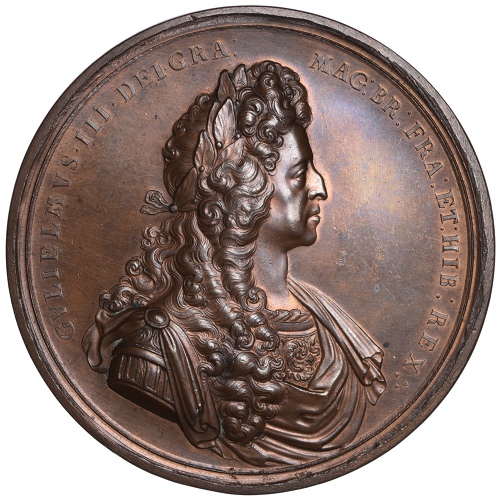
From this small collection of commemorative medals it is possible to obtain some slight appreciation of the beauties or otherwise of ‘medallic art’, or ‘medallic illustration’. It should be noted that this art did not originate in Britain. Its first homes were on the continent of Europe, notably in Italy. The art reached England roughly in the time of Henry VIII, but very few English medals were struck before the reign of Charles I. Such being the case, it is not surprising that the present collection commences with that martyred monarch.
In this collection it will be noted that all foreign productions are excluded. This is not an exhibition of melancholy insularity, as much as a demonstration that one must draw the line somewhere. Thousands of European medals can be found if sought, but it was considered to be of greater interest to confine this assembly to British history.
Casual onlookers may well enquire: ‘Why strike medals at all?’ But why paint pictures? Why devote attention to any branch of art? A commemorative medal (not a ‘war medal’) is really a miniature study in something approaching sculpture form. A medal is therefore entitled to be considered as a work of art just as a painted miniature is very worthy of our appreciative regard. Indeed, rather more so. Because of the difficult metallic medium employed, a medal involves a considerable degree of engineering craftsmanship in its production, in addition to its design, modelling and art-work proper.
On the other hand, exactly why medals were struck in such profusion in this country during a period stretching from the reigns of William and Mary to George III is open to some speculation. To say that the majority of people were illiterate during this period and wanted a ‘picture’ of sorts to remind them of current events scarcely meets the case, because at no time were commemorative medals really ‘cheap’. Indeed, for the most part they were rather expensive, so that those who purchased them must have been fairly well off and, presumably, not illiterate. Who bought them and why are questions of some little obscurity. They were keepsakes, perhaps, placed in cabinets and display tables among the other artistic odds and ends of the times. Were such medals, perchance, a social and artistic cult?
Ralph Kennedy
6 Augustus Road, London SW19
October 1942
Share This Page