Special Collections
Foreword
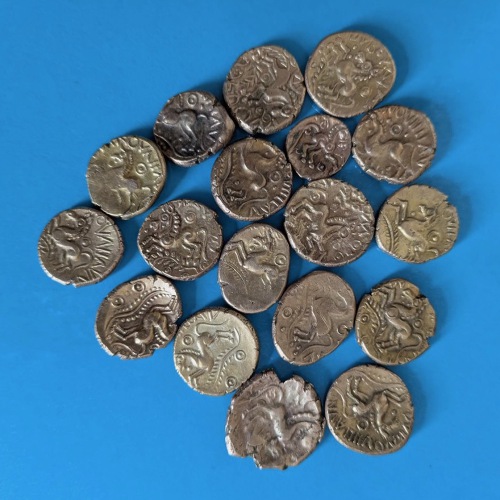
The Bury St Edmunds hoard was found in two parcels by Tom Licence, Professor of Medieval History and Literature at the University of East Anglia, in a field in Babergh, south-west of Bury St Edmunds. Between the 24th and 26th of October 2024 Tom discovered 16 full gold Iron Age Staters and one quarter-Stater, and these were promptly reported to the FLO and were declared treasure (2024 T1422; SF-03C894). Tom returned to the site a few months later in April 2025 and found one more Stater (2025 T558; SF-9BF314). Together these finds represent the largest known hoard of gold coins to be deposited in the reign of the Trinovantian King Dubnovellaunos, far surpassing in size and significance that found in September 2017 at Braintree, Essex (2017 T854; SF-FA65C9).
All of the Staters in the hoard are inscribed and they can be attributed to two figures: Addedomaros and Dubnovellaunos. In the catalogue below we follow the arrangement in Chris Rudd’s Ancient British Coins and assign these leaders to different tribes: the Catuvellauni and the Trinovantes respectively. As ever with British Iron Age numismatics, this simplicity masks a lot of hidden complexity. Addedomaros’ kingdom appears to have expanded to included much Trinovantian territory and it is possible that he was Dubnovellaunos’ father, an argument supported by stylistic links between their coinages (compare lots 2001 and 2015 below). Addedomaros was probably the first king north of the Thames to produce an inscribed coinage, but beyond that we know frustratingly little about him.
Dubnovellaunos ruled the Trinovantes, and at some point held sway in Kent as well; he is mentioned in the Emperor Augustus’ Res Gestae as having sought refuge in Rome. The findspot of this hoard, which sits a day’s walk from Colchester to the south and Bury St Edmunds to the north, is directly at the heart of Trinovantian territory. John Sills has suggested, on account of die sequencing, that Bury St Edmunds Hoard was concealed during the reign of Dubnovellaunos, for the hoard omits the ruler’s last two issues. The chronology of the reigns of both rulers is confusing and continues to be debated by scholars; the dates given in this catalogue are again those used in Rudd’s ABC.
Tom was drawn to the findspot because of its geography, with the field rising up from a nearby stream in a gentle gradient. After digging a couple of signals, he noticed the dark silty soil which had been deposited by the flow of an ancient water course. Upon talking with the landowner, Tom discovered that the end of the field had once been an ancient water meadow before being turned over to the plough. The landowner had found multiple intact crotal bells, and had built up a substantial collection, which suggested that the field remained largely untouched as these artefacts easily break up after periods of cultivation. Shortly after, Tom found half a Hod Hill brooch, and was thus determined to find more evidence of Iron Age and Roman activity.
On October 24th 2024, Tom began investigating the field in question more seriously. Initially he found a Sestertius of Claudius, followed by two pieces of Viking hack silver. As he continued he was met with a strange dull signal, normally characteristic of bronze; after some digging “the unmistakable chunky wonder of a full gold Stater” was revealed. Tom meticulously gridded out the area and utilised a 15” coil to further his investigation. On that first day, six Staters were unearthed. Over following days he widened his search, venturing south and then west of the slope; soon enough, more coins appeared. After three days of hard work, a total of 17 coins were found. In his discussion of microtopography Philip de Jersey (2014) notes that “among the hoards deposited on the brow of a hill there appears to be a clear preference for burial on east-facing slopes”. This hoard fits that pattern perfectly, with coins discovered just below the crest of a slope on the east-facing side, and no more coins were found to the north. Tom believes the “morning sun illuminating the hill-crest and a spring rising at the same spot” is a combination that could point to this hoard, and others like it, having a religious significance.
Tom started metal detecting as a young boy, but took a more serious interpret in the hobby 1994 as a young man. Whilst walking through Rye in East Sussex, he found a Charles I Rose Farthing in a flower bed, which immediately captured his imagination. When Tom isn’t busy with his Academic work he is out detecting alongside his trusty ‘Mandy’ Manticore detector. Mandy proved to be very reliable, as this new discovery is the largest and arguably the most important hoard of Dubnovellaunos coins to have been unearthed. He also writes about his detecting finds in the Searcher magazine, within which an article on this hoard was published in June 2025. Tom and the landowner have chosen to keep a single Stater each, and the remaining 16 coins are offered below. After splitting the money with the landowner, Tom plans to use some of the money raised to support local archaeological work in Suffolk.
Share This Page